
Delegation staff members gather in the lobby during a meeting between the U.S., Iran, Pakistan and Qatar at the Lake Lucerne Summit at the Bürgenstock Resort near Stansstad, Switzerland, on June 21, 2026. Photo: Nathan Howard/Pool/Getty Images
The U.S. and Iran agreed to stop attacking each other, according to a senior U.S. official, as the two sides plan to meet Tuesday in Qatar’s capital to work out their dispute over the Strait of Hormuz.
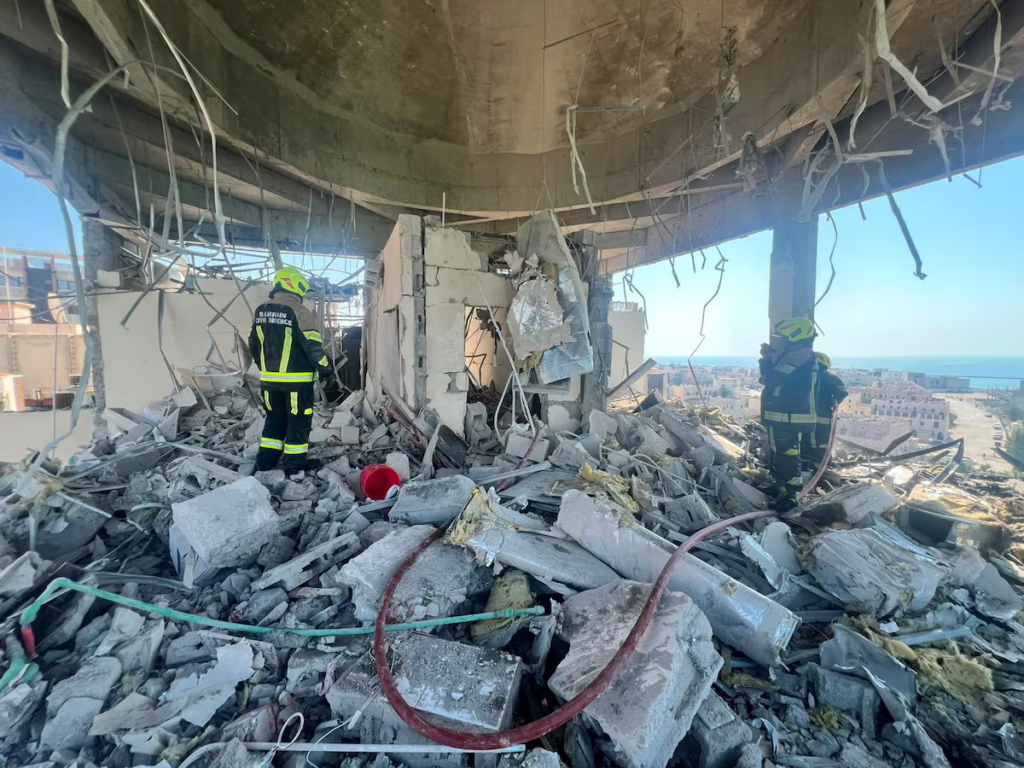
Bahrain civil defence and rescue personnel work in a residential building, which according to the Bahraini Interior Ministry, was hit by an Iranian drone, in Muharraq, Bahrain, June 28, 2026. Bahrain Police Media/Handout via REUTERS
Why it matters: The ceasefire is barely 11 days old and already on shaky ground with renewed strikes by both sides and President Trump’s threat to restart the war and “complete the job.”
- The renewed fighting was sparked by competing interpretations of the memorandum of understanding (MOU) to end the war — especially its terms on the Strait of Hormuz.
“We decided to stop all the kinetic activity,” a senior U.S. official tells Axios, using the military’s term for strikes and other attacks.
- A second U.S. official tells Axios both sides will stand down “for now” and that “vessels can move freely” as technical talks are set to continue.
- Both U.S. officials and a third source with knowledge confirmed Tuesday’s planned meeting.
- Under the MOU, Iran committed to make its best efforts to allow safe passage of commercial vessels through the strait. In return, the U.S. lifted its blockade of Iranian ports.
- During negotiations in Switzerland last week, the U.S. delegation — headed by Vice President Vance — agreed with Iran to establish a “hotline” between the U.S. military and the IRGC (Islamic Revolutionary Guard Corps), Iran’s military command, to coordinate traffic in the strait.
- As of Saturday, the “hotline” still wasn’t operational even as Iran started claiming, again, that ships need to coordinate passage
The Tuesday talks were originally set to happen in Switzerland to address Iran’s nuclear program, a source with knowledge of the talks said. The escalation moved them to a different venue and refocused them on the Strait of Hormuz.
- Nick Stewart, who heads the U.S. technical team, is expected to participate in the talks, according to a U.S. official and a source with knowledge.
- The White House didn’t immediately respond to a request for comment.
AXIOS
