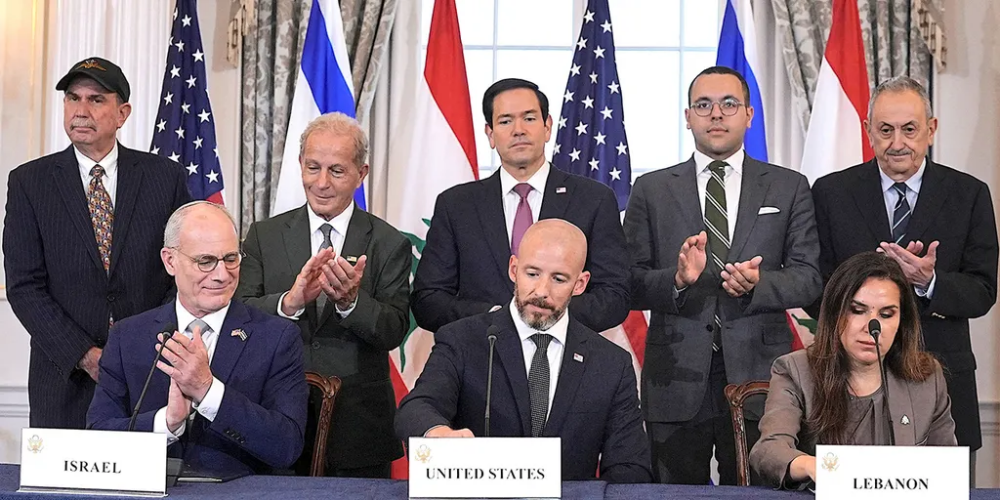
U.S. Secretary of State Marco Rubio looks on as State Department Counselor Daniel Holler, Israel’s Ambassador to the U.S. Yechiel Leiter and Lebanon’s Ambassador to the U.S. Nada Hamadeh sign a framework agreement between Israel and Lebanon, at the State Department in Washington, D.C., U.S., June 26, 2026. REUTERS/Ken Cedeno
Secretary of State Marco Rubio acknowledged that the agreement marked only “the beginning of the beginning” of negotiations between Israel and Lebanon
Israel agreed to test how it might execute a military withdrawal from Lebanon, under a U.S.-brokered agreement between the two countries unveiled on Friday by Secretary of State Marco Rubio.
Speaking at the State Department, Mr. Rubio said the two countries — which committed months ago to the goal of striking a lasting peace and security deal — had struck a new “framework agreement” to that end after several days of meetings.
Tensions have risen between the Trump administration and both countries about whether Lebanon’s fate will be linked to U.S. peace negotiations with Iran. The agreement reached on Friday amounts to a statement by the United States, Israel and Lebanon that they intend to shape Lebanon’s future independent of the U.S.-Iran conflict.
While Mr. Rubio praised the agreement as a “major milestone,” in remarks to reporters he acknowledged that it marks only “the beginning of the beginning” of negotiations between Israel and Lebanon, adding that “there’s a lot of work ahead.”
The challenges of reaching an enduring pact that would be upheld by the various interested parties appeared to compound on Friday, as retaliatory strikes by the United States on Iranian missile and drone sites added to the precarity of a cease-fire between the two countries.
The centerpiece of the agreement between Israel and Lebanon is a plan for Israel’s military to withdraw from a small fraction of occupied territory in southern Lebanon, which is home to the Iran-backed proxy group Hezbollah. Israel is waging its most sustained war in years against the militant group.
The limits of the agreement were reflected by a statement from Prime Minister Benjamin Netanyahu of Israel. He emphasized not the modest territory Israel says it will give up, but instead the much larger swath of Lebanon that it will continue to occupy.
“The most important thing is that, first and foremost, Israel remains in the security zone in southern Lebanon,” Mr. Netanyahu said. “This is a major achievement, and we will maintain it as long as Hezbollah has not been disarmed, as long as there is a threat to the State of Israel.”
A Hezbollah official, who spoke to the news media on the condition of anonymity, said the group rejected the framework agreement. The official said that the plan effectively allowed Israel’s continued presence in southern Lebanon and that Hezbollah would not give up its weapons without an Israeli withdrawal, echoing its longtime stance.
PILOT ZONES
The plan would begin to establish “pilot zones,” in which Israel’s military would yield control to the Lebanese Armed Forces, who would then be responsible for ensuring Hezbollah did not re-emerge there.
Mr. Netanyahu said the Israel Defense Forces recommended the two areas, one on each side of Lebanon’s Litani River.
But the Israeli leader did not offer a timeline for the withdrawal, saying only that Israel would allow the Lebanese army to “begin organizing” to take control of the areas.
Israeli officials remain deeply skeptical about the prospect of expanding the pilot zones, arguing that the Lebanese army lacks the training, equipment and political will to defang Hezbollah.
The New York Times
