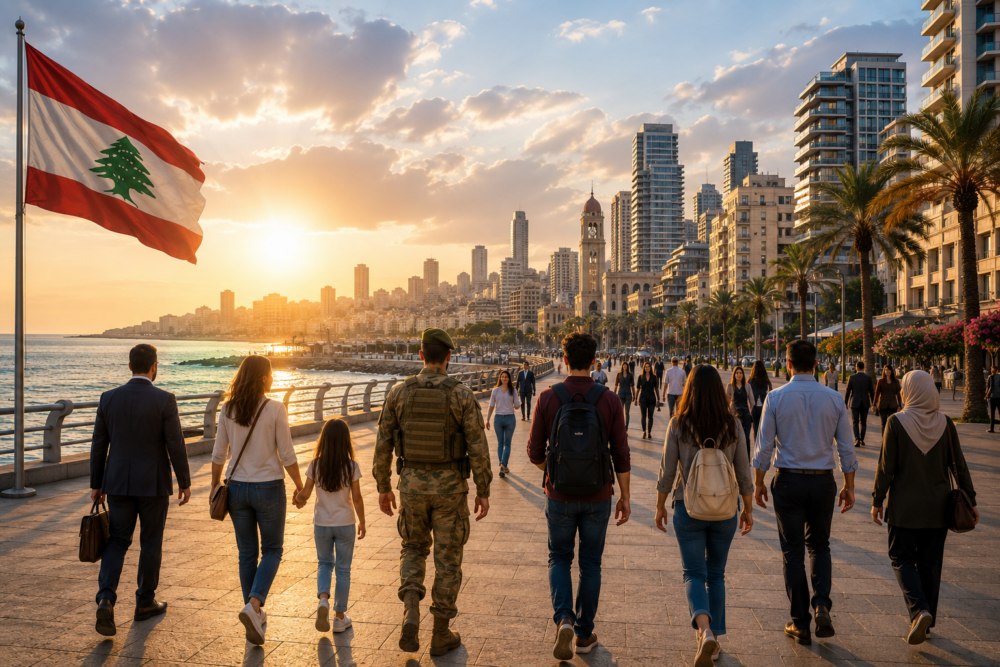
Photo illustration : “The greatest gift the world can give Lebanon is the chance to shape its own future.”
After decades of war, foreign interference, and divided authority, the Lebanese people deserve the chance to build a normal, sovereign, and prosperous nation.
By : The Editorial Board, Opinion
For decades, Lebanon has been asked to serve many purposes.
It has been a battlefield for regional wars. A stage for foreign rivalries. A launching pad for militias. A bargaining chip in negotiations conducted far from Beirut.
Everyone seems to have a plan for Lebanon.
Iran has a plan.
Syria has a plan.
Israel has a plan.
The United States has a plan.
The Gulf states have plans.
But one question is rarely asked:
What do the Lebanese people want?
Most Lebanese are not asking for victory over their neighbors. They are not seeking regional influence. They are not interested in becoming a frontline in somebody else’s conflict.
They want what people everywhere want.
Security.
Prosperity.
Opportunity.
A functioning government.
A stable currency.
Reliable electricity.
Safe streets.
A future for their children.
In short, they want Lebanon to become Lebanon again.

There was a time when Lebanon was known as the Switzerland of the Middle East. Beirut was a center of finance, education, tourism, culture, and entrepreneurship. People from across the region came to study, invest, build businesses, and enjoy life.
Mount Lebanon was a favorite destination for visitors from the Gulf, who escaped the summer heat to its cool mountains and picturesque villages. In winter, Lebanon offered something almost unique in the region: the ability to ski on its snow-covered slopes in the morning and enjoy the Mediterranean coast in the afternoon. Few places in the world can claim such a combination of natural beauty, diversity, and accessibility.
Lebanon was more than a country. It was a destination, a meeting place, and a symbol of what the Middle East could achieve when openness, tolerance, and opportunity prevailed over conflict and division.
That Lebanon did not disappear because of a lack of talent or resources.
It disappeared because the state gradually lost control over its own destiny.
Foreign powers gained influence.
Militias acquired authority that belonged to the state.
Political leaders became more focused on external alliances than national priorities.
And ordinary Lebanese paid the price.
Today, Lebanon has an opportunity that it has not enjoyed for many years.
For the first time in decades, it has a president and a government publicly committed to restoring state authority and rebuilding national institutions.
The international community should support that effort.
Not by giving Lebanon’s future to Syria.
Not by asking Iran to solve problems that Iran helped create.
Not by imposing new formulas that weaken state institutions.
But by strengthening the Lebanese Army, supporting economic recovery, encouraging investment, helping secure a lasting peace along Lebanon’s southern border, and empowering the legitimate institutions of the Lebanese state.
The goal should be simple.
One army.
One government.
One national decision-making authority.
One sovereign state.
Lebanon has spent far too many years serving the ambitions of others.
It is time for Lebanon to serve the aspirations of its own people.
It is time to allow Lebanon to become Lebanon again.
