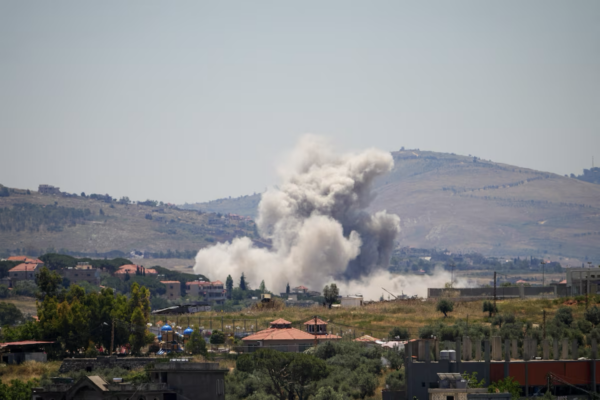
File- Smoke billows from southern Lebanon, following Israeli strikes, as seen from Nabatieh, Lebanon, June 4, 2026. REUTERS/Stringer
The United States and Iran inked a long-awaited provisional ceasefire deal on June 17, 2026. After months of uncertainty, the people of the Gulf region can, potentially, breathe a sigh of relief, and global markets look set to be boosted by the reopening of the Strait of Hormuz.
What about those who have endured the war’s spillover in Lebanon? After all, the memorandum of understanding signed is not just a peace agreement between the U.S. and Iran alone. Rather, on Tehran’s insistence, the deal is intended to provide a cessation of hostilities on all fronts – including in Lebanon.
President Donald Trump is framing the deal as a win for the U.S. and the closing of the latest chapter in Washington’s Middle East entanglement. But Israeli Prime Minister Benjamin Netanyahu, whose country was reportedly shut out of the diplomatic process, may have other plans that would challenge Trump’s authority in the region.
After news of the emerging deal broke on June 14, Netanyahu almost immediately announced that Israel will occupy Lebanon “indefinitely.” Israel then followed up with a fresh wave of airstrikes that killed four people in Lebanon.
A clearly displeased Trump publicly criticized those actions and even suggested that Syria could go in and dismantle Hezbollah, the Tehran-backed Lebanese group that has for nearly five decades fought Israel in southern Lebanon.
With Israel continuing to bomb Lebanon and remove Lebanese citizens from their lands – in defiance of Washington’s wishes – the fate of the U.S.-Iran deal in Lebanon remains obscure.
As a scholar of Middle East studies, I fear the agreement leaves more questions about the delicate situation in Lebanon that it solves. Moreover, any split in Israel-U.S. policy aims over Lebanon may have grave implications for Trump’s de-escalation attempts with Iran and also hamper hopes for a peace deal between Lebanon and Israel days before representatives of both countries plan to meet again in Washington.
A defiant Israel
History shows that any U.S. failure to rein in Israeli military action north of its border can have disastrous consequences.
A similar scenario happened back in 1982 after Israel launched “Operation Peace for Galilee,” invading Lebanon and imposing a brutal siege on Beirut that killed over 17,000 Lebanese and Palestinian civilians and fighters.
In an angry phone call in August 1982, U.S President Ronald Reagan asked Israeli Prime Minister Menachem Begin to stop the heavy bombardments of Beirut. “Menachem, this is a holocaust,” Reagan recalled saying.
But Israel ignored the U.S. demands for a ceasefire. As a result, Reagan sent a an international peacekeeping force into Lebanon. Composed of French, Italian and American troops, this multinational force in Lebanon was tasked to act as a buffer zone between feuding parties and provide port security to Palestinian fighters leaving Lebanon.
Not only did Israel ignore Reagan’s attempts at de-escalation, it also defied the multinational force, harassed its troops and endangered their lives, according to U.S. military leaders.
Ironically, when Israel invaded Beirut in 1982 and threatened the American troops, it did so using weapons supplied by Washington as part of the two countries’ long-standing defense arrangement.
History repeats itself
A similar scenario is unfolding today.
Just like Reagan and Begin’s clash in 1982, Trump and Netanyahu are engaged in what looks like a deadlock. In a recent phone call about Lebanon, Trump was reportedly overheard yelling at Netanyahu, “You’re f–king crazy. You’d be in prison if not for me,” while pressing the Israeli government to scale back its operation in Lebanon.
Today, as in 1982, Israel continues to benefit from U.S. support and arms sales. Congress has even moved to integrate U.S. and Israeli militaries.
Also, just like 1982, the American president is considering sending foreign troops into Lebanon.
But despite the American military and political support, Israel continues to brush aside any U.S policy that aims to place limits on its regional power, effectively showing a glaring limitation of U.S. dominance over the region.
Lebanon as an afterthought
When the U.S. and Iran initially agreed to a two-week ceasefire in April 2026, there was confusion over whether Lebanon was included in that deal. While Iran asserted Lebanon’s inclusion, Israel denied it and continued to bomb the country.
Lebanon became part of the equation because of Hezbollah’s actions after the U.S.-Israeli attack on Iran in late February 2026. Similar to how the Tehran-backed group vowed solidarity with Hamas after Israel bombed Gaza in response to Palestinian militants’ attack on Israeli soil on Oct.7, 2023, Hezbollah struck Israel when Iran was hit.
It reignited the simmering Hezbollah-Israeli war. Today, Israel occupies south Lebanon and is threatening to annex it.
The U.S.-released text of the latest Iran peace plan explicitly includes Lebanon.
While that will introduce serious points of friction with Israeli designs on the country, the people in Lebanon, too, will have many questions and concerns.
I believe the deal will be seen as a welcome step but also a potential blow to Lebanon’s sovereignty. While the text aims to protect Lebanon’s “territorial integrity,” it does not reference Israel’s actual withdrawal from these lands, and it is unclear whether this issue will be discussed in future negotiations between Israel and Lebanon or between the U.S and Iran.
Furthermore, the new deal ignores Lebanon’s efforts to free itself from Iran’s influence in the country through its Hezbollah ally.
In an unprecedented move in May, Lebanon filed a formal complaint against Iran at the United Nations Security Council, directly accusing Tehran of violating the Vienna Convention on Diplomatic Relations for interfering in its sovereign decisions and dragging the country into war.
In spite of Hezbollah’s open threats against the Lebanese government, Lebanese representatives held the first of several planned direct negotiations with Israeli counterparts in Washington.
Lebanon, Syria and a rocky path forward
Indeed, the new U.S.-Iran deal can be interpreted as a step back for the strength of an already weak Lebanese state. Indirectly, the deal cements Iran’s control on the country’s politics and, by extension, Hezbollah.
Furthermore, and just like in 1982, the U.S. is proposing a foreign force to enter Lebanon and help end the violence. In fact, Trump has now twice mentioned the possibility of Syria playing a role in Lebanon to enter and execute “a surgical attack on Hezbollah.”
It is unclear whether the U.S. president is using these comments just as a way to pressure Israel over Lebanon or whether there is an actual plan that includes a Syrian role in the country’s future. But just the mention of Syrian intervention evokes that country’s longtime occupation of Lebanon.
In fact, at the end of the Lebanese civil war in 1991, Syria established what amounted to absolute political, military and economic hegemony over Lebanon, during which thousands of Lebanese disappeared.

The assassination of Lebanese Prime Minister Rafic Hariri in 2005 and the Cedar Revolution that followed forced the Syrian troops out of Lebanon.
The fact that the new leadership in Syria is Sunni adds another complication due to Lebanon’s delicate sect-based balance of power. If Damascus interferes in Lebanon, sectarian violence could follow, as the Syrian military presence would likely be interpreted as direct opposition to Hezbollah’s Shiite fighters.
This is particularly true since Ahmed al-Sharaa’s government was accused of violence against religious minorities in Syria, including the Alawites – a religious sect close to Shia Islam – and the Druze.
Whether Syria plays a decisive role in Lebanon going forward, there is little doubt that the future of the U.S.-Iran deal depends on both Iran and Israel’s actions. So far, Israel seems uninterested in following Trump’s leadership in the region and is gearing up to play a spoiler role.
For now, and absent new breakthroughs, Lebanon, with its sovereignty almost entirely eroded, seems destined to remain at the mercy of its larger neighbors in Iran, Israel and Syria – and the erratic involvement of the U.S. abroad.
The CONVERSATION
