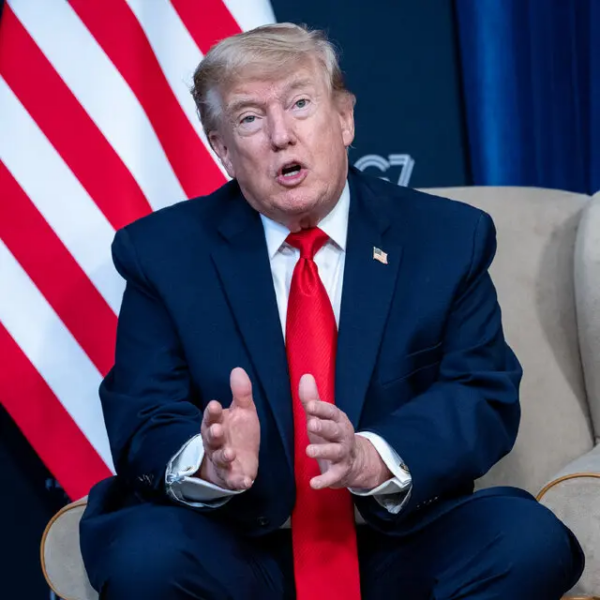
President Trump said Tuesday he hoped the war with Iran would soon be in the “rearview mirror”, even though the terms of a cease-fire he signed with Tehran remained secret
With this framework to end the war, the U.S. and Iran are trying to wipe the slate clean and pretend the past four months never happened.
By Daniel R. DePetris, Opinion
After a few dozen false starts, it looks like the United States and Iran have finally struck a framework agreement to pause the war for another two months, stabilize global energy prices and reopen detailed negotiations on Tehran’s nuclear program. President Donald Trump, in typical fashion, announced the accord on Truth Social, claiming it would put the Middle East on the road to peace. He quickly gave several interviews reiterating yet again that more U.S. military action was in the cards if Tehran didn’t satisfy its end of the bargain.
For once, the Trump administration and the Iranians are singing from the same song sheet. Both declared that a signing ceremony would take place this Friday, and while the actual text of the agreement hasn’t been published yet, both sides sketched out its general parameters.
The framework is similar to what has been reported for weeks now. The U.S. Navy would suspend its blockade of Iran’s ports in exchange for Tehran reopening the Strait of Hormuz over the next 30 days. The Iranians insist that Washington also agreed to unfreeze billions of dollars of Tehran’s own money currently frozen in foreign bank accounts courtesy of U.S. sanctions. (The Trump administration has yet to verify those assertions.) The ceasefire originally signed on April 8 will officially be extended for another 60 days. And, to Tehran’s delight, the ceasefire will encompass the fighting between Israel and Hezbollah in Lebanon.
On its face, stopping the fighting, at least for another two months, is a win for all sides. The war has hurt every one of its combatants mightily. More than 7,500 people have been killed. Trump’s approval ratings have gone down the tubes as Americans of all political affiliations question the war and the resulting rise in gas prices. Iran has been losing billions of dollars in oil revenue every week.
Even countries that didn’t want anything to do with the fighting felt the war’s negative impact. The United Arab Emirates, Qatar, Saudi Arabia, Kuwait and Jordan were all victims of Iranian ballistic missile and drone attacks. Washington’s traditional European allies, none of which believed this war was a good idea, faced spiraling fuel costs and an angry American president who demanded they bail him out of his own predicament.
Given all that, a deal — any deal — is the best possible option on the table. It is certainly a better alternative than Trump renewing a bombing campaign in the unlikely hope that Tehran capitulates.
Yet we shouldn’t get carried away and treat this framework as an unmitigated success for the United States. The U.S. fought a war of choice for six weeks, then paused it for a few months, only to end it (for now) by kicking the hard problems down the road to a later date.
Trump will likely claim this agreement is better than the one negotiated under President Barack Obama. It’s probably only a matter of time before the president insists that he deserves the Nobel Peace Prize for ending a war he started in the first place. But there’s no sense putting lipstick on a pig. This arrangement is a stopgap measure to buy time for a longer, technically complicated negotiation between two historical adversaries on Iran’s nuclear program, the very issue that purportedly compelled Trump to wage the conflict about four months ago.
Usually, diplomatic agreements solve problems between states. Yet this agreement doesn’t resolve anything. It turns the calendar back to Feb. 27, the day before the war, when the Strait of Hormuz was open to maritime traffic, gasoline in the U.S. was about $3 a gallon, the U.S. Navy wasn’t enforcing a blockade in the region’s waters and U.S. and Iranian negotiators were haggling over U.S. sanctions relief and Iranian nuclear concessions. In essence, with this framework, Trump and Iran are trying to wipe the slate clean and pretend the past four months never happened.
Assuming both sides live up to their obligations — no sure thing, given the mutual distrust and constant claims of ceasefire violations — Washington and Tehran will spend the 60 days after Friday’s signing ceremony negotiating a mutually acceptable formula that provides the U.S. with assurances that Iran won’t be able to acquire a nuclear weapon. If those demands are met to Trump’s satisfaction, Iran’s economy will be rewired back into the international financial system.
This new negotiation won’t be a cakewalk, however. The Trump administration and Iran’s leaders still have different concepts of what is considered an acceptable arrangement vis-à-vis the nuclear issue. The White House expects Iran to cease all enrichment for at least 20 years; Tehran is reportedly willing to do so for 10 years. Trump wants Iran to dispose of its enriched uranium stockpile entirely; the Iranians are only amenable to diluting it to a lower grade. Iran wants immediate access to cash held up in banks around the world, U.S. sanctions relief on the front end or (at the very least) U.S. waivers in the interim so Iranian crude oil can be exported again. The White House wants those financial rewards for Iran to be staggered and conditioned on Iran fulfilling its nuclear responsibilities.
Can all this work be completed in 60 days’ time, as the framework stipulates? The odds aren’t great. The Obama administration needed three years to negotiate caps on Tehran’s uranium stockpile, centrifuge manufacturing and enrichment production, with multiple extensions required along the way. It’s difficult to picture Trump, an extremely impatient man who frequently thinks he’s getting strung along, waiting around for the full 60 days, let alone multiple years.
On the one hand, we should give Trump some credit for choosing the least bad option in front of him. But what has the U.S. really accomplished since this conflict began? The fact that we even have to ask this question is an indictment of the war itself
MS.NOW
