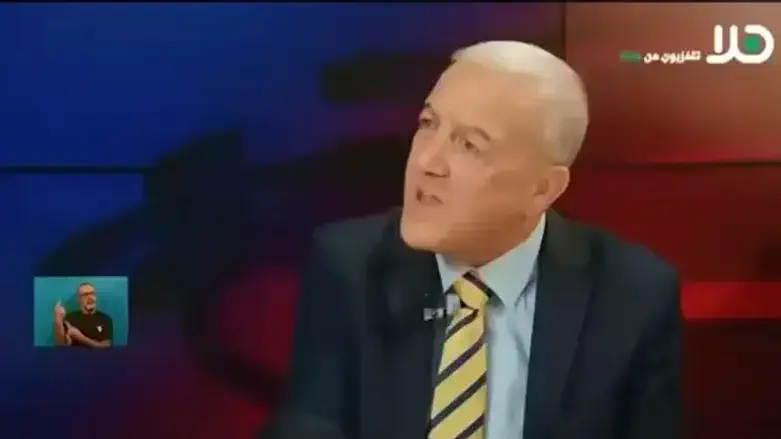
Dr. Akram Hasson says Lebanon’s communities could become partners for Israel if Hezbollah is weakened, arguing that a future agreement could be deeper than Israel’s cold peace with Jordan
Israeli lawmaker Dr. Akram Hasson is leading a new Knesset caucus aimed at promoting eventual peace and normalization between Israel and Lebanon, arguing that Israel should begin speaking directly to Lebanese communities that may want stability, economic recovery, and freedom from Hezbollah’s control.
Hasson says his push for the Caucus for Peace Between Israel and Lebanon, which he chairs, did not begin as a diplomatic gesture, but from years of watching a country he believes has been left under Hezbollah’s control. His answer is a parliamentary platform meant to keep open the possibility of eventual peace and normalization between Israel and Lebanon.
“Lebanon was taken hostage by Hezbollah,” Hasson told The Media Line. “It does whatever it wants there. It destroyed the Switzerland of the Middle East. It threatens Lebanon’s president, it threatens the government, and of course it harms the residents of northern Israel.”
The caucus is modest in form but ambitious in scope: it calls for diplomatic, economic, and civilian cooperation, support for northern Israeli communities, and a wider regional framework against common threats. Hasson says his request to establish the caucus was approved within days of being submitted, a sign, in his view, that lawmakers understood the importance of opening a political lane almost entirely buried under the language of rockets, evacuations, and border war.
He argues that Lebanon should not be viewed only through the armed group, but through the communities that, in his view, have a direct interest in stability, economic recovery, and reduced Iranian influence.
“The Lebanese people, in the latest survey, the Druze, more than 80%, want peace and relations with the State of Israel,” Hasson said. “Seventy-two percent of the Christians also want peace with the State of Israel, and there are Sunnis there who want it too. So the time has come for us to strengthen this alliance.”
Hasson did not present the caucus as a substitute for government diplomacy or as evidence that official negotiations are underway. Instead, he described it as a political and public instrument, intended to give legitimacy and visibility to Lebanese figures who may support normalization but fear Hezbollah’s response. His stated goal is to encourage them to speak more openly, both inside Lebanon and among Lebanese communities abroad.
“I want to encourage every person on the Lebanese side who seeks peace and believes in peace to stand up and say what he thinks, like in the latest survey, and begin to apply pressure,” Hasson said. “Because in the end, if the people want peace and security and freedom, nothing can stand in the way of that will.”
Hasson said that Israel should begin preparing for the possibility that the border will not always look the way it does now. He said his first Arabic-language speech from the Knesset podium was directed to the Lebanese people and reflected respect for a society he described as educated, cultured, and unwilling to be defined by terrorism.
“The Lebanese people are a people of books, a people of culture,” he said. “They do not want terrorism, and they do not want Hezbollah there. They are suffering terribly from them.”
But the more revealing part of his proposal is not the diplomatic endpoint. It is the comparison he draws with Israel’s existing peace agreements. Asked whether relations with Lebanon could one day resemble Israel’s relationship with Jordan, Hasson went further.
“In my opinion, normalization with Lebanon would be better than with Jordan,” he said.
He argued that the peace with Jordan, while strategically important, has remained cold and uneven. Israel provides Jordan with water, Israeli businesspeople have invested there, and Israeli tourists travel east, Hasson argued, but the relationship has not produced the kind of reciprocal public acceptance he would want to see in a future agreement.
“You do not see one tourist from Jordan in Israel,” Hasson said. “They do not contribute anything to us. On the contrary.”
For Hasson, the central distinction is between Hezbollah and Lebanon itself. He points especially to Druze and Christian voices, and to older memories of contact across the border, including years in which Lebanese workers entered Israel.
“Lebanon is a completely different people,” he said. “They do not have that hatred. They do not teach jihad.”
Hasson is not saying Lebanon is ready to sign an agreement tomorrow. His argument is narrower: Israel should not wait until official diplomacy exists before speaking to the Lebanese who may already be thinking differently.
The caucus filing lists possible areas of work, including tourism, trade, infrastructure, industry, energy, agriculture, innovation, environmental cooperation, and support for local authorities in northern Israel. Hasson said both sides could gain from a practical peace built around economic recovery and border stability.
“We can contribute to Lebanon’s economy,” he said. “It is win-win. Everyone, in the end, will bless this important step.”
He also framed the issue as one that should not belong to either the Israeli right or left. Peace, he said, can win support across Israel’s political spectrum if it is presented not as a slogan, but as a security achievement that protects Israeli citizens and weakens Iranian-backed terrorism.
“The people of Israel know how to unite and rise above themselves when there is real peace, and when they know it will bring security to all the residents of the State of Israel,” Hasson said. “I know many people in Israel, both on the left and on the right, who, when they hear about peace, real peace and not talk and slogans, will support it.”
The initiative comes at a moment when the word “peace” has largely disappeared from Israel’s wartime political vocabulary, replaced by terms such as deterrence, victory, pressure, disarmament, and security control. Hasson is trying to reintroduce it, but in a form that is anchored less in the traditional peace camp and more in the language of regional power, anti-Iranian alignment, and Israeli security interests.
That may be the caucus’s political opening. It does not ask Israelis to ignore Hezbollah. It begins with Hezbollah as the central obstacle. It does not present Lebanon as already ready for peace. It argues that parts of Lebanon may be ready, or could become ready, if they are strengthened and if Hezbollah is forced to retreat from its current position.
“We are stronger,” Hasson said. “We are the only ones standing against Hezbollah. And in the end, we can eliminate this terrorism, because the Lebanese state, as a state, as a government, as a presidency, cannot do much against Hezbollah.”
The caucus is still a parliamentary initiative, not a diplomatic process. Its weight lies elsewhere: an Israeli lawmaker is trying to bring into the Knesset a conversation that usually stays in private meetings, research forums, or military assessments. Hasson wants parliament to speak directly to the possibility that Lebanon’s future may not be permanently tied to Hezbollah’s present.
Whether that message can reach Lebanese audiences, and whether anyone there can safely answer it, remains uncertain. Hasson bets that the ground is less frozen than it looks.
“We want a real Middle East,” he said. “A Middle East without terrorists, without people who believe in jihad and brainwashing, and cause enormous damage to the Arab and Muslim population in the world. That is the final goal.”
About Dr. Akram Hasson
He is currently serving as a member of the Knesset representing New Hope, his third spell in office. He previously served as an MK for Kadima between 2012 and 2013, and then as an MK for Kulanu from 2016 to 2019. In 2015, Hasson became Kadima’s last leader, marking the first time a Druze had led a Jewish party.
In 1996 he graduated with a BA in education, gaining a master’s degree in business and education administration the following year. In 1997 he became a headteacher, before working as the Director of the Israeli branch of the University of Lincoln from 1998 until 2001. In 2002 he was awarded a PhD. Between 2003 and 2008 he served as mayor of Carmel City and a member of the Planning and Building Committee in Haifa. Since 2005 he been a member of the Committee for Changing the System of Government in Israel.
Hasson entered the Knesset in May 2012 as a replacement for Gideon Ezra, who had died of cancer. In December 2012 he became the first non-Jewish recipient of the Golden Inkwell Word prize, awarded by the Hebrew Writers Association in Israel. Hasson was awarded the prize after promoting legislation to preserve the Hebrew language by ensuring that all signage is primarily in Hebrew and that any speeches made abroad by government officials must be in Hebrew.
The Media Line
