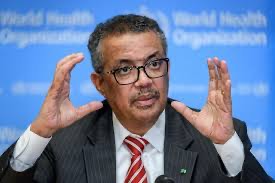
Tedros Adhanom Ghebreyesus, the head of the World Health Organization, said Thursday that the Ebola outbreak in the Democratic Republic of Congo, which has killed more than 200 people, can still be contained despite conflict in the country’s east. He also urged armed groups to declare a ceasefire as aid and medical support continue to arrive.
The ongoing conflict between armed groups in the eastern Democratic Republic of Congo has made it harder for health workers to contain the worsening Ebola outbreak, Ghebreyesus said Wednesday.
He warned Wednesday that conflict raging in eastern Democratic Republic of Congo was dramatically complicating efforts to rein in a deadly Ebola outbreak and urged an immediate ceasefire.
“Eastern DRC now faces a catastrophic collision of disease and conflict with the Ebola outbreak in Ituri province outpacing the response,” Tedros Adhanom Ghebreyesus said on X.
The WHO has recorded 10 confirmed Ebola deaths and 220 suspected deaths in DR Congo since mid-May, while also recording a further 900 suspected cases since Kinshasa declared the outbreak on May 15.
The United Nations’ health agency said the true spread of the virus was probably much wider. Experts have said it was probably circulating for some time.
The mineral-rich region has been scarred by violence from various armed groups for more than three decades. Since 2021, the Rwanda-backed AFC/M23 insurgent group has seized swathes of territory and fighting has stepped up since the start of 2025.
It is the 17th Ebola outbreak in DR Congo, one of the poorest countries in the world, and without a vaccine, efforts to contain the spread rely on adhering to preventive measures and quickly detecting cases.
“For good practices and rules on isolation, safe burials and contact tracing to be followed, a great deal of trust in the health authorities is required,” said Pierre Boisselet, head of the country’s Ebuteli research institute.
“The current situation of conflict and fragmented authority does not, at first glance, seem very favourable,” he added.
Tedros stressed that the Bundibugyo strain of Ebola that is spreading in DR Congo had “no approved vaccine nor treatment”.
“Stopping this Ebola transmission depends entirely on humanitarian access,” he said.
State services in rural areas of Ituri province have been largely absent for decades.
Tedros lamented that clashes were “driving mass displacement, pushing exposed contacts into overcrowded camps and severing critical containment corridors”.
“Frontline workers are risking everything, while attacks on health facilities make tracking cases and their contacts nearly impossible,” he warned.
Two isolation tents set up by the NGO Alima in the first days of the response were set on fire by an angry crowd demanding the body of one of their friends, who had died of Ebola.
The riot was broken up when soldiers fired warning shots.
Healthcare workers have increasingly been allowing patients’ families to visit them under the supervision of medical staff in order to reduce tensions and encourage the sick to go to the hospital.
“From a moral standpoint, it is important to establish this communication between patients and their family members,” said Ganou Lamissa, logistics coordinator for the NGO Alima.
“This reassures not only the patients, but also the relatives, who can know under what conditions the patients are being cared for,” he added.
The WHO secretary-general called for an immediate cessation of hostilities to allow medical staff to move in to at-risk areas.
“We cannot build community trust or isolate the sick while bombs are falling,” he said.
“We urge all warring parties to agree to an immediate ceasefire to contain this outbreak. To allow us safe and sustained access for medical teams.
“We plea to prioritise human survival above everything else.”
About Ebola
Ebola is a rare but severe and often fatal disease caused by infection with viruses from the Orthoebolavirus genus. Found primarily in sub-Saharan Africa, it is transmitted through direct contact with the bodily fluids of an infected or deceased person. Average fatality rates hover around 50%
(FRANCE 24 with AFP)
