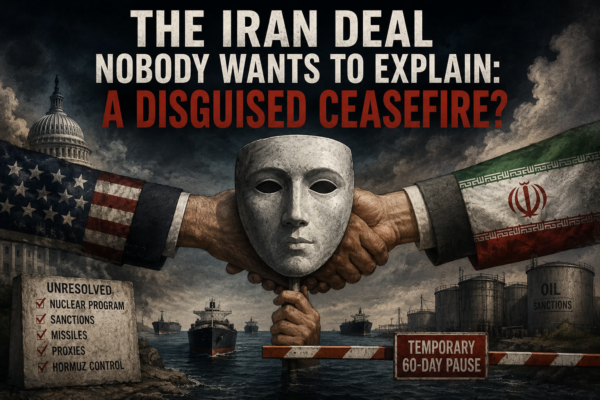
Markets may welcome temporary calm, but unresolved nuclear, sanctions, and Hormuz issues suggest this crisis may only be postponed.
By: The Editorial Board, Opinion
President Donald Trump says the agreement with Iran has been “largely negotiated.” Days later, he says he is “not in a rush.” Senior U.S. senators warn the framework resembles little more than a temporary ceasefire. Analysts increasingly describe it as a time-buying arrangement designed to postpone the hardest decisions rather than resolve them.
So which is it?
The American public, U.S. allies, global markets, and the shipping industry deserve clarity — because the stakes are far too high for strategic ambiguity and political messaging.
At the center of the confusion is the growing realization that what is currently being discussed may not be a historic peace agreement at all. Instead, it appears to be a fragile memorandum of understanding aimed primarily at de-escalating the immediate crisis in the Strait of Hormuz while pushing the toughest issues into future negotiations.
That is not necessarily diplomacy failure. Sometimes temporary de-escalation is necessary to prevent a larger catastrophe. But presenting a temporary pause as a lasting breakthrough would be dangerously misleading.
The unresolved issues remain enormous.
Iran’s nuclear infrastructure reportedly remains largely intact. Questions surrounding uranium enrichment, long-term inspections, missile development, sanctions relief, frozen assets, and proxy militias remain unsettled. Meanwhile, the issue that triggered panic across global markets — Iran’s ability to threaten maritime traffic in the Strait of Hormuz — appears to be treated as an urgent economic problem requiring immediate stabilization rather than permanent resolution.
In other words, this increasingly looks less like a peace treaty and more like an economic ceasefire.
That distinction matters.
The Strait of Hormuz is not simply another regional dispute. Roughly one-fifth of global oil flows through this narrow waterway. Any prolonged disruption threatens energy prices, inflation, supply chains, shipping insurance costs, and the stability of economies far beyond the Middle East. Europe and Asia depend heavily on uninterrupted Gulf energy exports. Even the perception of instability sends markets into panic.
This explains why the current negotiations appear heavily focused on restoring maritime security, calming oil markets, and reducing the risk of escalation.
But reopening shipping lanes alone does not solve the strategic problem.
If Iran retains the ability to weaponize Hormuz whenever tensions rise, then the world may simply be postponing the next crisis. Temporary calm should not be confused with permanent stability.
This is why skepticism inside Washington is growing. Critics fear that the framework could evolve into another version of a limited nuclear arrangement in which Iran receives economic relief while preserving key leverage points for the future. Supporters argue that diplomacy, however imperfect, is preferable to a wider war that could destabilize the global economy and ignite a regional inferno.
Both sides raise valid concerns.
But what is missing from the discussion is honesty.
Mixed signals from Washington only deepen uncertainty. When one day brings declarations of near agreement and the next brings warnings that there is no urgency, allies begin questioning strategy, markets begin questioning durability, and adversaries begin testing resolve.
America has seen this movie before.
Temporary arrangements presented as strategic victories often collapse because the underlying conflicts were never truly resolved. Delaying difficult decisions may buy time politically, but it rarely eliminates the long-term dangers.
If this framework is merely a 60-day strategic pause designed to reopen Hormuz and cool tensions, then leaders should say so openly. The public can handle the truth. Investors can handle the truth. Allies can handle the truth.
What the world cannot afford is confusion disguised as strategy.
Because if this is only a timeout rather than a genuine settlement, the next confrontation may arrive with even higher stakes — and even fewer options.
