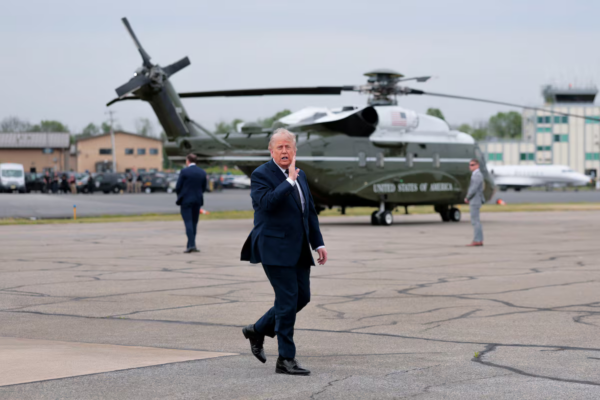
Photo- U.S. President Donald Trump leaves Marine One to board Air Force One en route to Joint Base Andrews, Maryland, as he departs Morristown Airport in Morristown, New Jersey, U.S., May 22. © Reuters
President Trump said Iran and the United States had “largely negotiated” an agreement “pertaining to PEACE.” Three senior Iranian officials said Tehran had agreed to a memorandum of understanding, but there was no public statement from Iran’s government.
Here’s the latest.
President Trump said on Saturday that the United States was close to reaching an agreement with Iran toward ending the war and reopening the Strait of Hormuz.
Mr. Trump provided few details about the preliminary agreement, which he said was “largely negotiated.” It is unclear whether the latest negotiations will succeed in extending the current cease-fire and reach a more permanent peace, or break down over the sticking points that have kept the war unresolved for months.
Many ordinary Iranians, including critics of the government, were relieved to hear that further war with the United States and Israel may have been averted and that the two sides could be close to reaching some sort of peace agreement. For days, they had anxiously followed the news of diplomatic negotiations, and many had anticipated American and Israeli airstrikes resuming as early as this weekend. Trump had repeatedly threatened to destroy power plants and infrastructure, causing panic among citizens already reeling from the economic impact of the bombardment and blockade. “We were trying to figure out if we should leave Tehran if bombs fall again, and buying water and batteries,” Nazanin, a 56-year-old engineer in Tehran, said in a phone interview, asking to be identified by only her first name. “I gave a big sigh of relief.”
Iranian pundits and supporters of the government celebrated the potential peace agreement with the United States as a diplomatic victory in posts on social media. Though the agreement has yet to be finalized and few details have been released, some Iranians were congratulating the country’s leadership for surviving the war and for averting further conflict on terms seemingly favorable to Iran. Some called it a defeat for President Trump, saying he had achieved few of his initial war goals. “Hold your heads high and take pride in being part of the Khamenei nation,” wrote Eshan Salehi, a political commentator and former official, in a post on X. “The very one who said Iran must surrender tonight excitedly declared he’s reaching an agreement with the ‘Islamic Republic of Iran.’”
Iran’s foreign ministry spokesman, Esmail Baghaei, offered what appeared to be an indirect response on X to President Trump’s annoucement that the two sides were close to a peace deal. The post referred to a third-century war between the Roman empire and Persia, in which the Roman emperor “had to come to terms” with the Persians. The post appeared to be the only public statement from a senior Iranian official since Trump’s announcement, and it did not mention Trump, a deal or Iran’s nuclear program by name.
Leaders from Arab and Muslim-majority countries told President Trump by phone on Saturday that they support the latest proposal to end the Iran war and urged him to accept it, according to three Middle Eastern officials, who spoke on the condition of anonymity to discuss sensitive details.
The call included top officials from Qatar, Saudi Arabia, the United Arab Emirates, Pakistan and other countries.
The terms of the latest proposal still have not been announced officially, but Trump said they included the opening of the Strait of Hormuz, a strategic waterway that previously was used to transport a large share of the global oil and gas supply.
In Iran, May 23 has been celebrated since 1982 as the anniversary of the day that Iran’s army liberated the city of Khoramhshahr from Iraqi forces in the Iran-Iraq war, a turning point in the bloody conflict. For many Iranians, especially supporters of the government, the fact that an agreement with the United States to end the war appeared to be close to being finalized was portentous. “Everyone was saying there was no way Iran could reach an agreement with the United States, but we did it,” said Hamid Hosseini, a member of Iran’s Chamber of Commerce, from Tehran. “It’s a victory.”
It’s well after midnight in Israel, where Prime Minister Benjamin Netanyahu has yet to comment on President Trump’s announcement that the United States is nearing an initial agreement with Iran. The New York Times has reported that the Trump administration effectively cut Israel out of the negotiations with Iran, leaving Israeli officials struggling to get a clear picture of the talks. Netanyahu launched the campaign in February with a vow “to put an end to the threat” posed by Iran and suggesting that the war could even lead to the end of the Islamic Republic. More than two months later, it is far from clear that those goals were achieved.
And it remains to be seen what the truce might mean for Israel’s ongoing clashes with Iran-backed Hezbollah in Lebanon. The fighting there rattled the broader cease-fire with Iran when Trump declared it back in April. Israel later reined in its attacks there under U.S. pressure, but has vowed to stay in southern Lebanon indefinitely.
Three senior Iranian officials said Iran had agreed to a memorandum of understanding that would stop the fighting and reopen the Strait of Hormuz.
They said the agreement would halt fighting on all fronts, including in Lebanon. They also said that it focuses on opening the strait— including lifting the U.S. naval blockade against Iran and allowing free commercial traffic without Iran charging any tolls — and leaves thorny questions related to nuclear issues for a later date. Those nuclear issues, which had been a major sticking point in talks, would be negotiated within 30 to 60 days, they said, adding that the deal would release $25 billion in Iranian assets frozen overseas. It was not clear if the proposal Iranian officials said they had agreed to was what President Trump was referring to in his post on social media.
The officials, who spoke on condition of anonymity because of the sensitivity of the talks, said Pakistani and Qatari mediators had been facilitated the draft agreement.
Trump also said he had spoken separately with Prime Minister Benjamin Netanyahu of Israel. He described that call as going “very well.” Israel joined the United States in the original attacks against Iran, and Netanyahu has pushed Trump to not let up the attacks, saying in a recent CBS News interview that there was still “work to be done” before the war ended.
In his Truth Social post, President Trump said he had spoken with leaders from Saudi Arabia, the United Arab Emirates, Qatar, Pakistan, Turkey, Egypt, Jordan and Bahrain about the memorandum of understanding. Many of those countries have been involved in negotiations with Iran during various stages of the conflict. In recent weeks, Pakistan has played the lead role in mediating between the United States and Iran, and Pakistani leaders have hosted the only face-to-face talks between the United States and Iran during the war.
THE NEW YORK TIMES
