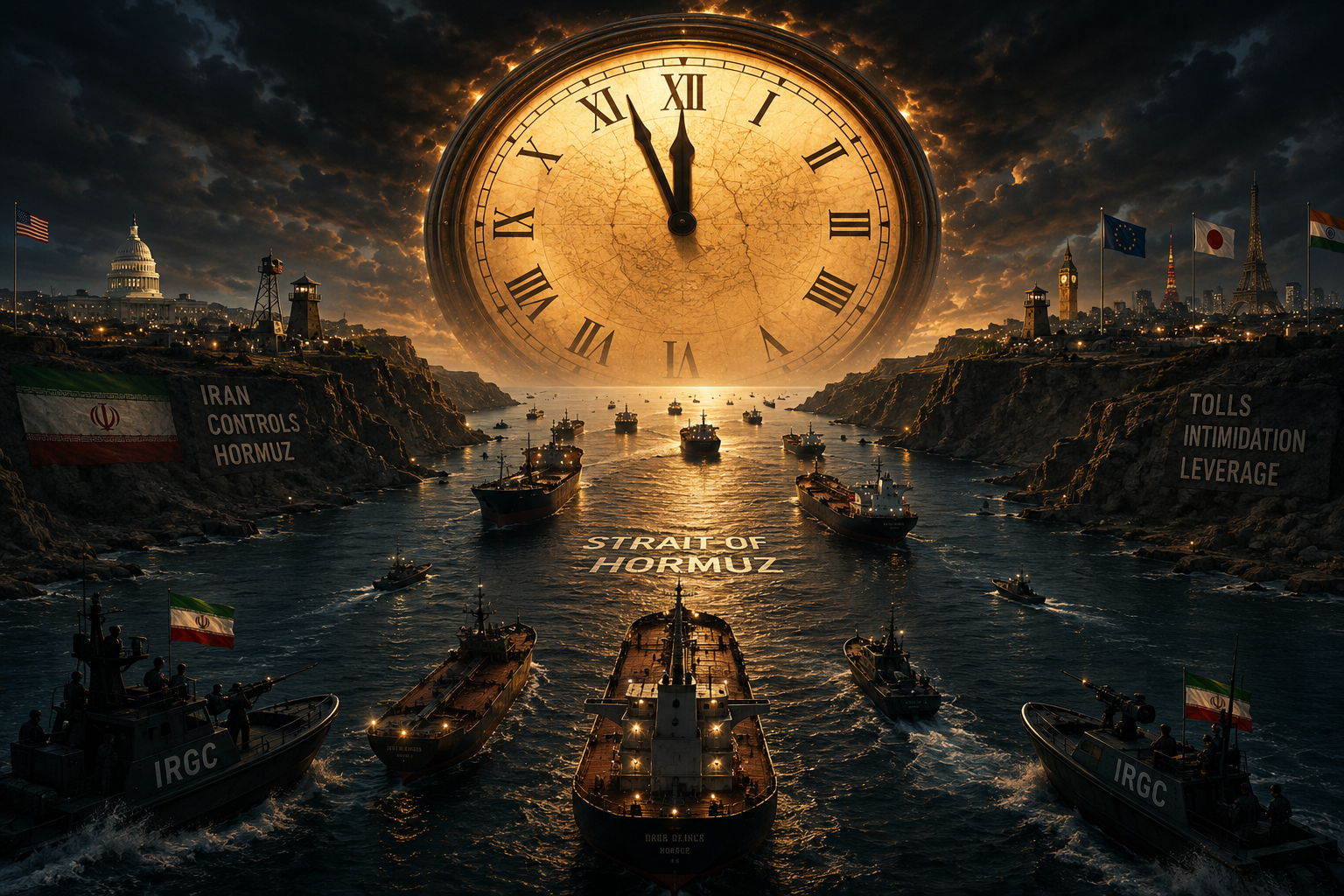
Image- The clock keeps ticking over Hormuz—but Iran still controls the passage.When threats are repeated without action, deterrence turns into disbelief.
Reagan protected Hormuz with action in 1987. Today the world hears warnings—but sees hesitation.
By: The Editorial Board, Opinion
President Donald Trump says “the clock is ticking” for Iran.
The problem is that the world keeps hearing the clock—but sees no consequences when the deadline expires.
Trump warned Tehran that if it failed to comply, “nothing will be left.” Yet Iran remains effectively in control of the Strait of Hormuz, the world’s most strategic energy chokepoint, while commercial shipping continues operating under intimidation, rising security costs, and what many now describe as toll-like payments for safe passage.
At some point, repeated threats without visible follow-through stop sounding like deterrence. They begin sounding like theater.
This is not merely a communications problem. It is a credibility problem.
Deterrence only works when adversaries believe consequences are real. If deadlines repeatedly pass without enforcement, rivals eventually conclude that America prefers postponement over action.
Iran appears to have reached that conclusion.
Tehran’s leaders openly signal they do not take Washington’s ultimatums seriously. Why should they, when every ticking clock simply resets itself?
That perception is dangerous not only for the Middle East, but for the entire international system.
The Strait of Hormuz is not an American issue alone. It is a global economic artery through which roughly one-fifth of the world’s oil and major LNG supplies pass. Europe, Japan, South Korea, India, and much of the developing world depend on Hormuz more directly than the United States itself.
This is precisely why Ronald Reagan understood the stakes in 1987.
Following repeated Iranian attacks on Gulf shipping during the Iran-Iraq War, Reagan launched Operation Earnest Will, the largest naval convoy operation since World War II. The mission was clear: protect freedom of navigation and ensure no country could hold the global economy hostage.
Reagan did not rely on endless warnings or dramatic rhetoric.
He acted.
And because America acted decisively, the world believed American deterrence once again.
That is the contrast troubling many observers today.
Washington issues increasingly dramatic ultimatums. Iran tightens leverage over Hormuz. Global markets remain nervous. Allies appear uncertain. Adversaries watch carefully.
Meanwhile, America’s credibility slowly erodes.
Ironically, Trump himself has demonstrated elsewhere that pressure can work when backed by action. His Venezuela strategy succeeded largely because the administration followed through with sanctions, seizures, diplomatic pressure, and enforcement measures that opponents knew were real.
Hormuz requires the same seriousness.
The solution is not another endless war in the Middle East. Most Americans clearly do not want that, nor should they. But there is a vast difference between avoiding war and tolerating strategic humiliation.
A superpower cannot repeatedly threaten catastrophic consequences while allowing the very behavior it condemns to continue openly.
Either Iran’s effective weaponization of Hormuz is unacceptable—or it is not.
If it is unacceptable, then the United States should stop acting as though this is America’s burden alone and immediately organize a multinational maritime coalition—similar to Reagan’s 1987 effort—to guarantee freedom of navigation.
If it is acceptable, then Washington should stop issuing theatrical ultimatums that weaken deterrence every time they expire unanswered.
Because credibility is like currency: once the world stops believing in it, restoring it becomes far more expensive than protecting it in the first place.
And today, the giant clock hanging over Hormuz is no longer frightening Iran.
It is timing America.
