By GISELLE RUHIYYIH EWING and DANIELLA CHESLOW
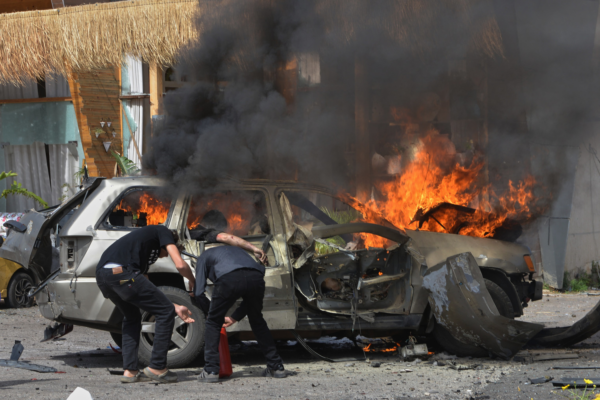
A person is seen inside a burning vehicle as men attempt to put out the fire after an Israeli airstrike hit a car in southern Lebanon on Wednesday. Israel and Hezbollah have continued to exchange strikes despite a U.S.-mediated truce. | Mustafa Jamalddine/AP
The White House is convinced Israel and Lebanon are on the path to peace. But there’s still significant daylight between the two sides as representatives kick off the third round of U.S.-brokered negotiations today.
Asked about the talks slated for today and Friday, a White House spokesperson told NatSec Daily that President DONALD TRUMP believes both sides want peace and share a common goal of eradicating Hezbollah, adding that the U.S. president is confident a deal can “happen quickly.”
That’s a tall order given the current state of play.
Israel has maintained that no further progress can be made without the disarmament of Hezbollah. But a senior Lebanese official told Reuters today that his country first wants “a ceasefire that Israel implements.” The current U.S.-brokered ceasefire is set to expire Sunday.
Still, Israel has continued demolishing entire villages in southern Lebanon and retains forces in a belt of Lebanese territory it has deemed a buffer zone. On Wednesday alone, Lebanese officials reported more than a dozen deaths, including several children. Meanwhile, Hezbollah has continued targeting Israel, with Israeli media reporting that four civilians had been injured in a drone attack today.
“We’re not going to let the process standstill, but we’re not going to be able to implement the peace that we signed unless the second track is fulfilled, which is the dismantlement of Hezbollah,” Israeli Ambassador YECHIEL LEITER told i24 News’ Mike Wagenheim on Wednesday.
That’s not a straightforward process.
“The sequencing is backwards,” MONA YACOUBIAN, director and senior adviser of the Middle East Program at the Center for Strategic and International Studies, argued to your host. Pushing for Hezbollah to disarm first as a precondition for assistance “seems to defy logic,” Yacoubian said, as the Lebanese government needs resources to not just disarm the group but also to assert its authority in the country.
That’s an area where the U.S. could pitch in. Asked how the U.S. can best support the Lebanese Armed Forces in that effort during a Senate hearing today, CENTCOM Commander Adm. BRAD COOPER said that the U.S. could commit the necessary funding to enable Lebanon to “do more.”
Meanwhile, Lebanese President JOSEPH AOUN is facing pressure back home. His decision to directly engage with Israel in the U.S.-mediated talks enraged Hezbollah and members of parliament aligned with the group who have vocally opposed the talks.
That dynamic raises the stakes for the Lebanese delegation to emerge from negotiations with something concrete to show for their participation.
The Israeli delegation also faces domestic pressures of its own, with elections slated for October amid continued support for military operations in Lebanon among the Israeli public.
Though bridging the gulf between the two sides is a nearly impossible task in the short term, there are some options for smaller steps in the interim, DAVID SCHENKER, who served as assistant secretary of State for the Middle East during Trump’s first term, told your host.
While it’s “unrealistic to expect that Israel will depart Lebanon in return for more promises of disarmament” that have yet to come to fruition, gestures of good will could include an exchange of Lebanese prisoners for the return of the bodies of Israeli soldiers, he suggested.
Neither the State Department nor Israel’s embassy in Washington responded to NatSec Daily’s requests for comment.
Politico
