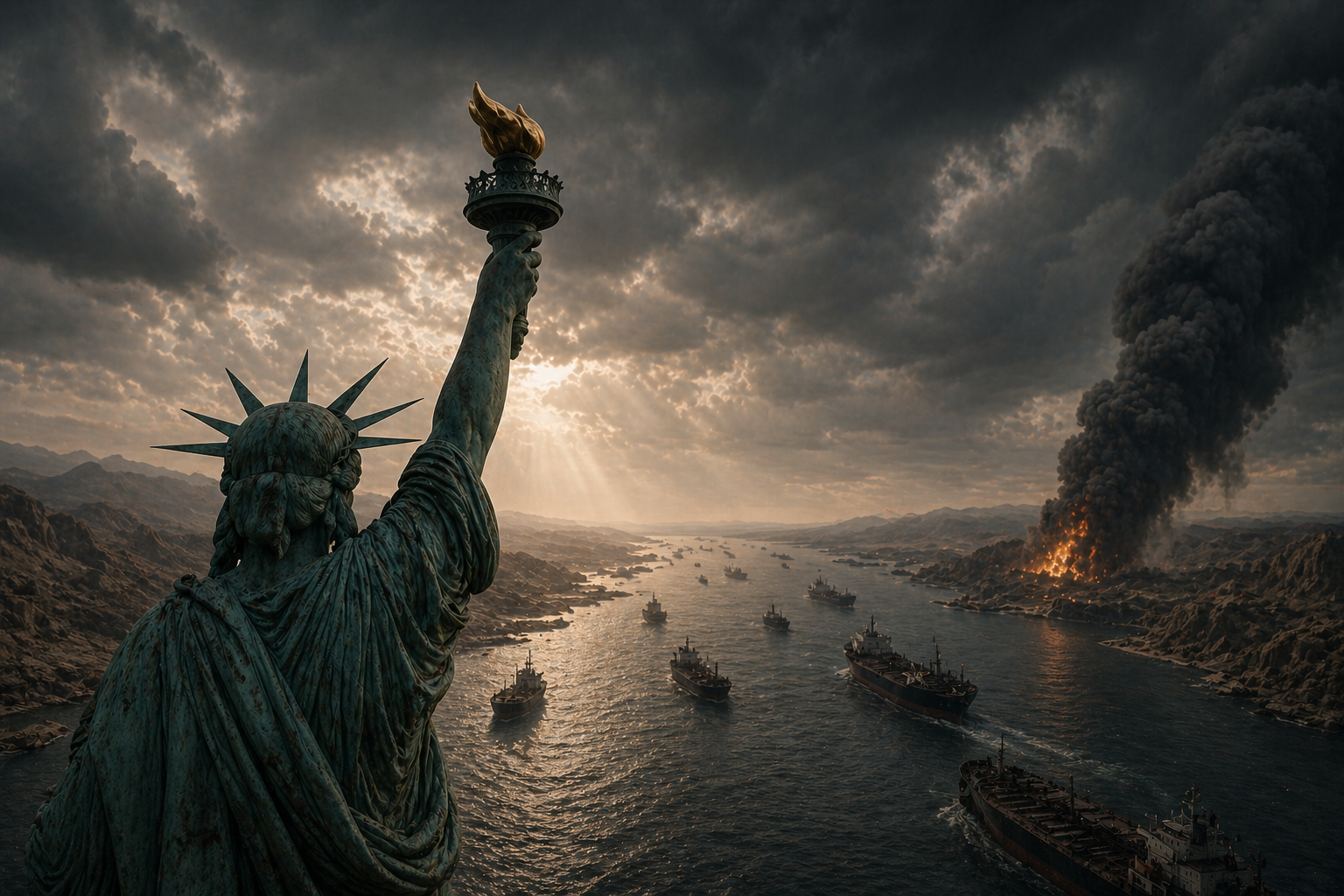
Image: From control to consequence: a war that created the crisis it now struggles to contain
Washington entered the conflict to stop Iran’s nuclear threat and weaken its regime. It achieved neither—and instead destabilized the world’s most critical energy corridor while ignoring the priorities of its own people.
By : The Editorial Board, Opinion
The United States did not drift into this war. It chose it—with clear objectives and strong conviction.
Stop Iran’s nuclear program.
Degrade its military power.
Create conditions for a weaker—or fundamentally changed—regime.
Those were the goals.
Today, none of them have been achieved.
Iran’s enriched uranium still exists. The regime remains firmly in control. Its military and proxy networks continue to operate. And instead of reducing global risk, the war has produced a new and dangerous crisis: the Strait of Hormuz—once stable—is now a strategic choke point.
This is not progress. It is reversal.
Before the war, Hormuz was not the problem. It was open. Energy flowed. Markets adjusted to risk, but the system functioned.
After the war, Hormuz became leverage.
Iran has done what weaker powers often do against stronger adversaries: shift the battlefield. Unable to match the United States head-on, it has imposed costs asymmetrically—disrupting shipping, raising insurance premiums, and injecting uncertainty into the global economy. It does not need to win militarily. It only needs to prove that it can disrupt more easily than America can stabilize.
So far, it is succeeding.
But the strategic failure abroad is now colliding with political reality at home.
An overwhelming 84% of Americans want Washington to focus more on the domestic economy—on inflation, gas prices, and the everyday pressures shaping their lives. Nearly six in ten believe the United States should play little to no role as a global policeman.
The message from the public is clear: focus inward, stabilize the economy, and avoid unnecessary wars.
Washington is doing the opposite.
President Donald Trump ran on economic nationalism—on putting American prosperity first. But in 2026, that promise is colliding head-on with the reality of an expanding conflict in the Middle East. Instead of relieving economic pressure, the war is amplifying it—through energy volatility, rising costs, and growing uncertainty.
“America First” is being tested—and it is not passing.
The contradiction is now impossible to ignore:
The public wants restraint.
The government is projecting force.
The result is a growing crisis of confidence—not just abroad, but at home.
America’s allies are watching with increasing alarm. European leaders, including Friedrich Merz, have openly questioned the direction of the conflict, warning that the United States risks appearing ineffective—not because it lacks power, but because its actions are not producing results.
That distinction matters.
Power is not measured by how hard you strike. It is measured by whether you achieve your objectives. On that test, the current approach is falling short.
The deeper problem is not just failure—it is strategic drift.
There is no clear articulation from Washington of what success now looks like. No defined end state. No visible alignment between military actions and political objectives. What began as a focused mission is now evolving into something far more dangerous: an open-ended conflict without a roadmap.
America has seen this before.
In Iraq, objectives expanded faster than results. In Afghanistan, timelines replaced strategy. In both cases, early confidence gave way to prolonged ambiguity—costly in blood, treasure, and credibility.
The warning signs are now visible again.
And the cost is not abstract.
Billions of taxpayer dollars are being spent with no measurable strategic return. Military assets are stretched. The risk of regional escalation remains high. Most importantly, lives are being placed in harm’s way without a clearly defined purpose that justifies the sacrifice.
This is not a reality show. It is not a test of rhetoric or personality.
It is a war.
The United States still has options. It can escalate decisively and impose control over key outcomes. It can pivot to a serious diplomatic track backed by credible leverage. Or it can redefine its objectives to match what is realistically achievable.
But it cannot continue like this—reacting, adjusting, and extending a conflict without a coherent strategy.
Because history is unforgiving in these moments.
Wars are not lost in a single decision. They are lost through accumulation—of unclear goals, shifting narratives, and the absence of discipline.
The Iran war has reached that inflection point.
The question is no longer whether the United States can win militarily.
The question is whether it knows what “winning” means.
Until that answer is clear, every additional dollar spent, every additional risk taken, and every additional promise broken moves this conflict further away from purpose—and closer to becoming what Americans already fear:
Another war they did not want, cannot afford, and see no end to.
