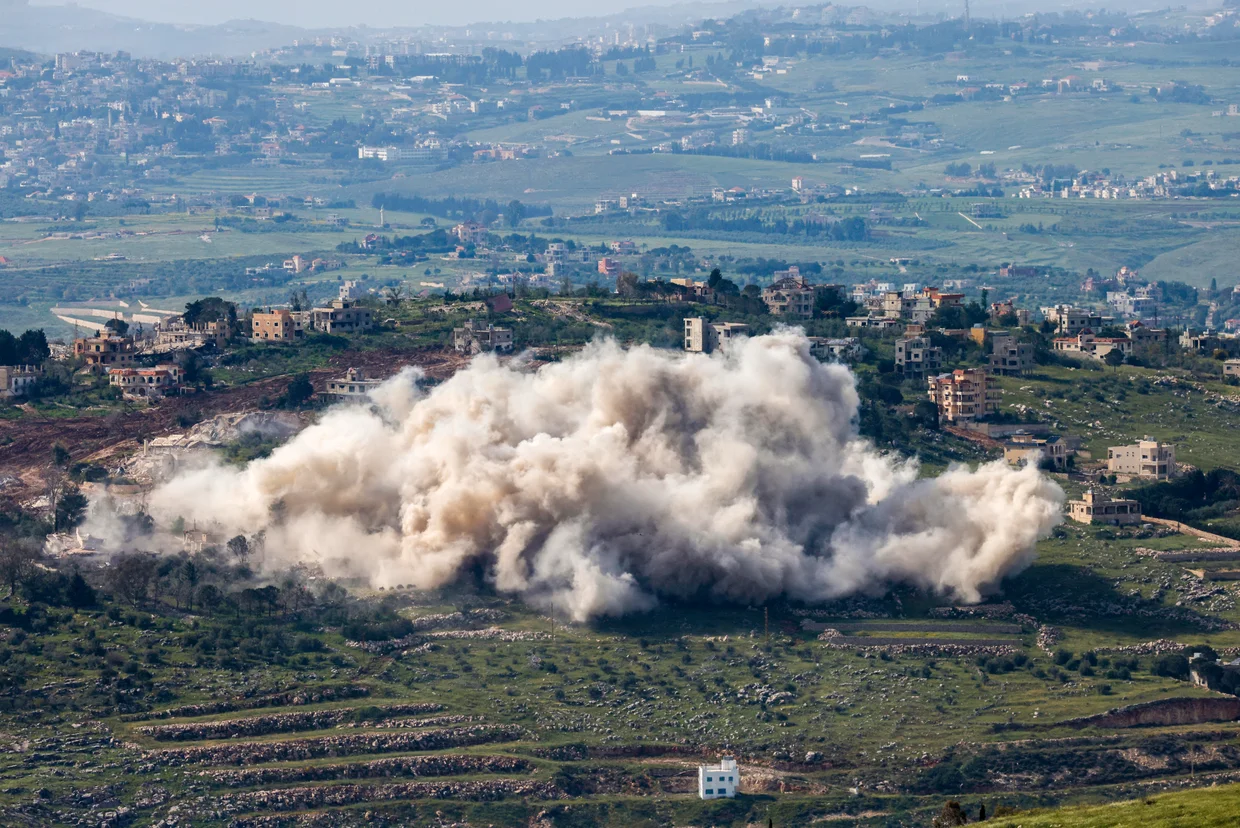
This picture taken from a position in Upper Galilee in northern Israel, near the border with Lebanon, shows smoke rising as the Israeli army demolishes buildings and homes in southern Lebanon, April 27, 2026.Jalaa MAREY/AFP/Getty
Here is the latest on the war in the Middle East
- President Trump has said, without offering any further context, that Iran “informed us that they are in a ‘State of Collapse,’” as his administration discusses an Iranian proposal for both countries to drop their respective restrictions on the Strait of Hormuz but delay talks on the Islamic Republic’s contentious nuclear program.
- Oil prices continue ticking up. International benchmark Brent Crude topped $112 a barrel Tuesday with no clear indication of an imminent resolution to the war that has severely constrained shipping traffic through the strait.
- Fighting between Israel and Iranian-backed Hezbollah in Lebanon, which has been a major sticking point in efforts to cement a wider peace deal between the U.S. and Iran, continues. Israel warned more Lebanese civilians to flee their homes Tuesday ahead of military operations.
- Israeli military says no casualties in Hezbollah drone attack on troops in southern Lebanon
- Hezbollah “launched a number of explosive drones that detonated adjacent to IDF soldiers operating in southern Lebanon” on Tuesday, the Israel Defense Force said in a brief statement, adding that no injuries were reported.
- The IDF said the incident occurred “south of the Forward Defense Line,” a boundary the military has established across southern Lebanon, and south of which it has ordered civilians to evacuate and not return indefinitely as it carries out operations against Hezbollah.
- In addition, the military said Israeli forces launched interceptors on Tuesday “toward a suspicious aerial target that was identified in the area in which IDF soldiers are operating in southern Lebanon,” adding that the “results of the interception are under review.”
Iranian media say authorities have barred export of steel products in latest economic blow to regime
Iran has banned the export of steel products, local media on Tuesday reported customs authorities as saying, after airstrikes targeted its steel industry in the war with Israel and the United States.
Fars news agency reported a directive from the Islamic republic’s customs authorities “regarding the prohibition of the export” of steel, including slab, sheet and strip products, effective from April 26.
Steel is a strategically important material, vital for a range of industries as well as military production, including missiles, drones and ships.
Israel said days before a ceasefire took effect on April 8 that its airstrikes had destroyed 70% of Iran’s steel production capacity while also hitting petrochemical facilities and transport infrastructure.
The damage could have a long-term impact on Iran’s economy, which was already struggling under sanctions before the war, with inflation at nearly 50%.
Economic hardship and devaluations of the rial were key factors behind major anti-government protests at the start of the year.
The strain has only increased since the war started on Feb. 28, according to Iranians who have spoken with CBS News’ producer in Tehran, with many reporting sharp rises in the prices of basic necessities including food and medicine, as well as shortages of some such goods.
Trump says “Iran has just informed us that they are in a ‘State of Collapse’”
President Trump asserted in a brief social media post on Tuesday that Iran had “informed” his administration that its theocratic regime, which has ruled the country for almost 50 years, was collapsing and looking for a way to end the two countries standoff over the Strait of Hormuz.
“Iran has just informed us that they are in a ‘State of Collapse.’ They want us to ‘Open the Hormuz Strait,’ as soon as possible, as they try to figure out their leadership situation (Which I believe they will be able to do!),” said Mr. Trump.
He did not indicate who in or from Iran had conveyed the message to him, or what exactly it entailed.
President Trump has insisted repeatedly that the joint war launched by the U.S. and Israel on Iran on Feb. 28 has already succeeded in changing the regime, though despite mixed signals from military and political leaders, there has been no indication of a real regime change.
Secretary of State Marco Rubio, speaking Monday with Fox News, said he had no doubt that “at some point in the future if this radical clerical regime remains in charge in Iran, they will decide they want a nuclear weapon.”
“That fundamental issue still has to be confronted. That still remains the core issue here,” Rubio said.
“Israel has no territorial ambitions in Lebanon,” foreign minister says
Israel’s foreign minister said Tuesday that the country is not seeking to permanently seize territory from neighboring Lebanon, as its military forces occupy a portion of southern Lebanon and push operations against Iranian-backed Hezbollah deeper into the country despite an ongoing U.S.-brokered ceasefire.
“Israel has no territorial ambitions in Lebanon,” Foreign Minister Gideon Saar said at a news conference Tuesday. “Our presence in the areas by our northern border serves one purpose: protecting our citizens.”
The Israeli military has said forces will remain in a security buffer zone extending at least six miles into Lebanese territory from the border indefinitely, with residents not allowed to return to their homes, until the threat posed by Hezbollah to citizens in northern Israel is removed.
Lebanese authorities say Israel’s ongoing military operations since the beginning of March have killed more than 2,500 people and displaced more than 1 million from their homes.
Iranian-backed Hezbollah started launching drones and rockets at Israel just two days after Israel and the U.S. launched their joint war on Iran on Feb. 28. At least 23 people have been killed in Israel by Iranian and Hezbollah attacks since then
UAE announces withdrawal from OPEC, vows to boost production amid “urgent needs of the market”
The United Arab Emirates announced Tuesday that it would be withdrawing from the Organization of the Petroleum Exporting Countries (OPEC) and the wider OPEC + on May 1.
The UAE, in a statement conveyed by its official news agency, indicated that the move was to give the country greater flexibility to boost oil production to meet market demand, saying the decision was “in line with the UAE’s long-term strategic and economic vision and the development of its energy sector, including accelerating investment in local energy production.”
The statement said the decision came “after an extensive review of the UAE’s production policy and current and future capacity and given the requirements of the national interest and the state’s commitment to contribute effectively to meeting the urgent needs of the market, while geopolitical fluctuations continue in the short term through the disturbances in the Arabian Gulf and the Strait of Hormuz, which affects supply dynamics.”
“The UAE will continue its responsible role by gradually and thoughtfully increasing production, in line with demand and market conditions,” the statement said.
The move, in the mid to longer term, could help bring global oil prices down if the UAE increases production significantly, as it will no longer be beholden to the OPEC group’s collective production and pricing.
Sweden warns of potential jet fuel shortage amid supply disruptions caused by Iran war
Sweden’s government warned Tuesday of a potential jet fuel shortage in the Scandinavian country due to supply disruptions caused by the Middle East war and the closure of the Strait of Hormuz.
“We want to provide an early warning that there is a risk of a jet fuel shortage. This is based on an assessment by the Swedish Energy Agency,” Energy Minister Ebba Busch said at a press conference.
“Even if a lasting peace deal (between the United States and Iran) were to be in place tomorrow, it would likely still take time before oil and gas supplies are restored,” Busch said, speaking alongside Prime Minister Ulf Kristersson and Energy Agency director Caroline Asserup.
There is currently no systemic shortage of jet fuel in the European Union. But concerns are rising as 20% of the jet fuel used by the EU normally transits through the Strait of Hormuz.
Kristersson said Sweden was less affected by the current energy crisis than many other countries overall, noting Swedish electricity production is largely based on nuclear, hydro and renewable energies. But it could be affected down the road if the conflict were to deteriorate and continue for a long time.
“We have seen no delivery disruptions” for now, she said. “What we are seeing, however, are price fluctuations, and it is due to these price movements that some companies, for commercial reasons, may sometimes decide to cancel flights.”
Sweden and the Nordic countries have a relatively large refining capacity, mainly thanks to North Sea oil. This oil is now in higher demand, which has led to higher prices.
CBS
