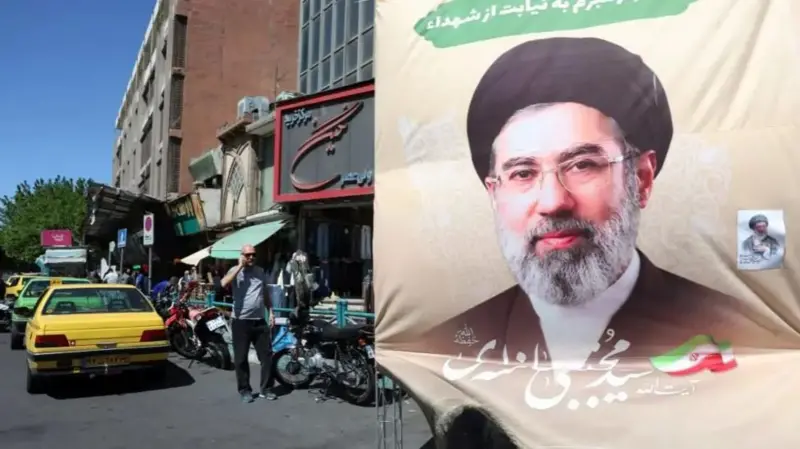
Mojtaba Khamenei has not been seen in public since succeeding his father as supreme leader
By: Amir Azimi
Iran’s Foreign Minister Abbas Araghchi was heading up talks with Pakistan earlier, but who is actually making decisions in the country?
Formally, the answer is clear. Mojtaba Khamenei has assumed the role of supreme leader following the killing of his father, Ali Khamenei, on the first day of the war on 28 February.
But in practice, the picture is far murkier. Mojtaba Khamenei has not been seen in public since taking power. That absence matters. In Iran’s political system, authority is not just institutional – it is also performative.
On paper, diplomacy sits with the government. Foreign Minister Abbas Araghchi continues to represent Tehran in talks with the US, under Iranian President Masoud Pezeshkian.
Araghchi’s role looks operational rather than directive. His brief reversal over whether the Strait of Hormuz was open or closed offered a rare glimpse of how little control the diplomatic track has over military decisions. Pezeshkian, meanwhile, has aligned with the broader direction of the regime without visibly shaping it.
But neither appears to be setting strategy and their authority is further put into question by the fact that Iran’s delegation is headed by Parliament Speaker Mohammad-Bagher Ghalibaf.
A former Revolutionary Guard commander, Ghalibaf’s position is precarious – active but not clearly authorised. He insists his actions align with Mojtaba Khamenei’s wishes, yet there is little visible evidence of direct co-ordination.
In a system that depends on signals from the top, that ambiguity is telling.
BBC
