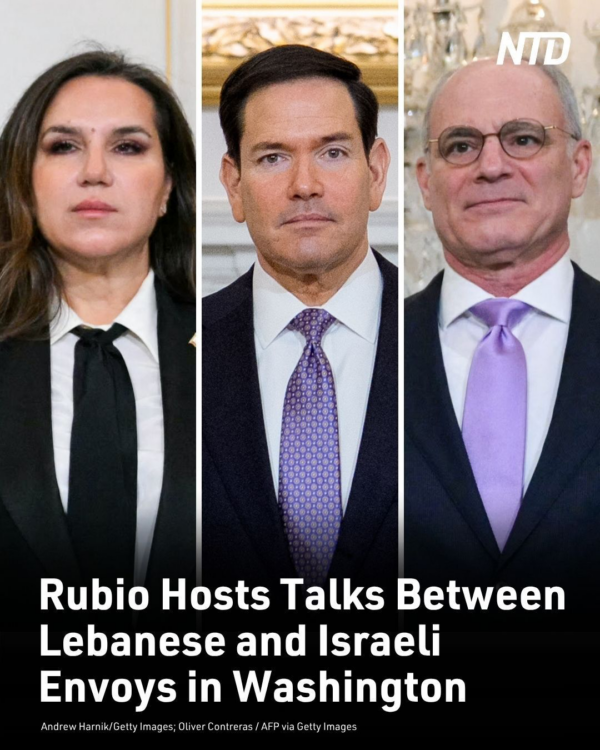
Israeli and Lebanese envoys met in Washington on Tuesday. U.S. Secretary of State Marco Rubio attended the meeting between Israeli ambassador to the U.S., Yechiel Leiter, and his Lebanese counterpart, Nada Hamadeh Moawad.
Lebanon offered peace and a sovereign path forward—yet left Washington empty-handed
By: Ya Libnan Editorial Board , Op.Ed.
Lebanon entered this week’s historic direct talks with Israel with cautious hope. For the first time in decades, diplomacy replaced confrontation. The Lebanese expected movement toward a ceasefire, a path to Israeli withdrawal, and progress on prisoner exchanges.
They got none of it.
Instead, Israel narrowed the entire discussion to one point: disarming Hezbollah. While that objective is valid—and notably shared by the Lebanese government—Israel’s approach turned a moment of convergence into one of imbalance.
This was a strategic mistake.
For the first time in years, Lebanon’s leadership signaled clearly that it wants one state, one army, and one authority over weapons. Israel claims to want the same outcome. That alignment should have been the foundation for a broader agreement—one that strengthens the Lebanese state while isolating Hezbollah.
Instead, Israel chose to lecture rather than lead.
By offering no visible return—no ceasefire framework, no withdrawal plan, no political horizon—Israel left the Lebanese government exposed. After extending its hand, Beirut walked away empty-handed, with nothing to show its people and everything to defend against Hezbollah’s narrative.
Lebanon has seen this before.
In 1983, President Amin Gemayel pursued peace with Israel. That effort collapsed when Israel insisted on unequal security arrangements that compromised Lebanese sovereignty. The lesson was clear then, and it remains clear today: agreements that lack equality do not survive.
This week in Washington, history echoed itself.
Prime Minister Benjamin Netanyahu speaks of a “lasting peace” that endures for generations. Lebanon wants exactly that. But peace built on pressure rather than partnership is not peace—it is postponement.
Final Word:
A real peace is still within reach. But it will not be achieved by demanding that Lebanon deliver while offering nothing in return. If Israel is serious about disarming Hezbollah, it must strengthen the Lebanese state—not sideline it.
Because peace without equality is not peace at all.
