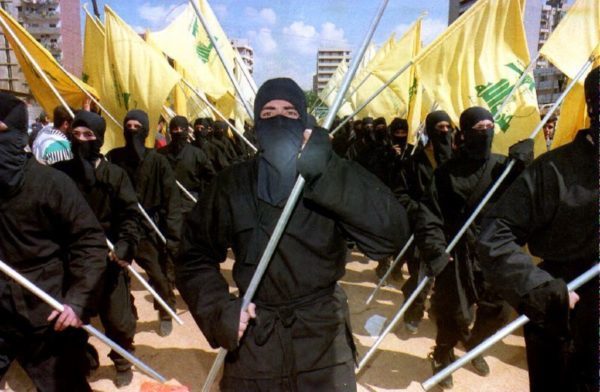
File : Masked Hezbollah fighters as they march through a suburb of Beirut in May 2008 , when the party occupied a large section of Beirut . and tried but failed to occupy Mount Lebanon. The majority of the Lebanese consider the heavily armed and Iran backed militia as the biggest threat to Lebanon’s sovereignty
Israel and Lebanon held rare, U.S.-mediated peace talks in Washington on Tuesday aimed at resolving the devastating conflict between Israel and Hezbollah, an Iranian proxy group based in Lebanon. “We discovered today that we are on the same side of the equation,” said Yechiel Leiter, Israel’s ambassador to the United States, adding that both countries were “united in liberating Lebanon” from Hezbollah’s influence.
Israeli Prime Minister Benjamin Netanyahu agreed to negotiations last week only after Tehran warned that it would withdraw from its two-week cease-fire with the United States if Israel did not cease its attacks on Hezbollah. Iran and Pakistan maintain that Lebanon was part of the U.S.-Iran cease-fire deal. However, Israel and the United States disagree, with the U.S. State Department arguing that Tuesday’s talks were not connected to Washington’s recent negotiations with Tehran in Islamabad.
According to a U.S. statement released on Tuesday, Israel and Lebanon agreed to “launch direct negotiations” to end their dispute, specifying that “any agreement to cease hostilities must be reached between the two governments, brokered by the United States, and not through any separate track.” This suggests that Beirut has sided with Israel’s and Washington’s demand that Lebanon not be part of the U.S.-Iran deal.
Notably, though, Beirut has no direct control over Hezbollah, and Israel and Lebanon do not have diplomatic relations. On Monday, Hezbollah leader Qassem Naim condemned the dialogue, calling it a ploy to pressure the militant group to disarm, and supporters of the proxy organization took to the streets to protest Beirut’s diplomatic involvement. No representative from Hezbollah attended Tuesday’s negotiations.
The historic meeting—the first bilateral engagement between Israel and Lebanon in decades—concluded after roughly two hours. According to U.S. Secretary of State Marco Rubio, Tuesday’s dialogue was about more than just securing a truce. “This is about bringing a permanent end to 20 or 30 years of Hezbollah influence in this part of the world.”
The most recent round of fighting between Israel and Hezbollah ignited on March 2, when Hezbollah launched rockets at Israel in retaliation for U.S.-Israeli strikes on Iran. Since then, the Israeli military has carried out heavy aerial bombardments on Beirut as well as a ground invasion of southern Lebanon, citing a need to protect Israeli citizens living near the border.
According to Lebanon’s health ministry on Monday, more than 2,000 people—including 252 women and 166 children—have been killed in Lebanon since March 2. Around 1 million others have been displaced. Israel estimates that Hezbollah strikes during this same time period have killed at least 12 Israeli soldiers and two civilians.
Several foreign governments and international humanitarian agencies have denounced Israel’s continued assault on Lebanon. On Tuesday, Italian Prime Minister Giorgia Meloni suspended the automatic renewal of her country’s defense cooperation deal with Israel, alluding to an Israeli attack last week on Italian troops serving in Lebanon under a United Nations mandate.
The International Committee of the Red Cross also expressed serious concern with Israeli strikes on Lebanese medical workers, after Israel hit a Red Cross center in the Lebanese city of Tyre on Monday, killing at least one person. Israel’s military said it had carried out a targeted strike on a “Hezbollah terrorist” in Tyre and was investigating reports that a Red Cross facility was damaged.
Yet much of the international community applauded Tuesday’s meeting as a necessity for eventual peace. “We call on both parties to seize this opportunity,” foreign ministers from 18 countries wrote in a joint statement on Tuesday. “Direct negotiations can pave the way to bring lasting security for Lebanon and Israel as well as the region.”
(Foreign Policy)
