By: Vlad Green , Op-Ed
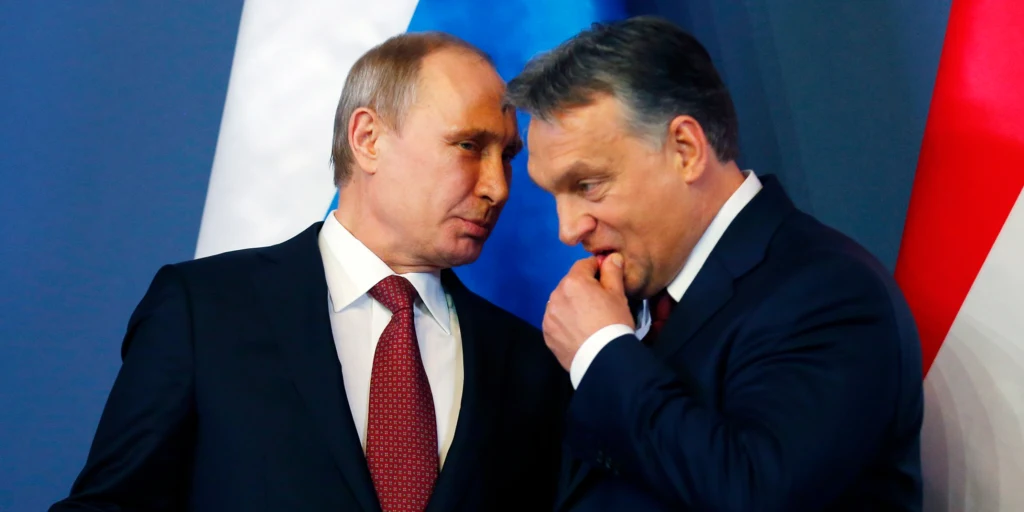
File photo of Hungary’s PM Viktor Orbán (R) and Russian president Vladimir Putin
For years, Hungarian Prime Minister Viktor Orbán has tested the limits of the European Union’s unity. What began as disagreements over democratic norms has evolved into a pattern of obstruction that touches the EU’s foreign policy, security strategy, and now even NATO cohesion. Orbán has discovered that a single-member veto can be a powerful bargaining tool — and critics argue he has used it repeatedly at moments when unity mattered most.
Hungary has delayed major decisions that other EU and NATO members described as essential for regional stability, from slowing Sweden and Finland’s earlier NATO accession processes to repeatedly resisting EU aid packages meant to support Ukraine after Russia’s full-scale invasion. Budapest has also maintained a warmer relationship with Moscow than any other EU capital, positioning itself outside the consensus on sanctions, military support, and diplomatic pressure against the Kremlin.
This divergence has only sharpened in recent months. As Europe has navigated the geopolitical shifts that followed President Trump’s return to office, Orbán has aligned himself with positions that echo both Russian interests and Trump’s criticism of European defense spending. For many EU leaders, this raises an unavoidable question: how can the bloc function when one of its members routinely sides against the common position on its most existential security issues?
Here is where the EU’s own treaties provide a unique — though rarely used — mechanism. Under Article 7, the EU can suspend a member state’s voting rights if it determines that the country is violating core democratic values or undermining the functioning of the union. It is not expulsion. It does not remove a state from the EU. But it is the strongest tool available to safeguard collective decision-making when consensus becomes unworkable.
Analysts stress that invoking Article 7 is not simply punitive; it is ultimately about credibility. The EU cannot claim to stand for democratic norms, unity, and shared security while allowing persistent internal obstruction that weakens its response to war on its borders. Nor can it allow one government to leverage its veto to extract unrelated concessions at moments of crisis.
In the end, the future of Hungary’s position in Europe will not be decided in Brussels but in Budapest. The Hungarian people — not EU leaders — will choose, through elections, whether their country continues down Orbán’s path or re-engages with the broader European mainstream. But until then, the EU faces a difficult dilemma: either act to protect its ability to function or allow one member to repeatedly undermine it from within.
