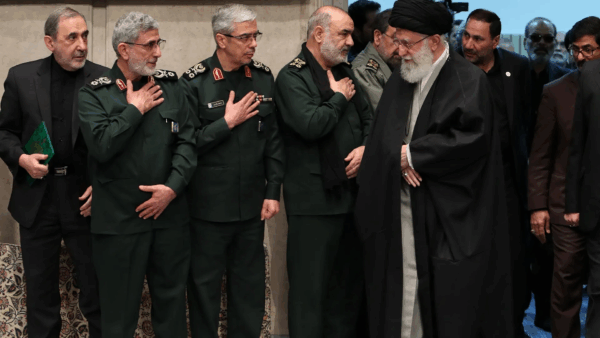
Iran’s Supreme Leader Ali Khamenei (R) with (R-L) IRGC commander Hossein Salami, Quds Force Commander Esmail Qaani, and military chief of staff Mohammad Bagheri in 2020. All three generals were killed in the strike. Photo: Iranian handout via Getty
By Leily Nikounazar and Vivian Yee, NYT
To hear the Iranian establishment tell it on Tuesday morning, the Islamic Republic had just pulled off a spectacular feat: launching an attack so crushing that the country’s mighty enemies, Israel and the United States, had been forced to submit.
“Defeat of the Zionist enemy,” ran the chyron on Iran’s state TV network on Tuesday morning as it broadcast news that Israel and Iran had agreed to a cease-fire. State news agencies published a fanfare-laden statement by the Iranian national security council saying that Tehran and the “dazzling power” of its military were “imposing a cease-fire” on Israel by striking a U.S. air base in Qatar and other targets. By evening, state TV was broadcasting images of a victory rally in Tehran.
But defeat seemed a more accurate reading of recent events — not just defeat, but the kind of battering that leaves a question mark hanging over the future of Iran’s nearly half-century-old theocratic regime.
The 12-day war began with a barrage of Israeli airstrikes on Iran that wiped out much of the Iranian military’s top brass, destroyed its air defenses and degraded some of its nuclear and missile facilities. Subsequent Israeli attacks killed at least 600 Iranians, including children, according to Iranian authorities, and clogged the roads out of Tehran with panicked, fleeing civilians. And American airstrikes on three Iranian nuclear sites damaged, or may have destroyed, key parts of the country’s nuclear program, a longstanding symbol for the ruling establishment of strength and resistance to Western pressure.
Attacks of such breadth and depth on Iranian soil were possible because Iran had already suffered a series of blows, failures and missteps over the last 20 months: The crumpling of Hezbollah and Hamas, two of its main militia partners in the Middle East. The fall of the Assad regime in Syria. The crippling of Iranian air defenses in previous tit-for-tat military exchanges with Israel.
With those air defenses now mostly gone, Israel could do what it wanted in the skies over Iran, with Yechiel Leiter, Israel’s ambassador to the United States, claiming “near-air superiority” in a social media post two days into the war. Iran’s vulnerability likely made a cease-fire an attractive option to its leadership, analysts said.
“If it’s as dire as it looks from the outside, they’ve really lost this war, and ‘this war’ isn’t just this small war, but this generational war they’ve fought for the last 30 years” against Israel, said Afshon Ostovar, an Iran military expert at the Naval Postgraduate School in Monterey, Calif.
While Iran’s nuclear program was dealt a serious setback, Western intelligence officials know neither how much of Iran’s uranium stockpile is left nor what military capabilities it retains.
Iran’s overall loss does not mean the end of clerical rule in Iran. The regime “can find another way forward,” Mr. Ostovar said.
In private, Iranian officials described the strike on the American base as a face-saving effort to make a show of retaliation while avoiding an unwinnable war with the United States.
In public, officials projected swagger, emphasizing displays of Iranian might: first, Iranian missile barrages into Israeli towns that sent Israelis ducking into bomb shelters, destroyed buildings and killed 28 people; then, the missile strike on Monday on the installation in Qatar, Al Udeid Air Base, though Iran gave advance warning of the attack through intermediaries and there were no casualties in the strike.
A retired Islamic Revolutionary Guards Corps naval commander, Gen. Hossein Alaei, told ISNA, a state news agency, that Iran had been able not only to withstand Israeli attacks but also to force Israel and the United States to retreat.
“In such circumstances, the warmongering Trump chose to accept a cease-fire and rein in the bloodthirsty Netanyahu,” General Alaei said, according to ISNA.
Despite losing its top commanders, Iran proved it still had the capacity to strike Israel, General Alaei said. He added that the United States had entered the war only because “it became clear that Israel was unable to defeat Iran.”
Iran’s eagerness to claim victory and move on without prolonging the conflict might signal a willingness to talk terms with the Trump administration, perhaps continuing the negotiations over limits to its nuclear program that the two sides were engaged in before Israel attacked.
Rhetoric aside, analysts said the real damage Iran managed to inflict on Israel — and the possibility that it might have more military capacity in reserve — might give it some leverage to avoid a total capitulation in such talks.
But with its legitimacy resting on a narrative of resistance to Israel and the West, Iran’s leadership will not be able to accept the “unconditional surrender” that President Trump demanded on social media last week, analysts say.
Ayatollah Ali Khamenei, the supreme leader, may be vulnerable to internal finger-pointing and potentially even replacement in the wake of the conflict, analysts said. And there is a possibility that more moderate voices could succeed in urging Iran to curb its aggressive foreign policy and focus on improving its economy, they said.
That is what many Iranians, who despise their theocratic leadership, would prefer. It is hard to gauge public opinion in Iran, where independent and foreign media face restrictions and polling is limited, but on social media at least, few except hard-line supporters of the regime appeared to be buying its triumphalist narrative on Tuesday.
Some Iranians expressed hope that the fear and destruction would finally end and criticized the leadership’s failure to protect the country. Others even regretted that the war had not brought about the regime’s fall.
“Many rejoiced, while others were profoundly disappointed, as they had hoped for regime change in Iran,” said Soheil, 37, an engineer in Isfahan, speaking of his colleagues. He asked to be identified only by his first name while criticizing the government, which has jailed many critics.
But it is the support of its hard-line base that matters to the leadership. That would give Iran an incentive to harden in the long run, perhaps pursuing its nuclear program again after a period of taking stock and rebuilding, analysts said.
If Iran’s leadership does choose to become more hawkish and reactionary, many Iranians fear that it could crack down even more harshly on internal dissent
The New York Times
