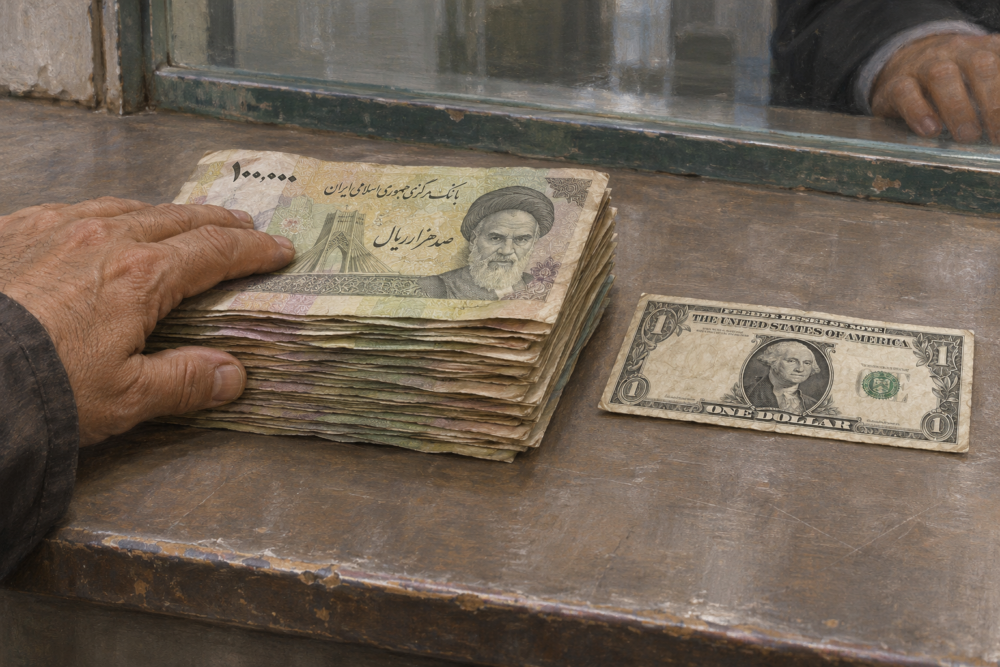
Editorial illustration. At Iran’s open-market exchange rate on November 29, it took over thirty 100,000-rial notes to buy one U.S. dollar.
The rial’s collapse is impoverishing Iranians. The fate of the Islamic Republic will depend on whether the people who keep it in power begin to break ranks.
By : Ya Liban Editor, Opinion
In 1978, before the Islamic Revolution, 100,000 Iranian rials were equivalent to about $1,420 at the exchange rate of the day. On November 29, a dollar cost over 3.04 million rials on Iran’s open market. Imagine counting out thirty 100,000-rial notes for one American dollar.
The exchange rate tells a story that spans nearly half a century. The price of food tells us how quickly life is changing now. Iran’s own statistical agency reported that consumer prices in October were 88.7 percent higher than a year earlier. Food and beverage prices rose 112.6 percent. A family whose income stayed the same would have to spend more than twice as much to buy the same basket of food and drink. How long can families keep absorbing that kind of shock?
Washington’s naval blockade, restored in July, has sharply curtailed Iran’s crude exports. Oil sales provide the hard currency Iran needs to pay for imports. As those dollars become harder to come by, the rial falls and imported goods become more expensive. Families who still have savings are buying dollars or gold to protect what they have left, adding to the pressure on the currency. Iran’s central bank governor says the country can pay for essential imports and medicine for months. For a family at the pharmacy counter, the test is whether the medicine is on the shelf and within reach. Reuters on the blockade · Reuters on prices and reserves
A struggle over who holds power
On November 29, parliament speaker Mohammad Baqer Qalibaf said Supreme Leader Mojtaba Khamenei had ordered an intelligence overhaul. Iran has gone more than eight months without naming a permanent successor to Intelligence Minister Esmail Khatib, killed in an Israeli strike on March 18. An earlier report on the proposed legislation said Khamenei would directly appoint the heads of two new bodies responsible for internal security and ideological affairs. The proposal suggests that, even as the government struggles to steady the rial, the supreme leader is seeking more direct control over domestic security. Reuters · Iran International
My judgment is that the Islamic Republic is more likely to survive through May 2027 than to fall by then. The most consequential change in the coming months could be a shift of power toward the Revolutionary Guard. Khamenei could keep his title while Guard commanders gain more sway over appointments, security policy and the terms of any negotiations with Washington. The system could survive even as the balance of power inside it changes substantially.
What would make me change that forecast? I would watch for strikes that spread across cities and industries and last long enough to disrupt normal business. There have already been reports of truck drivers striking in southern cities. If oil workers, transport workers and bazaar merchants sustain stoppages at the same time, the government will face a challenge that goes beyond scattered protests. Persistent trouble paying security personnel would add to the pressure. The decisive sign would be commanders openly breaking with the leadership or units refusing orders. If coordinated strikes and a serious split in the security forces come together, a timetable measured in months could suddenly be measured in weeks. Critical Threats Project and Institute for the Study of War
What Washington should do
The United States should make an Iranian-led democratic transition the aim of its policy. It should work with European and other allies to freeze the overseas assets of officials credibly implicated in abuses and restrict their travel. It should also back UN investigators who are documenting violations. A commander deciding whether to obey an unlawful order should know that he can be held personally accountable. UN human rights experts
Washington should give banks and shipping companies clear authorization to handle food and medicine and work with them to keep those channels open. A humanitarian exemption has value only if a supplier can get paid and a shipment can reach the people who need it. The United States should also help independent Persian-language media reach audiences inside Iran and make it easier for providers to offer secure communications. Treasury has already authorized a range of communications services that can support that effort. U.S. Treasury
Finally, Washington should engage a broad range of Iranian civil society voices and coordinate with allies around concrete demands. Political prisoners should be released. Workers should be able to organize independently, journalists should be able to report freely, and citizens should be able to assemble peacefully. Those freedoms would give Iranians the means to decide who governs them through free elections.
Thirty banknotes for a dollar tell us how much Iranian families have already lost. The test of American policy should be whether it gives those families more freedom to speak, organize and choose their own government.
