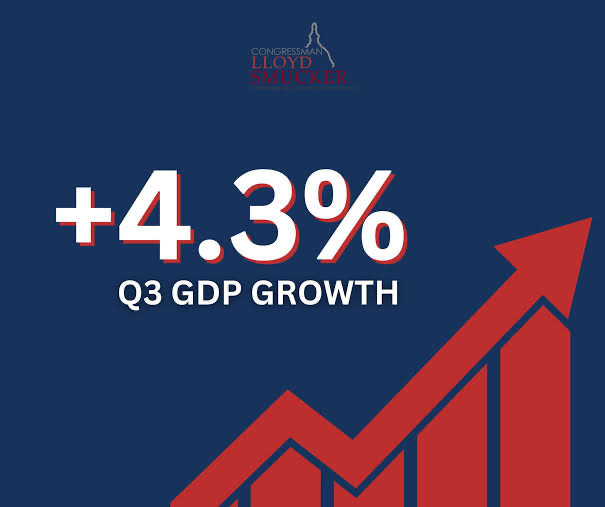
The U.S. economy grew substantially faster this summer than initially thought, the government said Wednesday — a blockbuster upgrade to its estimate of third-quarter GDP.
By the numbers: The economy expanded at a 4.3% annualized rate, up from the 3.4% initially reported and nearly twice the rate of 2.2% in the second quarter.
Why it matters: The economy has even more momentum than previously understood, a sign of remarkable resilience in the face of higher borrowing costs and stubborn inflation that could give the Fed more latitude to raise rates.
The upward revision reflected stronger business investment fueled by the AI buildout and software investment, as well as consumer spending.
- A measure of underlying private-sector demand — which strips out trade, inventories and government spending — rose at a whopping 5.8% annual rate, up from the 4.9% initially reported.
Separate data out Wednesday showed personal income jumped 0.7% in October while inflation-adjusted consumer spending stalled, pushing the saving rate up to 4.1% from 3.6% the prior month.
- The personal consumption expenditures price index — the Fed’s preferred inflation gauge — climbed 3.8% from a year earlier, from 3.6% in September.
- Core inflation, which excludes food and energy, accelerated to 3.3% from 3.1%.
- On a monthly basis, both headline and core prices rose 0.3%.
The bottom line: The U.S. economy was on remarkably strong footing heading into the end of the year, though inflation remains stubbornly high.
Axios
