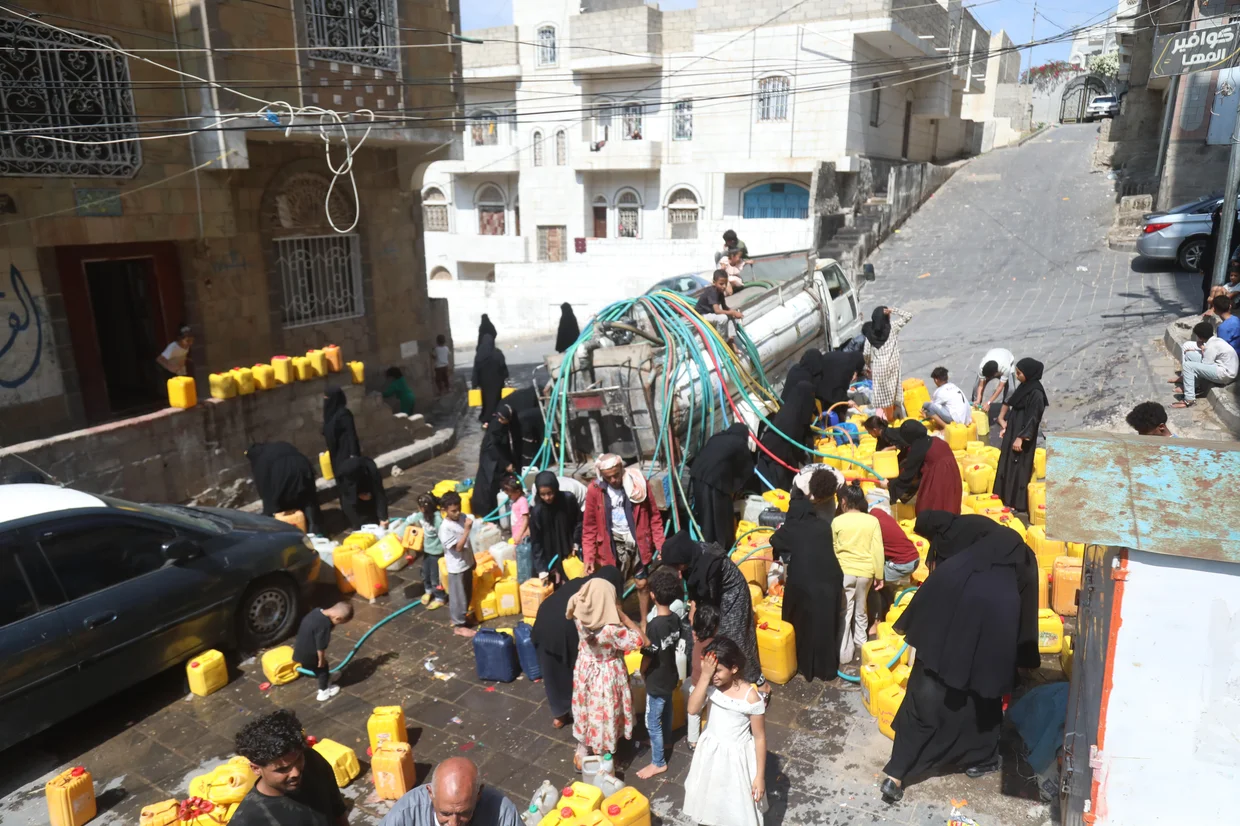
Yemenis gather with plastic containers to collect water distributed from a tanker truck in Taiz, southwest Yemen, Nov. 14, 2026. The iran backed Houthis have been targeting the Internationally recognized Yemen government forces in the south
HERE IS THE LATEST –
- Iran’s U.N. ambassador on Tuesday criticized the U.S. military’s use of artificial intelligence systems in the nearly 9-month war, claiming American forces leveraged the technology to plan and carry out some 2,000 attacks over just four days.
- The Iran-backed Houthi group claimed an attack on the financial district of Saudi Arabia’s capital on Wednesday, as well on a sprawling oil refinery in the country’s east.
- Israeli Defense Minister Israel Katz said on Tuesday that Iran is developing chemical weapons and vowed to stop Tehran from obtaining them. Iran has repeatedly denied it is developing chemical weapons.
- Israeli opposition leader Gadi Eisenkot faces significant political hurdles as he races against a December 6, 2026deadline to form a governing coalition. His hesitation and deep fractures within his opposition bloc threaten his path to a 61-seat parliamentary majority
The left-wing Democrats party announced it is suspending coalition negotiations with Eisenkot
The left-wing Democrats party, led by Yair Golan and holding eight Knesset seats, announced it is suspending coalition negotiations with Eisenkot. Golan’s faction objected to Eisenkot holding unity government talks with Prime Minister Benjamin Netanyahu’s Likud party and ultra-Orthodox factions.
Eisenkot’s hesitation is beginning to cost him. President Isaac Herzog gave him the first chance to form a government, despite Netanyahu’s bloc winning 53 seats to his bloc’s 48. Netanyahu lost his majority, yet his alliance still finished ahead of Eisenkot’s despite the backlash over his conduct of the war. Another election would give Netanyahu a fresh opportunity and could leave Eisenkot without the chance he has today according to congressional Research Services
The most direct path to a majority runs through the 19 lawmakers elected on Arab-led lists. Together with a united 48-seat opposition bloc, they could give Eisenkot a parliamentary base of 67 in a 120-seat Knesset. Reaching that number would require real agreements. Lieberman has opposed relying on Arab parties, and Ra’am and the Joint List have signaled different positions on a confidence vote. Eisenkot should be negotiating with both and asking his existing partners what commitments would bring them along according to Reuters and The Times of Israel
U.K. reportedly taking extra precautions to protect warplanes on bases due to drone threat
Britain’s air force is moving planes into hangars and hardened shelters overnight to protect them from drone threats, The Times and Sky News reported Wednesday. The two U.K. media outlets also said the Royal Air Force (RAF) is planning to install anti-drone nets around warplanes that remain exposed.
The Ministry of Defense did not immediately confirm the reports, but British authorities have issued warnings recently about the rising threats posed by Russia and Iran, and the government has urged citizens to be prepared for various contingencies that could make access to fresh food, water and other essentials difficult for days.
In October, the head of Britain’s domestic spy agency MI5 warned that Iran had made a “major shift” in its efforts to attack the U.K., including going after harder targets such as military bases,
He spoke weeks after authorities thwarted an alleged Iran-backed plot targeting the U.K. air base RAF Fairford. That incident, for which two men have since been charged with serious national security offenses, led the U.S. to withdraw all of its bomber aircraft, which had been used in strikes on Iran, from the base.
Iran-backed Houthis renew threat to target Saudi Arabia’s Red Sea ports
The Iran-backed Houthis reiterated on Wednesday their threat to target Jeddah and all Saudi Arabian ports on the Red Sea if the Saudis follow through on their threat to target Yemen’s Hodeidah port, which is held by the rebels.
Hodeidah is the main entry point for food and other essential supplies into Houthi-held northern Yemen.
In a statement posted online, Houthi military spokesman Yahya Saree called on “employees and workers at these ports, as well as those present in their vicinity, to evacuate them immediately and move away.”
Shortly after Saree issued the warning, the Houthi-affiliated Al-Masirah TV network reported a Saudi attack on the port of Hodeidah.
The rebel group said earlier Wednesday that it had carried out two operations targeting the Ras Tanura refinery in Saudi Arabia’s Eastern Province, as well as the financial center in Riyadh.
Saudi Arabia’s Civil Defense agency said Tuesday that a skyscraper in the financial district had been targeted by a Houthi attack, injuring 11 people.
U.N. humanitarian chief: Half of Yemen’s population needs aid as “Houthis ” drive displacement
United Nations humanitarian relief chief Tom Fletcher said Wednesday that half of Yemen’s population is in need of aid, as he arrived in the war-torn nation that has become the most active front in the intertwined Middle East conflicts.
Fletcher warned in a statement shared online that “renewed fighting has forced over 364,000 people from their homes since August, including tens of thousands this past week alone.”
He repeated his demand for Yemen’s Iran-backed Houthi rebels to “immediately and unconditionally release our detained UN colleagues” and other humanitarian workers and said the U.N.-led relief efforts in the country were overstretched, underfunded and under attack.
“Yemen is where we are furthest off track on our ambition to reach 87 million people with lifesaving support this year,” Fletcher said. “We will not allow the people of Yemen to slip off the world’s radar.”
Iran claims it has tightened its control over Strait of Hormuz
Iranian army spokesperson Brig. Gen. Mohammad Akraminia said the military had tightened its control and monitoring of the Strait of Hormuz on the orders of the army’s commander-in-chief.
Ships attempting to transit the waterway without coordinating with Iran’s armed forces have faced greater risks in recent weeks, including sea mines, Akraminia was quoted as saying Wednesday by the semi-official Tasnim news agency.
President Trump has dismissed Iran’s claims attacks on ships and sea mines being laid in the strait as lies intended to inflate global energy prices, and the U.S. military declared international shipping lanes through the waterway free of mines at the end of October.
Without offering any evidence, however, Akraminia claimed Iranian forces had upgraded their monitoring capabilities by introducing new systems, improving existing ones and strengthening their combat abilities, and he said the measures would continue.
Iran’s Persian Gulf Strait Authority (PGSA) said Tuesday that 26 tugboats had been added to the country’s “Non-Compliance List,” for providing services to non-compliant vessels, indicating they could be targeted.
Iran issues daily claims of commercial vessels striking mines in and near the strait, few of which are ever corroborated, but independent monitors do report frequent incidents involving “unknown projectiles” striking ships in the region.
