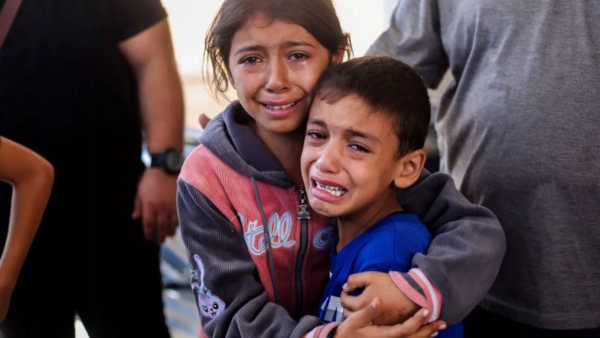
Over 13000 children in Gaza were being displaced every day according to MSF. Children as young as five told MSF that they “would prefer to die.” The Gaza genocide has been compared to the Holocaust by the Brazilian president “It’s not a war of soldiers against soldiers. It’s a war between a highly prepared army and women and children ”, he said
The International Court of Justice’s landmark ruling that Myanmar committed genocide against its Rohingya minority could have important implications for South Africa’s case accusing Israel of genocide in Gaza, although it does not determine how the judges will rule.
The case was brought by The Gambia in November 2019, which accused Myanmar of violating the 1948 UN Genocide Convention through its treatment of the Muslim minority. The Gambia, which was not directly affected by the alleged crimes, argued that all states party to the convention have a shared interest in preventing and punishing genocide.
Palestinian-Canadian lawyer and former Palestinian Authority spokesperson Diana Buttu said Thursday’s judgment was significant because it clarified key aspects of how genocide can be established, including the requirement to prove an intention to destroy a protected group “in whole or in part.”
“This is the first time we’ve had the ICJ find genocide, and that is really important,” Buttu told The New Arab. She said the ruling challenged arguments that have been used to dismiss allegations of genocide against Israel.
“The first is, they found that it doesn’t need to be that the entire population is wiped out,” she said. “Otherwise, there’s no need to have the convention to prevent genocide.”
The ICJ ruled that Myanmar’s security forces committed genocide against the Rohingya in northern Rakhine State, finding that the “only reasonable inference” from the evidence was that the country intended to destroy the group. The court cited killings, widespread sexual violence, extreme violence against children and the systematic destruction of Rohingya villages.
Why the ruling matters for Gaza
Genocide is exceptionally difficult to establish in court. It is not enough to demonstrate mass killings or widespread destruction: judges must also establish the specific intent to destroy a national, ethnic, racial or religious group, in whole or in part.
Before the mass exodus of 2017, an estimated 1.2 million to 1.4 million Rohingya lived in Myanmar, representing a small proportion of the country’s population of around 53 million at the time. Buttu said the ruling showed that the destruction of a part of a protected group could meet the threshold for genocide.
She also argued that evidence of intent in the Gaza case was particularly significant.

“On the issue of intent, the Israeli case is far clearer than it was in the case of Myanmar,” she said, pointing to “statement after statement after statement by Israeli officials, plus the actions of the soldiers themselves.”
Israel has denied committing genocide, saying its military campaign is aimed at dismantling Hamas and not targeting Palestinians as a group. Myanmar had also denied genocide, arguing that its military operations targeted insurgents.
South Africa filed its case against Israel in December 2023 under the 1948 UN Genocide Convention. The case followed Israel’s war on Gaza, which has killed more than 74,000 Palestinians since 7 October 2023 and displaced nearly all the enclave’s 2.2 million population.
The significance of the ICJ’s provisional measures
Buttu also pointed to the ICJ’s provisional measures in the Gaza case, arguing that Israel’s failure to comply with the court’s orders should be considered when assessing its intent.
The court has issued several sets of provisional measures ordering Israel to take steps to prevent acts prohibited under the Genocide Convention, facilitate humanitarian assistance and address the risk of irreparable harm to Palestinians in Gaza. These were interim orders, not a final determination that genocide had occurred.
“The mere fact that they’ve ignored those rulings also ends up lending itself to a greater case for stating that there is genocide,” Buttu said. “The fact that the Israelis didn’t engage in them in and of itself shows that they weren’t interested in preventing genocide, and this goes back to the question of intention.”
Her argument, however, is not a finding already made by the court. Israel’s compliance with the provisional measures and the evidence of genocidal intent will be matters for the judges to assess in reaching a final judgment.
The Myanmar ruling is also not a binding precedent in South Africa’s case, which concerns a different conflict and a separate body of evidence. But its interpretation of the Genocide Convention could nevertheless inform the court’s reasoning.
Buttu said the judgment should also prompt governments to reconsider their response to the war in Gaza, rather than wait for a final ruling in South Africa’s case.
“This is not only an indictment against Israel, but is very much an indictment against all these other countries that have been waiting for some sort of judicial determination,” she said. “Well, now there is a judicial determination in a different case, but we can see that the standards are very much the same.”
A final ruling from the ICJ in South Africa’s genocide case against Israel is not expected until at least 2029 or 2030, following the court’s extended written pleading schedule.
NEW ARAB
