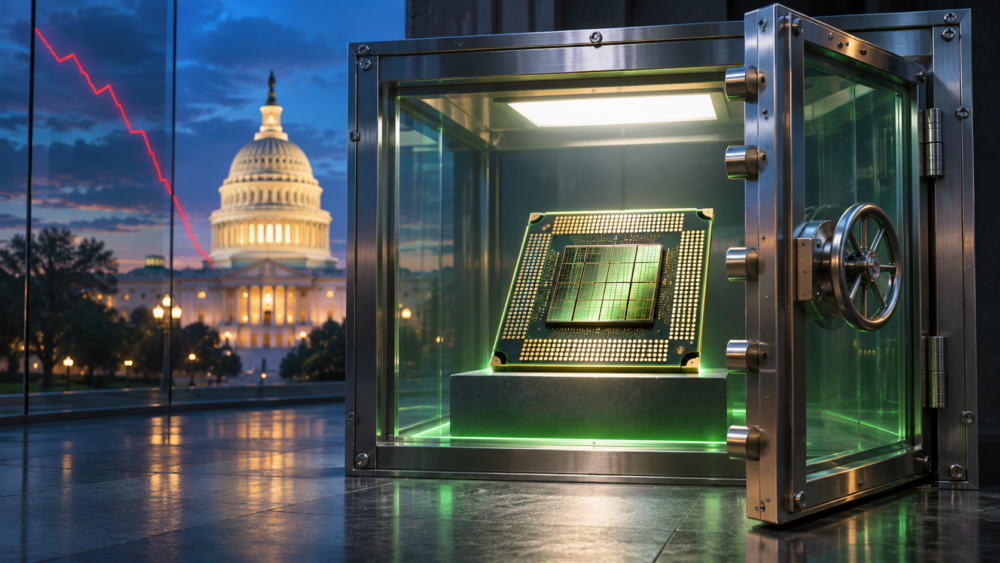
Editorial illustration – As Nvidia lost more than $1.8 trillion in market value from its October peak, a question for Washington grew more urgent. What did officials do after they were warned of a potential threat to America’s AI technology?
Nvidia lost $573 billion in market value this week, The Wall Street Journal reported Friday, bringing its decline since its October 6 peak to more than $1.8 trillion. The longer decline began before the affair became public. But the latest selloff, as founder Jensen Huang resigned as chief executive, gives shareholders an urgent reason to ask what Nvidia’s board and the Trump administration knew about a potential threat to one of America’s most valuable technology companies.
By : Vlad Green, Opinion
Reuters reported that Huang had an affair with Alice Huang, a former executive at Megaspeed, a Singapore-based Nvidia customer. U.S. authorities reportedly suspected she was working for Chinese intelligence. Reuters could not independently verify the espionage allegation, and Beijing denied it. The public has every reason to ask how Washington handled the risk, even while investigators work to establish the facts. Reuters
Who acted on the warnings?
The Commerce Department began investigating Megaspeed in 2024, according to the Associated Press, and later handed the inquiry to the Justice Department. The Washington Post reported that Secretary of State Marco Rubio briefed President Donald Trump in May about intelligence linking Jensen Huang to a woman suspected of spying for China. On Friday, Treasury Secretary Scott Bessent said that Treasury, State, Defense and the U.S. Trade Representative had favored placing Megaspeed on an export-control list for months. He said the decision rested with Commerce. Megaspeed says it takes compliance with U.S. export controls seriously. Associated Press · The Washington Post
The FBI leads domestic counterintelligence, the CIA gathers foreign intelligence, and Commerce oversees chip export controls. Did the FBI warn Nvidia’s independent directors? Did Commerce recommend interim safeguards while it investigated? After Trump was reportedly briefed, did he ask for a timetable or direct anyone to act? And if officials decided to wait, who made that call and on what grounds? FBI · CIA · Senate oversight letter
Nvidia’s board has questions to answer, too. Reuters reported that Jensen Huang described his interactions as routine business dealings when they drew attention inside the company. Nvidia’s independent directors have hired outside counsel to investigate. They should tell shareholders when they first learned of the relationship, what they did to verify management’s account and whether they reviewed Megaspeed’s access to chips and sensitive information.
Where are the administration’s priorities?
Last year, Congress and the Trump administration provided Immigration and Customs Enforcement about $75 billion through fiscal year 2029, including $45 billion for detention capacity, according to the Government Accountability Office. Washington found the money and the political will to expand immigration detention. Protecting the technology that underpins America’s lead in artificial intelligence deserves the same urgency. In Nvidia’s case, Congress should start by asking what the administration did with the warnings it already had. Government Accountability Office
Senators Elizabeth Warren and Chris Coons have asked the administration to preserve its records. Congress should now obtain the decision timeline and hear from the officials involved, behind closed doors where intelligence sources require protection. Then it should tell the public when the White House learned of the risk, whether Nvidia’s board was warned and why Commerce took as long as it did to decide how to handle Megaspeed. Senate oversight letter
The press brought this story to light. Congress must now establish whether the people entrusted with protecting America’s technology acted when they had the chance.
