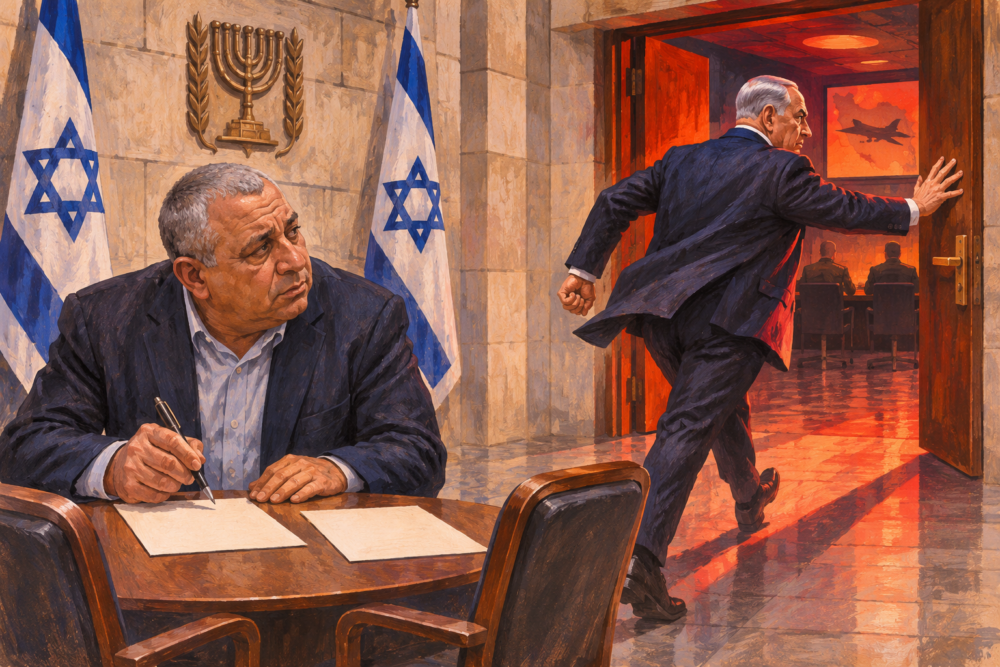
Editorial illustration – As Netanyahu pushes to resume the war with Iran, every day Eisenkot hesitates gives the caretaker prime minister more time to make his case for renewed strikes.
A prime minister who has lost his parliamentary majority should explain why his country needs another round of war. Benjamin Netanyahu is asking the United States to help resume one while Israel is trying to form a new government.
By : Ya Libnan, Opinion
Axios reported Friday, citing three people familiar with the matter, that Mossad director Roman Gofman was in Washington for talks with senior U.S. officials, including CIA Director John Ratcliffe. The visit comes as Netanyahu is urging President Donald Trump to return to combat against Iran. According to Axios, Trump has so far declined, favoring continued economic pressure and a naval blockade while leaving room for a deal. Axios, Nov. 13
The timing deserves scrutiny. Netanyahu lost his parliamentary majority in the October 27 election. Former military chief Gadi Eisenkot now has the mandate to form a government, and Netanyahu’s tenure would end if he succeeds. A renewed war could interrupt coalition talks, put pressure on parties to close ranks, and keep the caretaker prime minister at the center of Israeli decision-making. In my view, that makes war a potential political lifeline for Netanyahu. Axios reports that opposition figures fear an escalation could derail Eisenkot’s efforts. Netanyahu’s office has previously rejected accusations that he is using the Iran conflict for political gain.
Israel has genuine security concerns about Iran’s nuclear program, missile arsenal and support for armed groups across the region. Those concerns make it all the more important to ask what renewed strikes would accomplish. What threat requires action now? What military objective can be achieved? What is the plan if Iran retaliates against Israel, U.S. forces or Gulf neighbors? A government asking its citizens and allies to bear those costs owes them answers.
Eisenkot is right to demand oversight of Netanyahu’s decisions during the transition. As experts told Reuters, a caretaker government still has considerable latitude on security matters. Every day Eisenkot delays gives Netanyahu more time to press Washington for renewed strikes and increases the risk that events overtake the coalition talks. A prime minister fighting for his political survival has every reason to welcome that delay.
It is time for Eisenkot to take the bull by the horns. He must decide now which parties he is prepared to work with, seek their commitments and move to form a government.
It is time for Eisenkot to take the bull by the horns. He must decide now which parties he is prepared to work with, seek their commitments and move to form a government. Hesitation breeds fear. The longer he waits to make that choice, the greater the risk that Israel will be drawn back into war before its next government can take office.
Trump is right to resist the push for renewed strikes. Saudi Arabia, Qatar and the United Arab Emirates favor continuing pressure while giving diplomacy time, according to Axios. Any agreement should protect freedom of navigation through the Strait of Hormuz and impose verifiable limits on Iran’s nuclear program. Washington should judge any proposal to resume combat by what it would achieve for American and regional security and what it would cost.
Israel’s voters have already had their say. Their elected representatives should be able to finish the work of forming a government. Israelis, Americans and their neighbors have too much at stake to let the political survival of one man set the timetable for another war.The timing is the heart of the argument.
