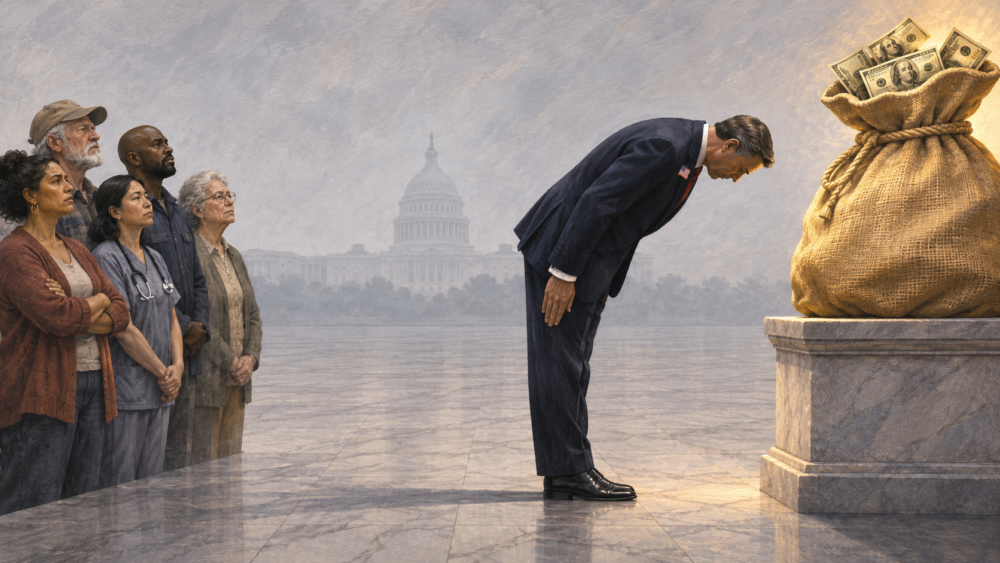
Editorial illustration : When elected officials bow to big money, they turn their backs on the people who sent them to Washington. The country they swore to serve comes last.
Abdul El-Sayed’s victory in Michigan shows what voters can do when they organize. Congress should make it easier for ordinary Americans to be heard in every election.
By: YA LIBNAN EDITOR, OPINION
“We built something bigger than a bank account,” Abdul El-Sayed told supporters after winning Michigan’s U.S. Senate race. In his victory speech, he said more than $350 million had been spent trying to defeat him across the primary and general election, including $70 million in the primary. He called it a Michigan record. Victory speech transcript..
Michigan voters made their own choice. But why should any community have to overcome spending on that scale to send the person it wants to Washington? And after Election Day, whose call gets returned first: the constituent who cast a ballot or the donor who can bankroll the next campaign?
When elected officials put the interests of their biggest financial backers ahead of their duty to the country, I call that a form of corruption. It can happen without a bribe or a whispered promise. An official may have all the powers of office and still feel powerless to challenge the interests that helped put them there. The public pays for that dependence when a bill never gets a hearing, when an industry writes the rules meant to govern it, or when a family’s struggle to pay for medicine barely registers in Washington.
Make candidates answer to voters
Campaigns need money to reach voters, and a modest contribution is one way for a citizen to take part. The problem is the power concentrated in a handful of wallets. Federal rules allow super PACs to raise unlimited sums for independent political activity. That spending can shape a race even though it is legally separate from a candidate’s campaign. Federal Election Commission
Congress should require timely disclosure that lets voters see who is actually financing major election spending before they cast their ballots. It should strengthen enforcement of the rules against coordination between campaigns and outside groups. And it should establish voluntary public matching funds for small donations in congressional elections. New York City already uses this approach to help candidates build campaigns around contributions from local residents. A federal program would give candidates a reason to spend more time with the people they seek to represent. New York City Campaign Finance Board
A kinder America starts at home
El-Sayed ended his speech by calling for getting money out of politics, putting money in people’s pockets and passing Medicare for All. Those ideas belong in the same conversation. A worker who postpones a doctor’s visit because of the cost should have as much claim on a senator’s attention as someone who can write a six-figure check to a super PAC. Americans can debate how to provide health care for everyone. The people who struggle to afford it deserve to be at the center of that debate. CBS Detroit
A kinder America begins with the way we treat people whose only political currency is their vote. If we want to lead the world in kindness, we can begin by making sure a parent worried about a medical bill gets a hearing in the same Capitol where wealthy donors already know which doors to knock on.
An elected official owes loyalty to the country and to the people who entrusted them with office. It is time to build a campaign finance system that lets them keep that promise.
