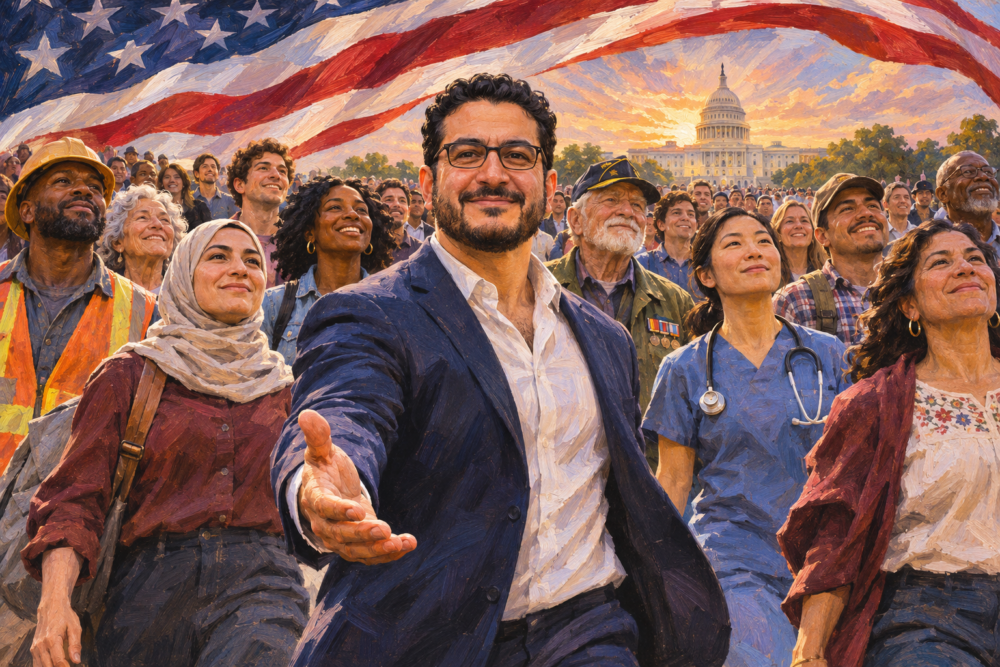
An Editorial illustration that captures the hope his victory speech stirred: that a divided nation can find common purpose while making room for every American.
At a time of deep division, America needs leaders who can build bridges, restore a sense of belonging, and turn the promise of equality into everyday reality.
By: YA LIBNAN EDITOR
Listening to Michigan Senator-elect Abdul El-Sayed’s victory speech, I found myself thinking of Dr. Martin Luther King Jr.
I heard gratitude for America, faith in its possibilities, and a determination to extend those possibilities to people still waiting for their share. What moved me was the sense that public office, for this man, represents a responsibility larger than the office itself.
One sentence captured it: “I love America enough to ask her to be America for all her kids.”
Those words carried special weight because of what he had endured. President Donald Trump portrayed him as a terrorist and compared him to the September 11 hijackers. Campaigning alongside Mike Rogers, Senator John Kennedy said El-Sayed sleeps “in a bin Laden jersey.” Senator Ted Cruz called him a “jihadist leprechaun” and warned that his election could put American lives at risk.
These attacks sought to cast an American seeking public service as a threat to his own country. His policies deserved scrutiny; his Muslim faith was no reason to question his right to belong.
After all of that, he stood before his supporters and spoke about how much he loved America. He acknowledged the opportunities it had given him and asked that its promise reach every child. That is what made his declaration so moving to me. He could distinguish the country he loved from the politicians who had attacked him.
Such a response offers something a divided America badly needs: the possibility of answering exclusion with a broader vision of belonging. Gratitude for what a country has given us can inspire a lifelong obligation to help it serve others.
For me, that was the echo of King’s dream: the conviction that America’s founding promise belongs to everyone, and that loving this country means working to make that promise real.
The urgency of unity
America desperately needs that spirit today.
Too many political conversations begin by questioning another American’s loyalty. Too many disagreements end with people treating one another as enemies. Families struggle to speak across political differences, while leaders discover that outrage brings attention more quickly than patient problem-solving.
Yet a Republican parent worried about paying for medicine and a Democratic parent facing the same bill share an urgent concern. An independent worker afraid of losing a job needs an answer, regardless of which party offers it. A struggling business owner needs customers, stability, and a fair opportunity to succeed.
Their lives cannot remain secondary to an endless contest of political retaliation.
An election gives its winners authority and responsibility. They must serve the people who opposed them as well as those who cheered them. The opportunity after victory is to widen the circle of trust.
El-Sayed should make that obligation central to his service.
Building beyond agreement
His willingness to speak to audiences outside his political base offers a useful starting point. Appearing on Fox News means addressing Americans whose assumptions and priorities may differ sharply from his own.
That willingness matters. A leader who wants to bring people together must be prepared to listen where agreement is uncertain.
The coalition principle El-Sayed has invoked—associated with civil rights activist Bernice Johnson Reagon—recognizes that broad alliances require people to work through discomfort. Cooperation asks something of everyone.
Americans can disagree about taxes, healthcare, immigration, or foreign policy while accepting one another’s equal place in the country. They can argue vigorously and still protect the institutions that allow those arguments to be settled peacefully.
A unifier must defend that space. He must also recognize that people outside his coalition have legitimate concerns deserving a serious response.
From inspiration to service
I do not know what El-Sayed will ultimately accomplish. No victory speech can establish a legacy, and the comparison with King carries a responsibility that eloquence alone cannot fulfill.
He answered his opponents sharply in the speech, too. Being a unifier does not require silence in the face of bigotry. It requires defending equal citizenship while keeping open the possibility of working with people who disagree. The challenge ahead is to carry that generosity into office, especially when he faces resistance.
Will he listen to constituents who distrust him? Will he seek workable agreements without surrendering his principles? Will he challenge divisive language among his own supporters? Will families experience improvements they can recognize in their daily lives?
These are the measures that will give his words lasting weight.
What I heard nevertheless gave me hope. He spoke as someone who understands that America helped shape his life and who wants that opportunity extended to others. His account of gratitude and belonging reached me personally.
My impression was of a man who sees a Senate seat as a means to pursue change. He now has the opportunity to demonstrate the patience, humility, and persistence that change requires.
America needs leaders capable of helping its people see a shared future. It needs conviction joined to generosity, and ambition directed toward public service.
In El-Sayed’s words, I heard an echo of Dr. King’s dream. My hope is that his service will help more Americans feel they belong within it.
