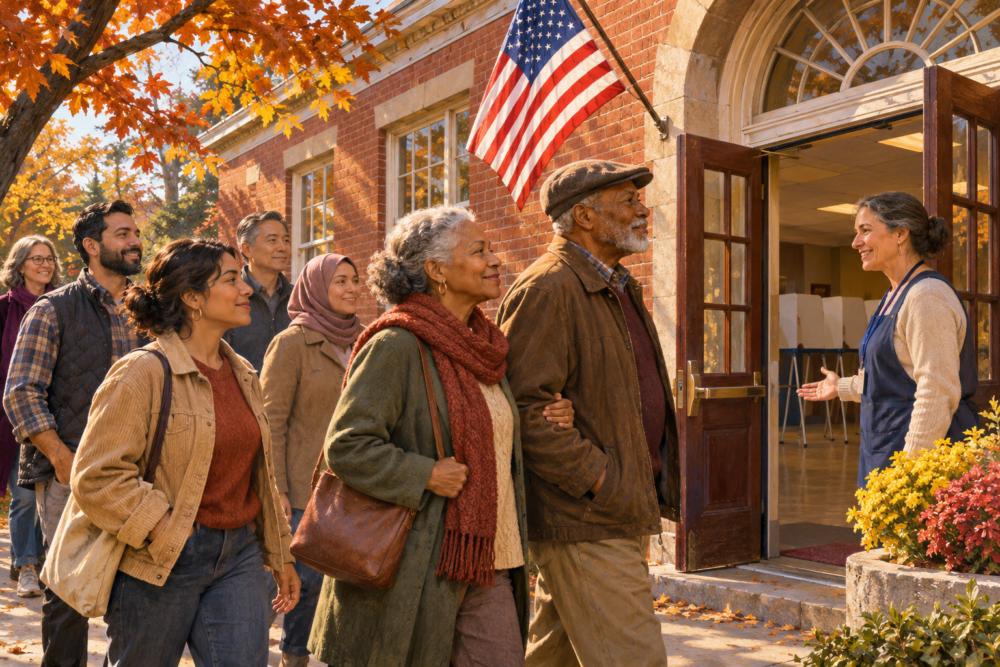
Editorial illustration- Different birthplaces. Equal citizenship. The same right to vote without fear.
Naturalized Americans have the same voting rights as every other citizen. No eligible voter should have to choose between exercising that right and feeling safe.
By: Ya Libnan Editorial Board
An American citizen should approach a polling station thinking about the country’s future—not wondering whether armed immigration officers will question their right to be there.
Yet, on the eve of the November 3 midterm elections, some Americans born outside the United States are expressing precisely that fear.
Their concern deserves a clear response from public officials: every eligible citizen has the right to vote free from intimidation. Citizenship does not become less valid because someone speaks with an accent, has a foreign-sounding name, or was born somewhere else.
Reporting by Australia’s ABC Four Corners describes election officials preparing for possible federal intervention. In Denver, chief election official Paul López has raised concerns about armed immigration agents appearing at polling places and emphasized his responsibility to protect voters. The administration’s unwillingness to categorically rule out deployments has intensified those concerns. However, the possibility of deployment must not be confused with confirmation that agents will appear at particular polling stations.
That distinction matters. Responsible journalism must inform citizens without spreading rumors that could frighten them away from voting.
The same responsibility applies to advice circulating that naturalized citizens should bring passports because their driver’s licenses might not suffice.
Here, two different issues are being confused.
A driver’s license generally does not establish American citizenship. But it may satisfy a state’s voter identification requirements. Those requirements vary by state. There is no nationwide rule requiring naturalized citizens to present a passport when casting their ballots. Voters should consult their state or local election office for the identification required where they vote.
Citizens who already have a U.S. passport may choose to carry it for reassurance. That personal choice must never be presented as a universal condition for voting. An eligible voter without a passport should not assume that the ballot box is closed to them.
The larger issue is the atmosphere surrounding this election.
When citizens fear that exercising a constitutional right could expose them to harassment, public officials have a duty to address that fear. A democracy cannot be satisfied merely because polling stations remain open. Citizens must be able to enter them without threats or coercion.
Federal law prohibits voter intimidation, including intimidation by government officials. Separate federal restrictions address the deployment of troops or armed personnel under federal authority at election sites. A badge does not place anyone above these protections.
Election security and voter protection belong together. Enforcing legitimate election rules should strengthen public confidence. Using the suggestion of armed intervention to make lawful voters afraid would undermine it.
For citizens heading to the polls, preparation is more useful than panic.
Check your polling location, opening hours, and state identification requirements. If someone interferes with your ability to vote, alert a poll worker. Election Protection offers assistance at 866-687-8683, with Arabic assistance available at 844-925-5287. If your eligibility is challenged, ask about a provisional ballot and the steps required for it to count. If you are in line when polls close, remain there: eligible voters already in line have the right to vote.
The president and his administration should make an unequivocal public commitment that federal authority will never be used to intimidate eligible voters. Leaders of both parties should insist on the same standard.
Americans can disagree fiercely about immigration, border enforcement, and the direction of the country. None of those disagreements justifies treating naturalized citizens as lesser Americans.
Their citizenship is real. Their vote is theirs. Their right to exercise it must be protected.
Tomorrow, America must demonstrate that the ballot belongs equally to every eligible citizen—and that fear has no place at the polling station.
