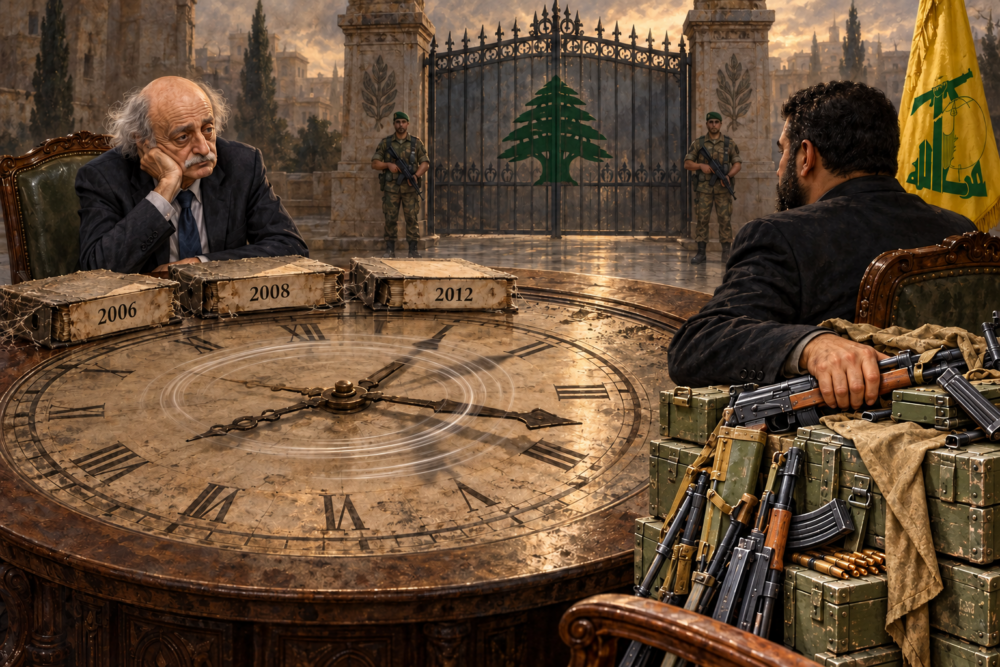
Editorial illustration – Twenty years of dialogue. The clock keeps turning, Hezbollah keeps its weapons, and Lebanon’s state authority waits at the gate.
Lebanon needs a timetable for implementing state authority over weapons. Another open-ended discussion risks giving Hezbollah more time
By: Ali Hussein, Political analyst , Opinion
Walid Jumblatt is again calling for dialogue over Hezbollah’s weapons. His concern about civil conflict is understandable. Lebanon has suffered enough, and no responsible leader should casually contemplate another confrontation among Lebanese.
But after twenty years of discussions that failed to secure Hezbollah’s disarmament, proposing another national dialogue requires answering a basic question: What will make this time different?
Jumblatt supports exclusive state control over weapons and acknowledges Iran’s decisive influence over Hezbollah. The disagreement concerns how Lebanon reaches that goal—and whether another political conference will advance it or postpone it.
The record offers little reassurance.
In March 2006, Lebanese leaders gathered for a national dialogue that included Hezbollah’s arsenal and a national defense strategy. In July, Hezbollah launched the cross-border raid that triggered a devastating war with Israel. UN accounts confirm that its fighters crossed into Israel, killed three soldiers and captured two. While politicians discussed defense, Hezbollah retained the power to initiate hostilities.
In May 2008, Hezbollah turned its weapons against domestic opponents. The subsequent Doha Agreement helped end the immediate crisis and established a unity cabinet in which the opposition received 11 of 30 seats. It also included a commitment against using weapons for political gains.
Those achievements mattered. Stopping bloodshed matters. But Doha left Hezbollah armed while giving its political camp a blocking third in government. Crisis management had failed to produce disarmament.
The June 2012 Baabda Declaration provided another test. It committed Lebanon to distancing itself from regional conflicts, supporting state institutions and preventing its territory from becoming a route for weapons and fighters.
Hezbollah subsequently openly fought alongside Bashar al-Assad’s forces in Syria. In May 2013, the UN secretary-general expressed concern about its increased participation and urged renewed adherence to Baabda. The gap between agreement and conduct could hardly have been clearer.
Lebanon’s problem has therefore been enforcement. Its leaders have repeatedly found language they could endorse while Hezbollah preserved the military independence those agreements were supposed to constrain.
The government has now moved beyond discussion. In August 2025, it instructed the army to prepare a plan for a state monopoly on weapons. On March 2, 2026, it banned Hezbollah’s military and security activities and required the organization to surrender its weapons while retaining a political role.
Reopening the principle for negotiation risks making those decisions conditional on Hezbollah’s approval.
Former lawmaker Fares Souaid argues that the decisive authority lies in Tehran. That is his assessment, but it raises an unavoidable question: What can another Lebanese conference deliver if Hezbollah’s strategic choices remain tied to Iran?
President Joseph Aoun and Prime Minister Nawaf Salam should establish a public timetable, measurable stages for transferring weapons, army verification and judicial consequences for obstruction or illegal armed activity. International partners should provide the army with the resources needed to carry out that responsibility.
Practical discussions can help arrange safe handovers, protect communities and prevent violence. Their purpose must be implementing state decisions, with clear deadlines and accountability.
Israel must also withdraw from Lebanese territory and respect Lebanon’s sovereignty. Its obligations remain binding. They cannot give Hezbollah an indefinite entitlement to maintain an independent army.
Lebanon’s Shiite citizens deserve security, reconstruction and full political participation. Their rights must be protected throughout this process. No community should be treated as collectively responsible for a party’s decisions.
Jumblatt is right to fear another civil war. But lasting peace requires ending the arrangement that allows one faction to possess weapons beyond public control.
Twenty years of dialogue have left that fundamental imbalance intact.
Lebanon has already stated the principle: the state alone controls weapons and decides war and peace.
Its leaders must now make that principle a reality.
