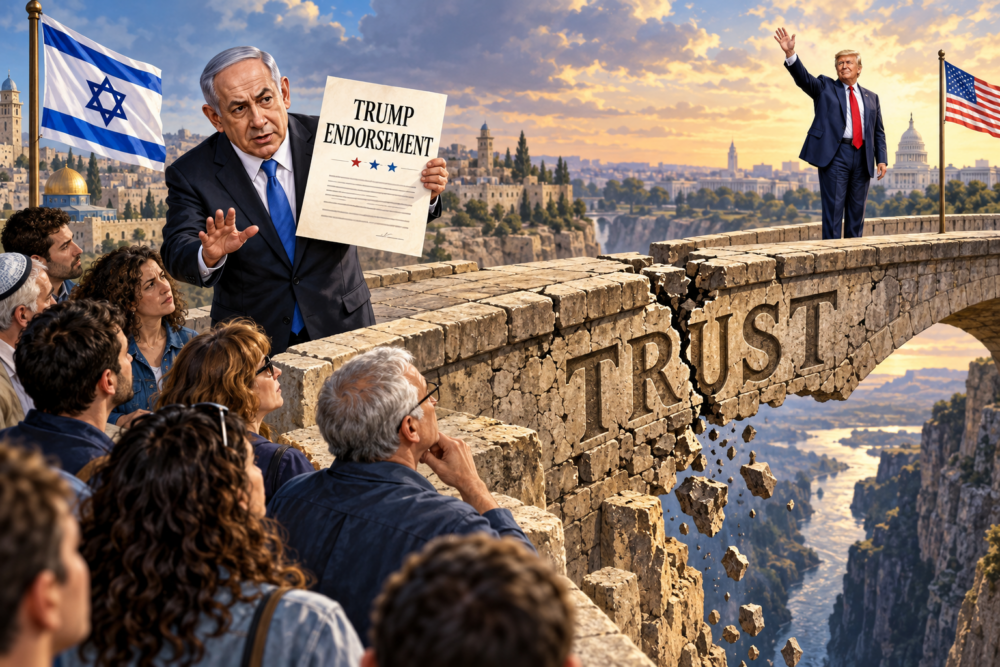
Photo illustration- “Trump’s endorsement reaches Netanyahu across a bridge of trust weakened by uncertainty.”
Public praise cannot erase private doubts—or restore the credibility of an increasingly unpredictable ally.
By: Vlad Green, Opinion
President Donald Trump has endorsed Benjamin Netanyahu for another term. But an endorsement carries only as much weight as the credibility of the leader delivering it—and Trump’s standing among Israelis has weakened.
That is why his intervention may prove too little, too late. The issue goes beyond its arrival nine days before Israel’s October 27 election. Netanyahu is seeking reassurance from a president whose policy reversals have raised questions about his reliability—and who has reportedly expressed serious reservations about Netanyahu himself.
Reuters reports that Israeli public support for Trump has diminished amid disagreements over Iran. For Netanyahu, who has promoted his relationship with the American president as a strategic advantage, that decline presents a problem. A relationship with Washington has less electoral value when voters question what Washington’s promises are worth.
The contradiction becomes sharper when Trump’s public praise is placed alongside his reported private judgments.
In August, Axios reported that Trump had called Netanyahu “his own worst enemy.” The Times of Israel’s account of that reporting described American frustration with Netanyahu’s decisions concerning Iran, Lebanon and Gaza. Axios separately reported private criticism over October 7 failures and Netanyahu’s effect on Israel’s reputation.
These reports do not establish that the endorsement is fake. Trump can support Netanyahu while doubting aspects of his leadership. Political endorsements often involve compromise, calculation and a preference among imperfect alternatives.
But those reservations cannot simply be erased by an enthusiastic statement of support.
Has Trump reassessed Netanyahu’s judgment? Have their disagreements been resolved? Or has he concluded that backing a familiar partner serves his immediate political and diplomatic interests?
The endorsement alone does not answer those questions.
For Israeli voters, the issue is practical: Does today’s public embrace offer any confidence about tomorrow’s decisions? A letter of support cannot guarantee that Washington will maintain its position when the next disagreement emerges.
Doubts about Trump’s reliability were visible well before this election’s final days.
In its June 2026 national security survey, Israel’s Institute for National Security Studies reported that 66 percent of respondents considered the U.S.-Iran memorandum of understanding detrimental to Israel. Only 12 percent believed Trump was highly committed to protecting Israel’s security interests.
Those findings are not an October voting forecast. They nevertheless show that substantial doubts about Trump’s commitment existed months before he endorsed Netanyahu.
An Israeli voter can appreciate American military assistance while questioning American diplomatic decisions. Gratitude for past support does not require unquestioning confidence in future promises.
Governments have legitimate reasons to change policies. Diplomacy requires flexibility, and allies will sometimes disagree. But changes must be explained through a coherent strategy. Partners need to know which commitments remain dependable when circumstances change.
When policy appears to turn on personal relationships, negotiating convenience or a leader’s shifting preferences, allies have reason to worry. Public praise offers little protection against the next reversal.
Netanyahu’s access to Trump may therefore demonstrate influence without demonstrating security. Being able to telephone the American president is useful. Knowing what that president will stand by after the conversation is more important.
America’s partnership with Israel should also outlast any particular prime minister. It must rest on institutions, shared interests and durable commitments. Israeli voters should remain free to choose their government without confusing loyalty to Netanyahu with continued friendship with the United States.
Netanyahu, meanwhile, must answer for his own performance. Neither Trump’s endorsement nor his reported private criticism should replace the judgment of Israelis who have lived through the consequences of their government’s decisions.
The endorsement could still help Netanyahu rally supporters. In a close parliamentary election, even a modest shift can matter. It would be premature to dismiss its influence or declare Netanyahu defeated.
But it would be equally premature to call it a political rescue.
Netanyahu is asking voters to place confidence in a relationship marked by public disagreements and reported private doubts. Trump is offering reassurance after some Israelis have begun questioning his own dependability.
That is why “too little, too late” is about more than the campaign calendar. It is about the erosion of the trust that once made such an endorsement valuable.
The endorsement is real. Its power to restore confidence is uncertain.
Trust cannot be rebuilt by a letter of support. It requires consistent conduct—and commitments that remain dependable after the campaign applause ends.
