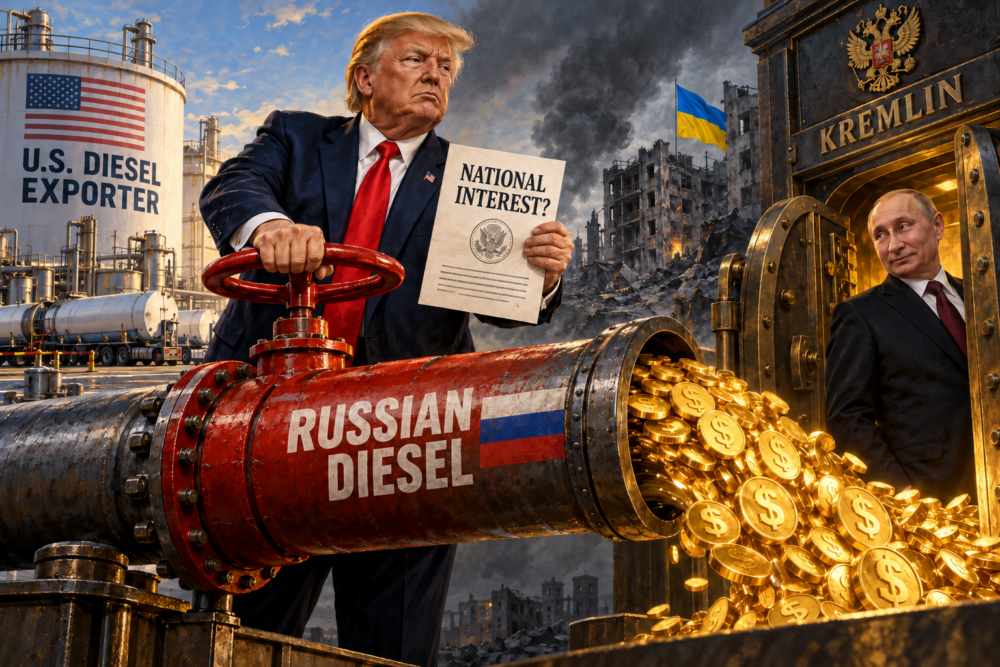
Editorial illustration – “Russia gains revenue. America deserves an explanation: whose national interest?”
America exports far more diesel than it imports. The president must explain why easing pressure on Putin serves Americans better than enforcing sanctions.
By Vlad Green, Opinion
When a president invokes America’s national interest, Americans are entitled to ask a straightforward question: What, exactly, does our country gain?
President Donald Trump’s decision to waive major provisions of newly enacted Russia sanctions makes that question urgent.
On October 16, Trump issued an executive order waiving major sanctions, restrictions and duties under the Graham Act, legislation he signed less than a month earlier. Section 115 authorizes such waivers, subject to a written certification to Congress that they serve the national interest and a report explaining why. Trump’s order states that these documents have been submitted.
The distinction matters. Congress gave the president waiver authority. Exercising it does not automatically mean he broke the law.
But legal authority does not establish sound judgment. Nor does writing “national interest” explain whose interests a decision actually advances.
The waiver follows Trump’s arrangement permitting Russian diesel sales. The administration presents that arrangement as a way to ease energy prices. Yet America is a major diesel exporter.
For the week ending October 9, the Energy Information Administration reported American distillate exports of approximately 1.37 million barrels a day, compared with imports of about 145,000 barrels a day. Distillate fuel includes diesel and heating oil. Exports exceeded imports by roughly nine to one.
Americans understand that exporting countries also import. Geography, transportation costs and regional supply needs explain why fuel moves in both directions. But those practical arrangements do not establish dependence on Russian diesel.
The administration’s strongest possible argument is therefore about global prices: allowing additional Russian fuel onto world markets might reduce costs elsewhere, including America.
That argument deserves examination. It requires evidence.
How much additional supply will reach the market? How much will American consumers save? For how long? And how do those savings compare with the security cost of increasing Russia’s income?
A bipartisan group of twelve senators has already challenged the premise. In an October 13 letter, they argued that the diesel arrangement would provide limited or no relief to Americans while generating revenue for Russia’s war against Ukraine. Their signatories included Republicans Thom Tillis, Susan Collins, Lisa Murkowski, Mitch McConnell and John Cornyn, alongside Democratic colleagues.
This is a question of American security that crosses party lines.
Sanctions are intended to make aggression more costly. Relieving that pressure should secure something substantial in return. The administration should identify any verifiable Russian concessions and explain why the expected benefits justify its decision.
Americans should not have to guess what bargain was made in their name.
Congress should obtain and scrutinize the waiver justification, examine the diesel negotiations and require officials to defend their price claims publicly. It should investigate whether any private financial interests influenced the arrangements, without prejudging what that investigation will find.
If lawmakers believe the waiver defeats the legislation’s purpose, they should consider narrowing that authority and requiring stronger conditions for future relief.
Calls for impeachment require a separate evidentiary judgment. A damaging policy decision is not, by itself, proof of corruption or a grave abuse of office. But that distinction cannot become an excuse for congressional passivity.
Oversight is how Congress determines whether misconduct occurred.
America’s credibility also carries a cost. When Washington legislates pressure on an aggressor and then suspends it, allies need to understand the strategy. Otherwise, they are left questioning whether American commitments will survive the next presidential announcement.
The immediate benefit to Moscow is easier to identify than the promised benefit to American households.
President Trump owes the country a convincing explanation of that imbalance.
America’s national interest must be demonstrated through results, security and public accountability. It cannot be established by presidential declaration alone.
