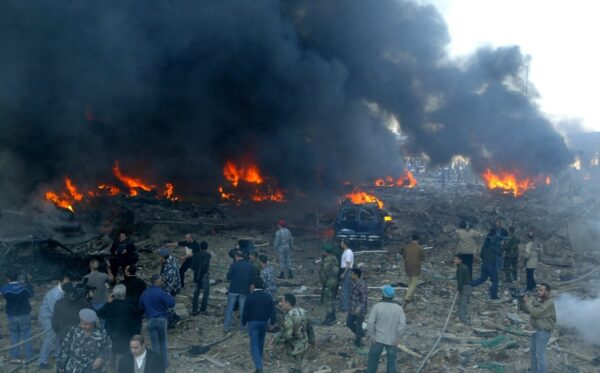
Former Lebanese PM Rafik Hariri was assassinated in downtown Beirut on February 14, 2005. Three Hezbollah operatives Habib Merhi, Hussein Oneissi, and Salim Ayyash were convicted and sentenced to life by a UN-backed Special Tribunal for Lebanon (STL) but Hezbollah refused to hand them over to the court. The explosives used were identical to those confiscated by the Lebanese security forces
- Summary
- Lebanon’s government has sought to control weapons flow
- Hezbollah military activities banned after rockets hit Israel
- Iran-backed group asks for explosives to be returned
- MP Gemayel is convinced that the explosives are to be used for assassinations like in 2005 and. 2006
BEIRUT, Oct 15 (Reuters) – A Hezbollah lawmaker said on Thursday that the hundreds of kilograms of explosives seized last week by Lebanese security forces belonged to his group, as tensions persist over the government’s push to disarm the Iran-backed movement.
Lebanese authorities stopped the explosives-laden vehicle at a checkpoint in the eastern Bekaa region last week and arrested two people in the car. Both were members of Hezbollah and one was the soon a of a top Hezbollah politician
At the time, authorities did not say who the vehicle belonged to, prompting widespread worry in Lebanon that the explosives were intended for car bomb assassinations or other destabilising attacks inside the country.
Speaking to reporters at the Lebanese parliament on Thursday, Hezbollah lawmaker Hassan Fadlallah claimed that Hezbollah had intended to use the explosives against Israel, whose troops are occupying swathes of Lebanese territory seized in this year’s war.
PRESIDENT CALLS FOR ISRAELI COMPLIANCE
A Hezbollah official and a Lebanese security source told Reuters that the explosives seized in the car last week were intended to be used in explosive drones targeting Israeli troops.
Fadlallah said Hezbollah had immediately contacted security agencies to clarify that it owned the vehicle and the cargo, and to demand the materials be returned and those detained be released.
Fadlallah’s acknowledgment reflects Hezbollah’s efforts to continue transporting weapons across Lebanon despite the government’s vow to bring all arms in the country under state control.
On March 2, the government specifically banned Hezbollah’s military activities, hours after the movement launched rockets at Israel to back up Tehran, pulling Lebanon into the regional war begun by US and Israeli strikes on Iran.
The government decision was an attempt to reverse the relative freedom Hezbollah had enjoyed for years in transporting military equipment across Lebanon.
The group’s main arms supply route through Syria was severed when its ally, then-president Bashar al-Assad, was ousted in late 2024. The new Syrian authorities have regularly announced seizures of weapons along their border with Lebanon that they say are intended for Hezbollah.
Throughout 2025, Lebanese troops seized and destroyed Hezbollah weapons depots in southern Lebanon in line with the government’s plan to exert state control over all weapons, but that roadmap was put on pause when the new war erupted.
President Joseph Aoun told US Secretary of State Marco Rubio in a telephone call on Thursday that the Lebanese army and security forces were fully carrying out decisions to prevent armed displays, confiscate weapons and ammunition, and combat smuggling, the presidency said.
Aoun said recent measures taken by the security services fell within that effort, and said judicial authorities would pursue all cases referred to them, with no leniency for offenders.
Under a deal reached through US-brokered talks between Lebanon and Israel this year, Beirut has vowed to disarm Hezbollah, which would in turn lead to Israeli troops gradually withdrawing from Lebanon.
But Hezbollah has refused to disarm as long as Israeli forces remain on Lebanese land and Israel has continued carrying out strikes across southern Lebanon. Israel says its actions in the area are aimed against Hezbollah.
Aoun asked Rubio to pressure Israel to halt what the presidency described as attacks on southern Lebanese towns and villages, comply with the framework agreement, stop bulldozing work and allow farmers to reach their land without being targeted, the presidency said
More on the seizure of Explosives
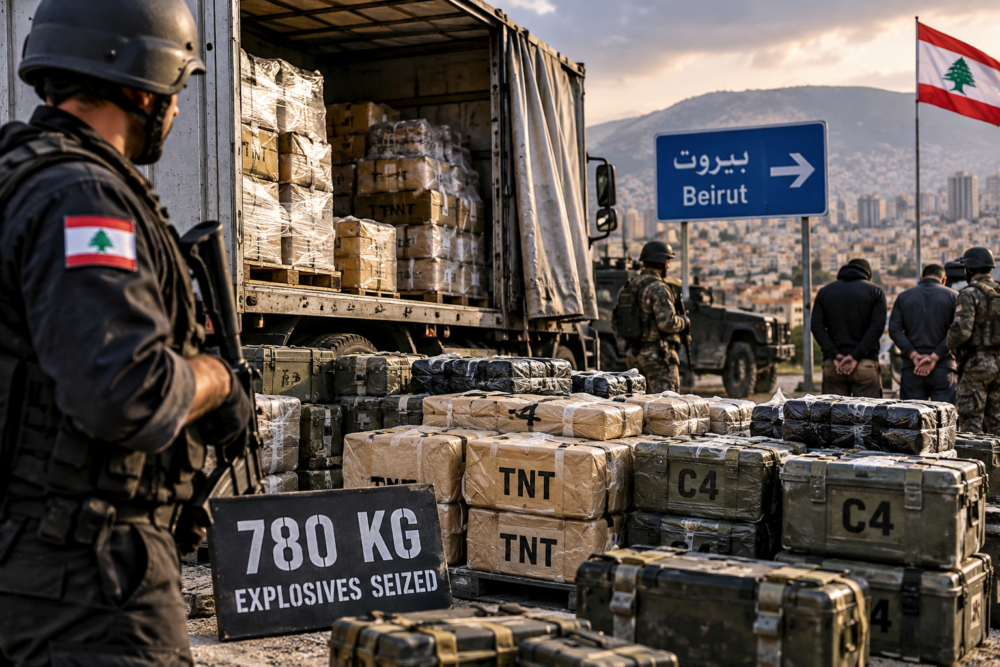
The Seizure: On October 5, 2026, Lebanese Internal Security Forces stopped a vehicle at the Dahr al-Baidar checkpoint on the Bekaa–Beirut highway and confiscated roughly 780 kg (1,720 pounds) of explosives, including 250 kilograms (550 pounds) of TNT and 250 kilograms (550 pounds) of C4 plastic explosives, judicial officials told AP
The Lebanese army said that troops seized also another shipment of explosives weighing 200 kilograms (440 pounds) as it was being smuggled from Syria into the northeastern Lebanese border town of al-Qasr.
Kataeb Party leader Sami Gemayel demanded that the Lebanese state immediately dismantle Hezbollah’s military and security infrastructure following the seizure of a major explosives shipment linked to the group
Writing on X (formerly Twitter), Sami Gemayel warned that the explosives were likely intended to fuel a new wave of political assassinations similar to those that targeted Lebanon between 2004 and 2008
Historical Comparison: Gemayel explicitly drew parallels to the February 14, 2005, truck-bomb assassination of former Prime Minister Rafic Hariri, arguing that failing to intercept hidden explosives allows terrorism and political violence to destabilize civil peace
Call to Action: Gemayel urged the Lebanese government to stop delaying the enforcement of the law and immediately dismantle Hezbollah’s armed apparatus.
Hezbollah has repeatedly threatened Lebanese Prime Minister Nawaf Salam and President Joseph Aoun as tensions over the group’s weapons and disarmament escalated throughout 2026
2004–2006 marked a broader wave of political bombings and assassination attempts targeting anti-Syrian and anti-Hezbollah figures in Lebanon (including the 2004 attempt on Marwan Hamadeh and the 2005 killings of PM Rafik Hariri , Samir Kassir, George Hawi, and Gibran Tueni and several others
Lebanon will carry out a thorough investigation to track down the suspected members of the militant Hezbollah group believed to be linked to an explosives-laden truck intercepted at the Dahr al-Baidar checkpoint last week, PM Nawaf Salam said on Monday.
REUTERS/ YL
