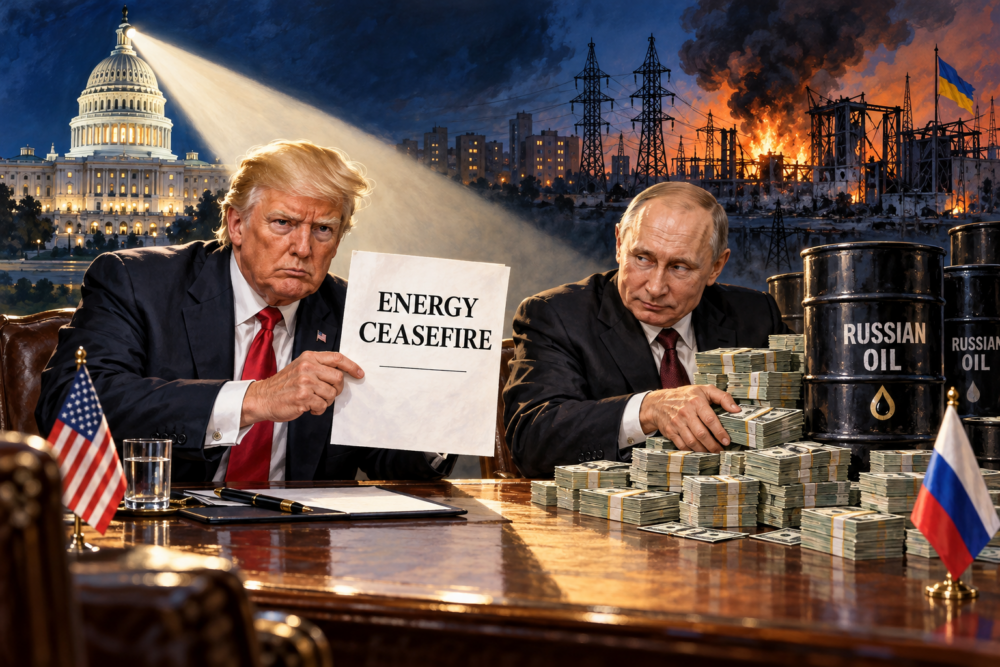
Editorial illustration-“Congress must shine a light on what America gives—and what Putin delivers.”
An announced ceasefire without confirmed commitments, concessions to Moscow and mounting pressure on Ukraine demand urgent congressional scrutiny.
By Vlad Green, Opinion
President Donald Trump announced an immediate energy ceasefire between Russia and Ukraine. Yet Ukraine’s president needed clarification about the agreement, and Russian attacks on Ukrainian energy infrastructure continued.
Congress must establish what happened—and what American policy toward Vladimir Putin is intended to accomplish.
On October 11, Trump publicly presented an energy ceasefire as an agreement already reached. Zelensky’s response indicated that Kyiv had not been informed of the arrangement Trump announced.
That discrepancy demands an explanation.
What exactly had Russia accepted? Did the arrangement protect electricity grids and power stations, oil refineries, or all energy infrastructure? When was it supposed to begin? Who would verify compliance? What consequences would follow violations?
These are the essential terms of any meaningful agreement. Without them, a presidential announcement offers civilians little protection.
Reuters reported continued Russian attacks on Ukrainian energy facilities after Trump’s declaration. Moscow described discussions about a possible energy arrangement as ongoing. That leaves a fundamental question: why did the American president announce an accomplished agreement while its terms and acceptance remained unresolved?
The stakes extend beyond another unsuccessful diplomatic announcement.
Days earlier, Trump unveiled a diesel arrangement easing sanctions pressure on Russia. His administration defended it as a way to reduce American fuel costs, while pressing Ukraine to stop attacking Russian refineries.
Americans deserve affordable energy. They also deserve to know what Moscow must deliver in exchange for economic relief.
If Russian diesel gains greater access to international markets, what enforceable commitments protect Ukraine? If Russia continues attacking Ukrainian power stations, does the relief stop? What prevents additional Russian energy revenue from supporting its war effort?
Congress should demand the documents that answer those questions.
A reciprocal energy ceasefire could save lives and preserve essential infrastructure. But reciprocity must exist in practice. An arrangement that restrains Ukrainian attacks on Russian refineries while leaving Ukraine’s electricity system exposed would grant Moscow a substantial advantage.
Congress must determine whether Washington secured mutual protection—or offered concessions before securing Russian commitments.
American credibility is also at stake.
When a president declares that both sides have agreed, allies should be able to rely on that declaration. If attacks continue and Washington cannot explain what was promised, its assurances lose authority.
Other adversaries are watching. They will draw conclusions about whether American demands carry consequences and whether American concessions require anything in return.
This is why an investigation should examine Trump’s dealings with Putin directly.
That does not require assuming a hidden bargain, financial wrongdoing or secret influence. An investigation should establish facts, including facts that support the administration’s explanation.
But Congress cannot accept presidential confidence as a substitute for evidence.
Relevant committees should obtain the records of recent communications with Russian officials, the written terms and legal justification of the diesel arrangement, and the assessments supporting the energy ceasefire announcement. They should hear from the officials who negotiated these measures and determine whether national security warnings were considered.
Where evidence raises potential conflicts of interest involving decision-makers or intermediaries, those questions should be examined too.
Sensitive information can be reviewed in closed session. The public should receive the fullest findings consistent with protecting legitimate national security interests.
The inquiry must also assess results. How much economic benefit could Russia receive? What relief can American consumers reasonably expect? What commitments did Putin make, and which has Russia fulfilled?
Republicans and Democrats should insist on the same answers.
Congressional oversight is a responsibility to the American people. It becomes especially important when a president offers an adversary economic benefits while announcing commitments that remain publicly unverified.
The administration should have every opportunity to explain its strategy. If the diesel deal and energy diplomacy advance American security, the evidence should demonstrate how.
If they strengthen Russia without obtaining meaningful restraint, Congress must use its legislative and oversight powers to change course.
The issue is larger than whether Putin has embarrassed Trump. It is whether American policy is rewarding an adversary while weakening confidence in America’s word.
This is a crisis of American credibility. Congress must act.
America’s credibility belongs to its people. Its president must answer for how he uses it.
