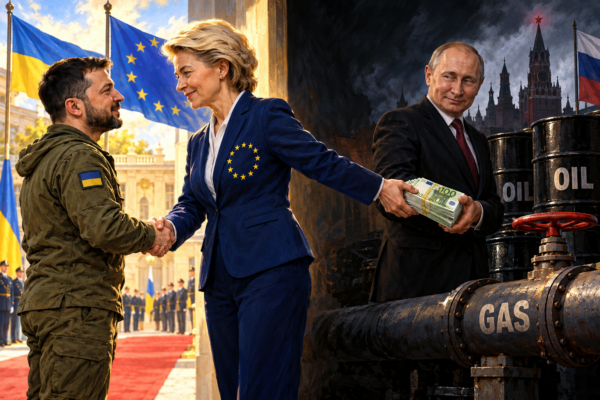
EDitoria illustration – A handshake for Zelensky. Energy payments for Putin. Europe must stop financing the war it condemns.
Europe cannot keep supporting Ukraine while purchasing energy that sustains Russia’s war machine. The time to stop is now.
By Vlad Green, Opinion
Europe condemns Russia’s invasion of Ukraine, pledges solidarity with its victims and insists that aggression must not pay. Yet European buyers continue paying for Russian energy. That is hypocrisy par excellence.
On October 12, Russian Deputy Prime Minister Alexander Novak claimed that Russia had supplied European Union countries with $320.7 billion worth of energy resources since 2022, including $21.3 billion in the first nine months of 2026. These are Moscow’s figures and must be identified as such, rather than presented as independently audited accounts.
But Europe cannot dismiss the underlying contradiction as Russian propaganda. Independent research documents the continuing trade.
Urgewald’s analysis of shipment data found that the EU received 98 percent of Yamal LNG exports reaching their final destination during January–April 2026. Volumes were 17.2 percent higher than in the same period of 2025. The organisation estimated the cargoes’ value at €3.88 billion, using benchmark prices rather than confidential contract prices.
Europe was still serving as the overwhelming market for a major Russian energy project, more than four years after the full-scale invasion.
France deserves particular scrutiny. France, Belgium and Spain were the largest destinations for Yamal LNG deliveries in the first half of 2026. French declarations of solidarity with Ukraine sit uneasily beside that trade.
Precision matters: this does not establish that France was Europe’s largest buyer of every Russian hydrocarbon over the entire war. Hungary, for example, was the EU’s largest overall Russian fossil-fuel buyer in CREA’s June 2026 assessment. Nor does a cargo arriving at a French or Belgian terminal necessarily remain in that country. Gas moves through Europe’s interconnected network.
Those distinctions spread responsibility across the European market. They do not erase it.
Not every euro paid to a Russian energy company goes directly into a missile. But export earnings sustain the economy from which Moscow draws taxes, foreign exchange and resources for its war. Europe cannot credibly seek to weaken Russia’s war-making capacity while continuing to sustain a major source of Russian income.
Europe’s substantial assistance to Ukraine deserves recognition. It also makes this contradiction harder to defend. European taxpayers help Ukraine withstand destruction while European energy purchases help sustain the country inflicting it.
The familiar explanations are contracts, exemptions, energy security and transition periods. Governments must protect households and industry from shortages. But after years of war, these explanations demand scrutiny rather than automatic acceptance.
The EU has adopted a phaseout: Russian LNG imports under existing long-term contracts are scheduled to end on January 1, 2027, with pipeline gas following in autumn 2027. That is progress. It is also an admission that this dependence must end.
The demand now should be to accelerate the remaining phaseout wherever replacement supplies permit, enforce the restrictions already in force and publish the contracts and exemptions that continue sending revenue to Russia. Emergency exceptions must remain narrow, transparent and temporary.
Europe must also make Russia bear more of Ukraine’s costs. Approximately €210 billion in Russian central-bank assets are immobilised in the EU. Extraordinary revenues from those holdings already support Ukraine. Mobilising the underlying assets through a durable legal mechanism would be a further step.
But frozen assets cannot become an excuse to keep buying Russian energy. Europe must address both sides of the ledger: more resources for Ukraine and fewer revenues for Moscow.
The same gap between declarations and effective action appears in maritime security.
Hormuz and Bab al-Mandeb are arteries of international commerce. Europe’s prosperity depends on shipping lanes that cannot be subjected to coercion, unlawful tolls or attacks on civilian vessels.
Europe is not absent. Its ASPIDES operation provides defensive maritime protection around the Red Sea and Bab al-Mandeb. On October 12, EU foreign ministers again called for restored freedom of navigation and discussed strengthening that mission.
Nevertheless, declarations must be matched by ships, capabilities, coordination and sustained political resolve. A European Parliament briefing on the March summit recorded leaders’ rejection of demands to help unblock Hormuz during the hostilities, while several countries expressed readiness to contribute once fighting had stopped and other conditions were met.
Governments may disagree with how a war began. They still have a responsibility to help protect lawful commercial navigation. That responsibility calls for a credible defensive strategy, diplomacy and practical cooperation.
A bloc that speaks as a strategic power must act with the resources and resolve of one. Otherwise, it risks looking like a paper tiger: economically formidable, politically hesitant and unable to translate its principles into sufficient action.
Europe should judge its policy by results: less revenue sustaining Russia’s war, stronger Ukrainian defences and safer international shipping.
Ukraine needs solidarity that survives commercial inconvenience. European citizens need leadership that protects their security.
The time to stop financing the war Europe condemns is now.
