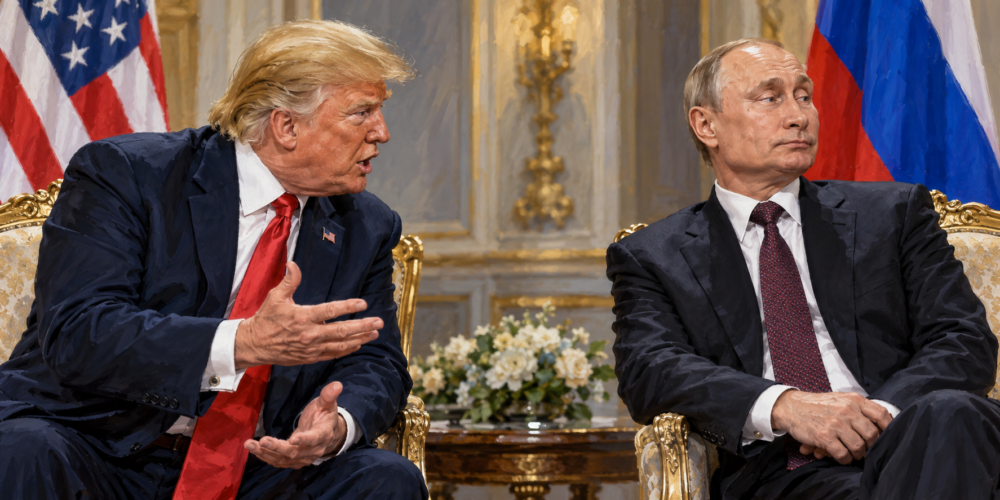
Photo illustration – US President Trump and Russian President Putin -American concessions should depend on verified results, not promises.
By rewarding Moscow before securing verifiable concessions, Trump risks turning his search for a diplomatic victory into another strategic victory for Putin.
By Vlad Green, Opinion
There is a question President Donald Trump can no longer avoid: Why does he keep giving Vladimir Putin opportunities to embarrass him?
The answer matters far beyond presidential pride. When an American president rewards an adversary before obtaining enforceable commitments, the consequences can reach allies, taxpayers and people living under bombardment.
Republican Senator Thom Tillis delivered an unusually blunt warning on Sunday, October 11: “I will guarantee you at the first opportunity Putin has to embarrass or undermine President Trump, he will.”
Tillis also questioned whether Trump’s Russian diesel agreement complies with the law. Former Vice President Mike Pence urged Trump to rescind the sanctions relief. These objections come from within the Republican political family.
Their concern deserves an answer grounded in results.
Trump’s administration says easing restrictions on Russian diesel will help lower fuel prices. Treasury Secretary Scott Bessent maintains that it has the legal authority to proceed. But analysts cited by Reuters question whether the agreement will deliver sustained price relief. [1]
Cheaper fuel would be welcome. Farmers, truckers, businesses and households have every reason to demand relief. Yet that objective does not excuse a bargain whose strategic costs may exceed its economic benefits.
Russia gains an opportunity to earn additional energy revenue. What enforceable change in Russian conduct does America receive in exchange?
That is the test Trump should meet before celebrating.
An announcement is not an achievement
Sunday provided a troubling illustration. Trump announced an immediate energy ceasefire between Russia and Ukraine. Zelensky said he was awaiting details. According to Reuters, a Ukrainian official confirmed that a Russian attack on a Kharkiv energy facility occurred after the announcement. [2]
The distinction matters. A ceasefire has value when attacks stop. Until then, the announcement creates expectations that events can quickly destroy.
If Washington grants relief while implementation remains uncertain, Moscow has less incentive to make the concessions Washington seeks. Putin can benefit from the agreement while Trump bears the political cost of defending it.
This is the central weakness in Trump’s approach: he appears too willing to count a promise as a result.
Why keep taking the risk?
We cannot establish Trump’s private motives. But we can examine the incentives and decisions in public view.
High fuel prices create pressure for a quick solution. A deal offers an announcement, a headline and a claim of progress. [1]
My judgment is that Trump’s confidence in personal bargaining compounds that pressure. He seems to believe that direct dealings with Putin can achieve what sustained economic and diplomatic pressure has not.
Personal diplomacy can be useful. It becomes dangerous when confidence replaces verification.
Once a president publicly invests his reputation in an agreement, acknowledging its failure becomes politically painful. That creates a further risk: defending a weak deal, or offering another concession, to preserve the appearance that the original bargain worked.
Putin need not share Trump’s urgency. An adversary can wait, bargain and exploit the gap between what an American president promises and what he can actually enforce.
Congress deserves more than reassurance
Seven senators, including four Republicans, issued a joint statement saying the diesel decision conflicts with Congress’s 2022 ban on Russian energy imports. They also said the administration had failed to provide the required consultation and explanation. [3]
The administration disputes the legal objection. That dispute requires scrutiny of the authority invoked and the conditions attached to it. A president’s assurance that a transaction is beneficial cannot settle whether it is lawful.
Nor should sanctions relief become a reward for merely agreeing to talk. Sanctions exist to impose a cost on conduct that the United States seeks to change. Easing them should purchase a measurable change in that conduct.
Otherwise, Washington weakens its own leverage.
Put results before rewards
Trump can change this pattern.
Any energy arrangement should have clear written terms, reciprocal obligations, independent monitoring and explicit consequences for violations. Relief should follow verified compliance, with a mechanism to restore restrictions if commitments are broken.
Ukraine must participate in decisions concerning its security. Congress must receive the legal explanation and oversight its role requires. Americans should see a credible assessment of the expected fuel-price benefit alongside the strategic cost.
These are practical negotiating requirements. They protect an agreement from becoming a public-relations victory for one side and a financial victory for the other.
The question is not whether Trump can maintain a cordial relationship with Putin. The question is whether that relationship produces results that protect American interests and help end Russian aggression.
Trump does not need another declaration of success. He needs evidence that Putin has delivered.
The way to stop Putin from embarrassing an American president is to stop rewarding him before he keeps his commitments.
SOURCES:
- Reuters: Republican criticism of Trump’s Russian diesel agreement, October 11, 2026
- Reuters: Trump announces Ukraine energy ceasefire with Russia, surprising Zelenskiy, October 11, 2026
- Senate Foreign Relations Committee: Bipartisan statement on legality of Russian diesel imports, October 11, 2026
