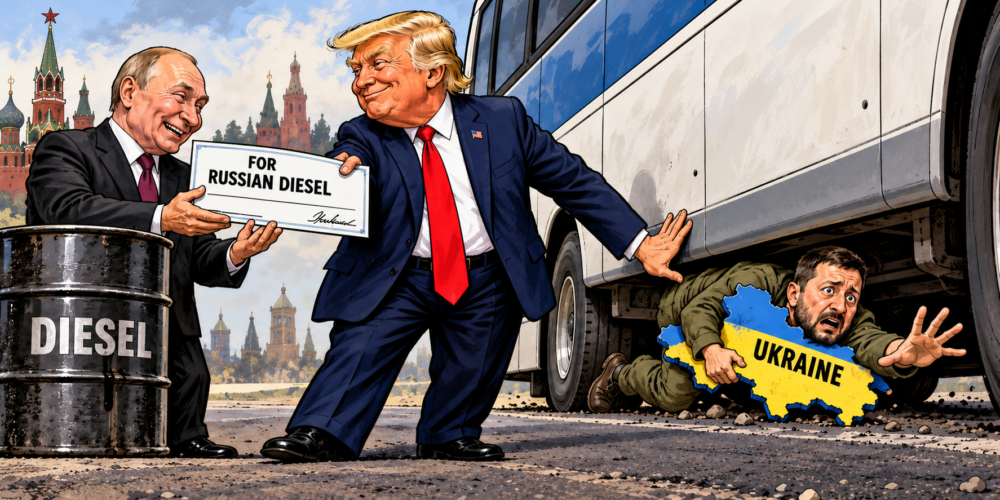
Photo illustration – Trump hands Putin a diesel deal while leaving Ukraine under the bus. An opportunity to advance peace risks adding fuel to the war.
Trump could have used access to American markets to demand an end to Russia’s war. Instead, the announced deal offers Moscow economic relief without a disclosed concession for peace—and risks adding fuel to the fire.
By Vlad Green, Opinion
There are moments when a president must decide whether to use America’s economic power to stop a war or to make a transaction.
Donald Trump’s diesel deal with Vladimir Putin raises precisely that question.
On Friday, October 9, Trump announced that Russia would supply more than 300,000 tonnes of diesel to American and global markets, with further shipments to follow. His stated objective was lower fuel prices. Treasury’s Office of Foreign Assets Control issued a license authorizing transactions involving Russian diesel.
But where was the announcement that Russia would stop attacking Ukraine?
Where was the ceasefire? Where were the enforceable commitments that would make this opening a step toward peace?
No such concession accompanied the announced diesel agreement.
That is the heart of the problem. Trump had something Putin wanted: relief from restrictions on Russian energy sales. He could have used that leverage to demand concrete progress toward ending the war. Instead, the publicly announced bargain offers Russia a commercial opportunity while leaving Ukraine’s security unresolved.
Lower diesel prices matter. Farmers need fuel to harvest their crops. Truckers need it to deliver food and goods. Families feel transportation costs at the supermarket.
But a president must consider the full price of a deal. A cheaper delivery of fuel can carry an expensive strategic consequence if it strengthens an aggressor and weakens the pressure to stop his war.
Russia’s energy sector supports the economic resources available to the Kremlin. Opening additional opportunities for Russian diesel sales risks easing the pressure that sanctions were designed to create.
We should not pretend that every dollar earned from diesel sales goes directly into a missile factory. The connection is broader: stronger energy earnings can help sustain an economy supporting a prolonged war.
Why provide that relief without obtaining a measurable reduction in aggression?
The contradiction is especially troubling because Trump signed a sweeping Russia sanctions law only last month. That legislation was intended to pressure Moscow over its war in Ukraine, including through measures targeting its energy economy.
What message does Washington send when it announces new pressure and then opens a new commercial door?
Putin may conclude that he can wait for American domestic political pressures to erode the restrictions imposed on him. Other governments may wonder why they should maintain costly sanctions if Washington makes exceptions when fuel prices become politically inconvenient.
And Ukrainians have reason to ask whether their survival is being treated as a secondary concern.
Zelensky called the decision “not fair and not honest.” His anger is understandable. An ally seeking peace should not have to watch the country attacking it receive economic relief without a clearly stated obligation to stop.
America also has choices. The United States exports substantial quantities of diesel, although that does not eliminate regional shortages. The East Coast depends partly on imports, and low inventories create real vulnerabilities.
Those difficulties deserve a serious response: closer coordination with reliable suppliers, attention to domestic distribution constraints, and a coordinated approach with European allies. They do not make an unconditional opening to Russia the inevitable answer.
Europe, too, should continue reducing its exposure to Russian energy. Alternatives may cost more or take time to secure. But dependence on a hostile supplier carries costs that extend far beyond the invoice.
Sanctions relief can have a legitimate place in diplomacy. It should purchase a concrete result.
At a minimum, Washington could insist on a verified agreement to halt attacks on energy infrastructure, negotiated with Ukraine. Broader relief should depend on enforceable steps toward ending the war, with restrictions restored if Moscow violates its commitments.
The principle is straightforward: concessions should be reciprocal, monitored, and tied to peace.
If Trump secured an undisclosed Russian commitment, he should explain it. Americans, Ukrainians, and European allies deserve to know what was obtained in exchange for this opening.
Until then, the announced deal looks less like a peace strategy than a fuel transaction that risks rewarding continued aggression.
Did Trump throw Ukraine under the bus for Russian diesel? Judging by the bargain announced so far, the question is justified.
Trump should have used the deal to help extinguish the war.
As it stands, he risks adding fuel to the fire.
