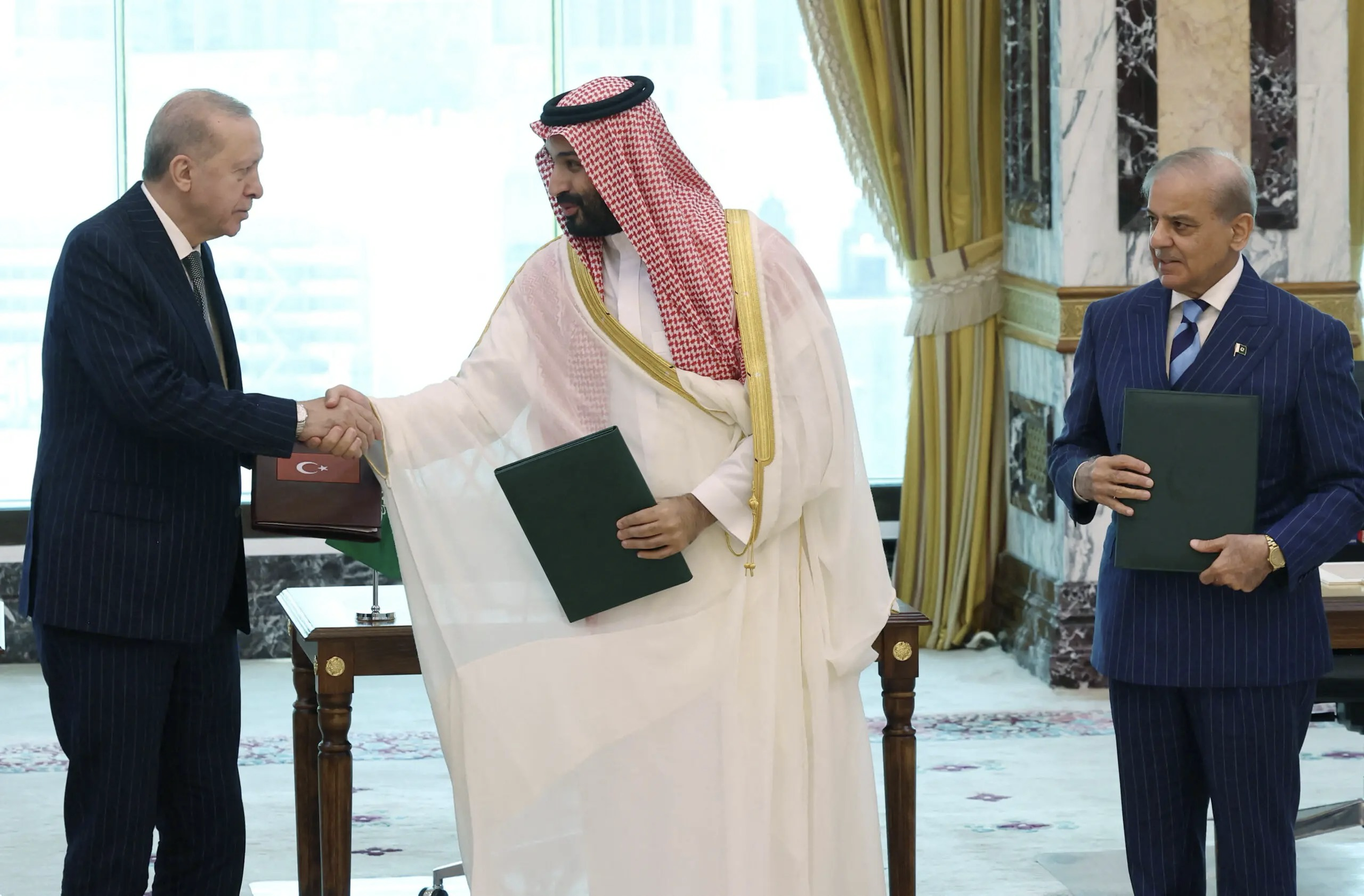
Turkish President Tayyip Erdogan shakes hands with Saudi Crown Prince Mohammed bin Salman( MBS) as Pakistan’s Prime Minister Shehbaz Sharif looks
Even the threat of joint involvement could dramatically shift the Saudi-Houthi conflict.
Pakistan, Saudi Arabia, and Turkey triggered a mutual defense pact on Monday in response to repeated Houthi strikes on Saudi infrastructure. The joint deterrence measures, which appear to include the “rapid deployment” of Pakistani and Turkish troops to the Saudi kingdom, mark the first time that the Mecca Joint Defense Agreement has been invoked since it was signed in August.
The Houthis have yet to comment on the activation of the mutual defense pact.
Under the trilateral, NATO-style agreement, “any armed attack against any one of the three states shall be regarded as an attack against them all.” Although military cooperation among the three Sunni Muslim-majority nations is nothing new, the timing of the pact’s creation was particularly notable, as it came less than one month after Yemen’s Houthi rebels began launching attacks on Saudi Arabia.
In recent weeks, fighting between the Iran-backed Houthis and the Saudi-backed, internationally recognized Yemeni government has only worsened. Houthi forces seized control of Yemen’s Red Sea coast, including the strategic Bab el-Mandeb strait, and targeted critical energy infrastructure and Muslim holy sites in Saudi Arabia. This week, the Houthis also claimed to have launched attacks on King Khalid International Airport in Riyadh, Saudi Arabia’s Aramco-associated Petro Rabigh refinery, and other locations.
In response, Saudi-led coalition forces in Yemen launched a counteroffensive on Monday in an effort to retake the coastal territory. Yemeni officials said the forces successfully recaptured several key towns near Bab el-Mandeb.
Meanwhile, Saudi Arabia has doubled down on the defense of its own territory by bringing Pakistan and Turkey further into the fold. A joint statement released by the three countries following Monday’s emergency meeting in Riyadh did not explicitly name the Houthis as the rationale for activating the pact, though it did cite recent attacks on the holy cities of Mecca and Medina.
It is unclear to what extent Islamabad and Ankara will aid Riyadh. The trio announced on Monday that they will “move immediately to the practical implementation of the collective defense commitments and to take the necessary measures to provide the agreed military forces and capabilities and ensure their rapid deployment in the kingdom.”
However, Pakistan said it will not release the details of its deployment, though Pakistani Defense Minister Khawaja Asif said on Monday that Islamabad and Ankara were already aiding Riyadh in a “supporting role,” including in the form of reconnaissance. And the Turkish parliament has yet to ratify the mutual defense pact.
Still, even the threat of joint involvement could dramatically shift the Saudi-Houthi conflict. The members of the Mecca Joint Defense Agreement boast a combined military strength of nearly 1.4 million active troops. That doesn’t include their 3,400 aircraft, 6,000 tanks, and more than 340 naval assets. Pakistan is the only nuclear-armed Muslim-majority nation in the world, and Turkey has NATO’s second-largest armed forces.
FoReign Policy
