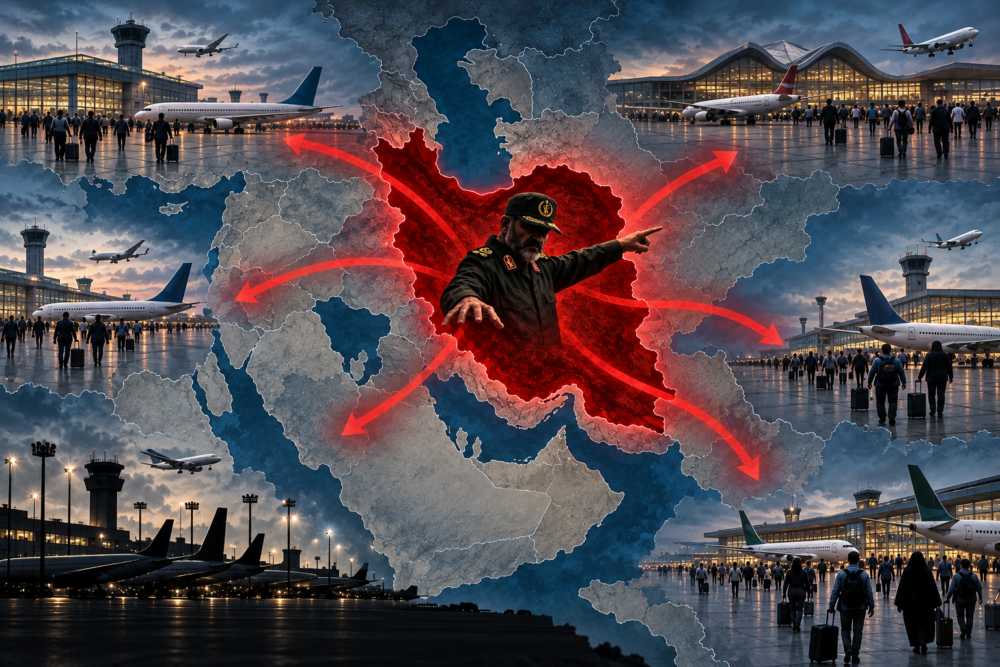
Photo illustration : Iran’s warning puts its neighbors’ civilian airports—and the people who depend on them—under threat.
For decades, Iran’s regime has used armed proxies to threaten its neighbors and undermine their sovereignty. Its threat against regional airports raises the question anew: Is Iran declaring war on its neighbors??
By: Ya Libnan Editorial Board , Opinion
When a senior Iranian official tells neighboring countries that their airports will be unable to operate if they stop Iranian flights, what are those countries supposed to hear? A request for friendship—or a threat of war?
On September 23, Mohsen Rezaei, secretary of Iran’s Supreme National Security Council, warned governments in the region against cooperating with a U.S. campaign to restrict Iranian aviation. He said that if they prevented Iranian aircraft from traveling, their own airports would be unable to have flights. Reuters also reported the warning. investing.com
That statement deserves to be read for what it says. It is a conditional threat directed at the civilian transport systems of sovereign countries. Tehran has not explained how it would make those airports stop operating. But when a national security chief promises that consequence, neighboring governments cannot dismiss it as ordinary political rhetoric.
Airports are not merely buildings or bargaining chips. They carry families, medical travelers, workers and essential goods. An attack or severe disruption could endanger people who have no part in the conflict between Iran and the United States. The governments responsible for those passengers have every reason to take the warning seriously.
Iran may object to American sanctions. It may criticize neighbors that choose to restrict flights. It may seek diplomatic and legal avenues to challenge those decisions. What it cannot claim is a right to shut down another country’s airport in retaliation. A government’s decision about which aircraft may enter its territory does not transfer control of its skies to Tehran.
The distinction between a formal declaration of war and a threat to use force matters. Iran has issued no formal declaration of war against these neighbors. Yet the United Nations Charter prohibits both the use of force against another state and the threat of it. Whether Rezaei’s words meet that legal test depends partly on what means Iran intends to use. The danger, however, does not wait for that question to be settled. A warning that civilian airports may be disabled risks widening a conflict that the region desperately needs to contain.
Tehran’s message also contains a contradiction. Rezaei urged neighboring countries to prevent the war from spreading, while warning that their own airports would lose flights if they refused Iran’s demand. Threatening a neighbor’s civilian infrastructure is a way to spread the war, not contain it.
Regional governments should ask Iran to withdraw the warning and state unequivocally that their civilian airports and air traffic will not be targeted or disrupted. They should make clear, together, that disagreements over aviation policy must be handled without coercion against passengers and civilian infrastructure. The wider international community should say the same.
The question in this headline is deliberate. Has Iran declared war on its neighbors? Not formally. But when its security chief threatens to make their airports inoperable unless they obey Tehran, those neighbors are entitled to ask what else they should call it.
