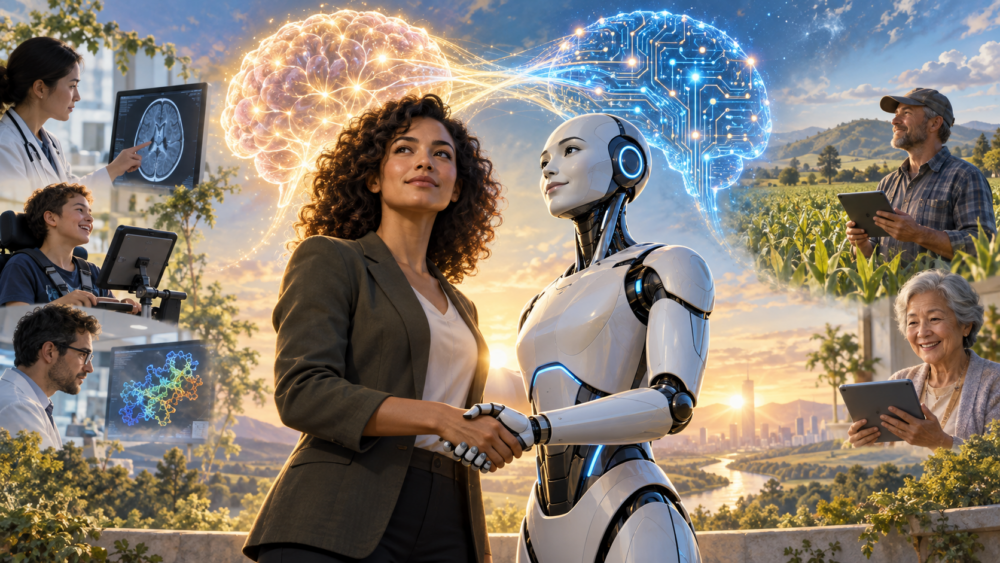
Photo illustration -Human intelligence provides the purpose, judgment and responsibility. Artificial intelligence expands what humanity can achieve.
AlphaFold has opened millions of protein structures to researchers, helping them pursue answers to diseases that have challenged humanity for generations.
By: Ya Libnan – Fourth article in a series about how AI is improving our lives : Analysis
Imagine trying to repair a machine when you know the names of its parts but cannot see their shapes or how they fit together. For decades, biologists faced a similar obstacle with proteins—the tiny molecular tools that carry out much of life’s work.
A protein’s shape helps determine what it does. Learning that shape through laboratory experiments can demand great skill, expensive equipment and years of effort. Then artificial intelligence gave scientists a powerful new way to approach the problem.
AlphaFold can predict a protein’s three-dimensional structure from its sequence of building blocks. Working with the European Bioinformatics Institute, its developers made predictions for more than 200 million proteins available in a public database. Researchers across the world can now examine structures that might otherwise have remained out of reach. EMBL-EBI
Consider malaria. Oxford researcher Matthew Higgins and his colleagues were studying a protein involved in the parasite’s life cycle. Combining their laboratory work with an AlphaFold prediction helped them see how the protein functioned and decide which parts to investigate for a potential vaccine. AI did not design a finished vaccine. It gave human scientists a clearer view of a difficult target. Google DeepMind
That distinction makes the achievement more impressive, not less. A predicted structure is a starting point: researchers still have to test their ideas, check where the prediction is reliable and establish whether any proposed treatment is safe and effective. But when millions of starting points become accessible, scientists can ask questions they previously lacked the time or resources to pursue.
AlphaFold’s impact reaches beyond one disease. Its public database has been used by millions of people in more than 190 countries, according to its research partners. Its contribution to protein structure prediction was recognized with a share of the 2024 Nobel Prize in Chemistry. EMBL-EBI
To me, this is one of the clearest examples of AI helping humanity. Scientists brought the questions, the experiments and the judgment. AI helped reveal a vast molecular landscape for them to explore. The next discovery still depends on people—but they can now see farther.
