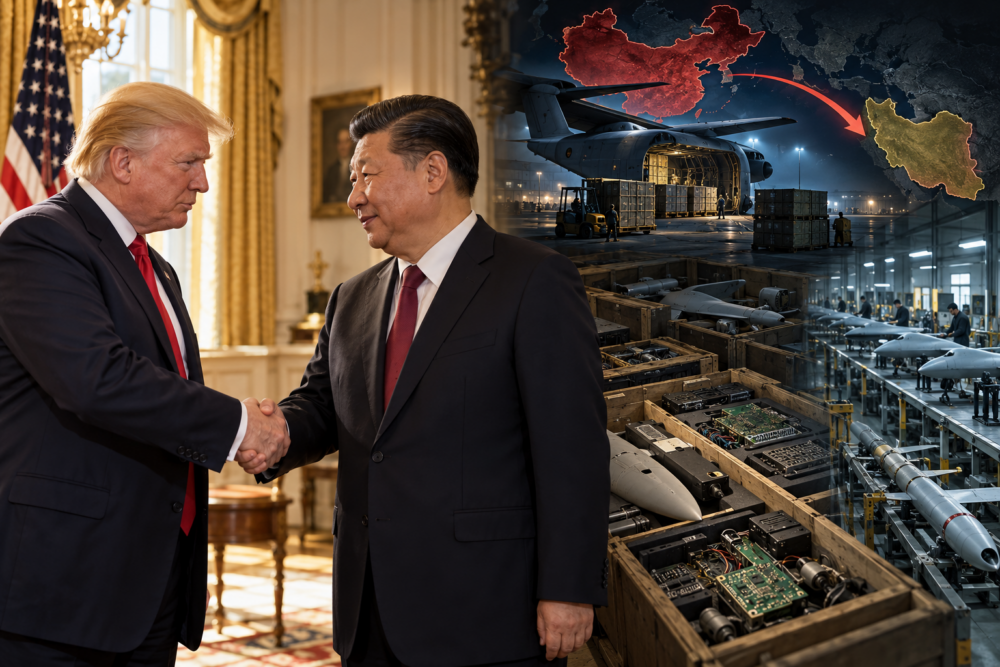
Photo illustration- A ceremonial welcome in Washington cannot conceal the shipments reaching Iran’s military.
As Xi Jinping receives the honors of a state visit, shipments from China to Iran’s Defense Ministry demand an answer.
By Vlad Green, Opinion
The White House has prepared an elaborate welcome for President Xi Jinping. Military honors, a state dinner and a presidential meeting are all on the schedule. But the question hanging over this visit is not about ceremony. It is about the supplies moving from China to Iran while Iran remains at war with the United States.
According to The Wall Street Journal, Iranian customs data show roughly 1,300 shipments containing dual-use components from China to Iran’s Defense Ministry during the first six months of this year. The newspaper described electronics that can be used in drones and missile guidance systems, as well as subsequent shipments of parts worth more than $6 million that can be used in drones.
These are not merely exports to an ordinary commercial customer. The reported recipient is the ministry charged with Iran’s military supply. A component may have both civilian and military uses, and customs entries cannot tell us where every item ultimately went. But the scale of shipments to that recipient, during a war, warrants a direct explanation from Beijing.
There is more than one newspaper report to consider. In June, the U.S. Treasury identified China- and Hong Kong-based people and companies that it said helped procure weapons for Iran’s Islamic Revolutionary Guard Corps and Defense Ministry. In an earlier sanctions action, Treasury identified a China-based supplier in a network procuring components for Iranian drones. These findings do not prove that Xi personally authorized every transaction. They show why the traffic cannot be dismissed as an isolated misunderstanding.
Beijing presents itself as a voice for peace. China’s foreign minister said last week that his country wants the fighting to end and negotiations to resume. I welcome any genuine effort to stop the war. But a government cannot expect its appeals for peace to be accepted at face value while material useful to the war effort continues to flow from its territory to Iran’s military establishment.
President Trump should put a simple question to Xi: Will China stop these shipments and provide a verifiable account of what has already been sent? He should also seek action against the suppliers and financial networks identified by U.S. authorities. The question deserves an answer whether the conversation takes place before cameras or behind closed doors. What matters is whether the supply routes close.
Diplomacy with China is necessary. So is clarity about what China is doing. Xi’s visit gives the two presidents an opportunity to deal with the evidence directly. The honors of a state visit should not make the reported shipments disappear from view.
If Xi wants China to be taken seriously as a peacemaker, he can demonstrate it by ensuring that Chinese goods no longer help replenish Iran’s military arsenal. Until then, the American public has every reason to ask what kind of partner is being welcomed at the White House.
