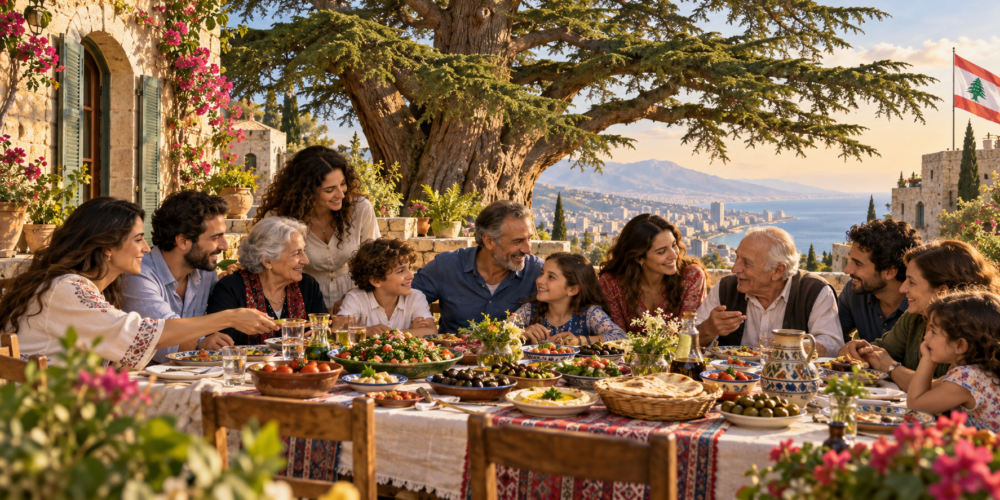
Photo illustration One country, one shared future: Lebanon grows stronger when its people draw strength from one another.
Coexistence can become Lebanon’s strength when every community is protected by the same state and every political decision is made in Lebanon’s name.
By : Ali Hussein, Political Analyst , Opinion
President Joseph Aoun has offered the Lebanese a simple truth that decades of conflict have made difficult to practice: “our homeland cannot be built by a single group, sect, or party.” He reminded us that it is our destiny to live together, that hatred cannot build a nation, and that dialogue builds trust among its people.
These words deserve more than polite applause. They ask every Lebanese leader and citizen to decide what kind of country we intend to leave to the next generation.
Lebanon belongs to its Christians and Muslims, its Druze, its Shiites and Sunnis, and to every citizen who calls it home. No community can be written out of its future. Nor can one party claim the right to decide that future for everyone else. Our differences are real, but sharing a country means settling them through its institutions, not through intimidation, foreign patrons or another war.
Aoun’s warning against seeking strength abroad against one another is especially important. Foreign friendships and assistance can serve Lebanon when they support its independence. They become dangerous when a Lebanese faction relies on an outside power to prevail over fellow citizens. The result is a country whose people distrust each other and whose fate can be bargained away by others.
Coexistence therefore needs a practical foundation. The Lebanese state must protect every community equally. The Lebanese Army must be able to defend the country and its citizens under one national command. Decisions of war and peace must belong to the constitutional authorities, accountable to all Lebanese. No family should have to wonder whether its safety depends on the weapons of a party rather than on the protection of its country.
This principle must never be used to threaten or humiliate the Shiite community. Shiite families have borne terrible losses and deserve safety, representation and a full voice in Lebanon’s future. So do families in every other community. Asking Hezbollah to hand its weapons to the state is an appeal for a common guarantee of security, not for the exclusion of the people among whom it has support. Dialogue can help make that transition peaceful and dignified, provided it leads to concrete decisions rather than another indefinite postponement.
Lebanon must also speak for itself in its dealings with Israel. Ending attacks, securing an Israeli withdrawal, bringing displaced families home and protecting the south require determined state-led diplomacy and a capable Lebanese Army. No foreign capital, and no armed faction acting alone, should determine the price Lebanese civilians pay for decisions made in their name.
Aoun called on us to “draw strength from one another rather than from abroad.” That strength will grow when a resident of the south, a family in Beirut or a farmer in the Bekaa can trust that the same republic stands behind them. It will grow when political opponents can argue fiercely without treating one another as enemies. And it will grow when leaders choose the difficult work of compromise over the easy language of sectarian fear.
We cannot erase Lebanon’s painful history. We can decide whether to repeat it. President Aoun has given us the right starting point: listen to one another, reject hatred and place Lebanon above every faction. Now the state and all its people must turn those words into a shared future.
