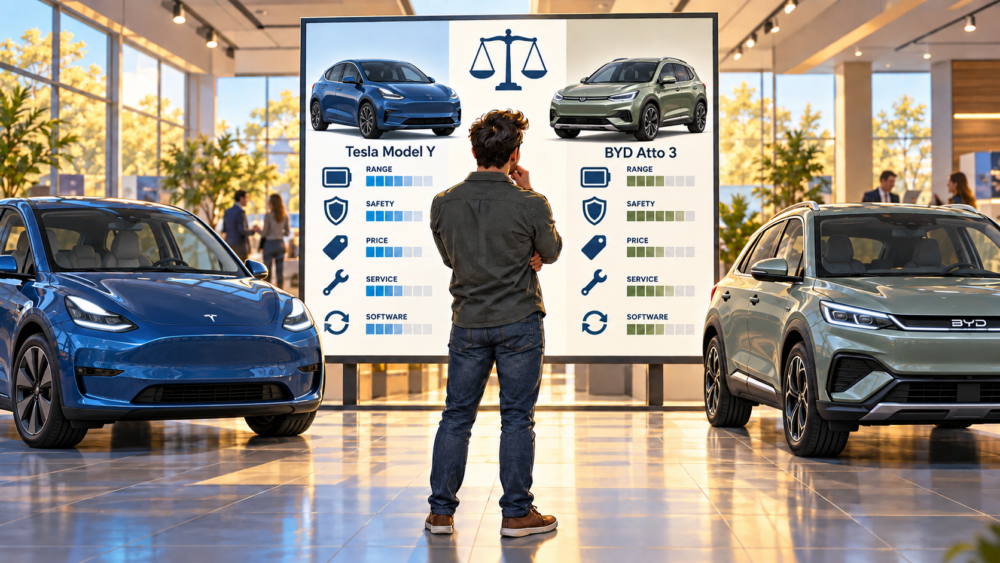
Photo illustration – Let both cars meet the same standards. Then let the consumer compare their merits.
As Trump and Xi meet, the United States should protect its workers, its consumers and its security without treating competition itself as the enemy.
By: Ya Libnan, Opinion
When President Donald Trump said he could accept Chinese automakers building cars in the United States if they hired American workers, the auto industry responded with alarm. Its concerns deserve a hearing. But so does a question for American consumers: If another company can build a better car at an honest price, why should buyers be denied the choice?
The answer cannot be simply that the company is Chinese. America became an automotive power by competing, manufacturing and improving its products. It should be confident enough to compete again—provided every company plays by rules that can be checked and enforced.
Those rules must begin with price. A cheap car is not necessarily a subsidized car; efficient factories, strong supply chains and good engineering can lower costs. Equally, a low sticker price should not excuse dumping or government support that unfairly undercuts competitors. The United States should examine the evidence, identify any improper subsidy and apply a proportionate remedy. It should require clear accounting for imported vehicles and batteries, while enforcing the same safety and consumer standards for every brand.
Building a factory in America would be welcome. It would create jobs and give Chinese manufacturers a stake in the communities where they sell cars. Yet a U.S. assembly plant alone would not settle questions about subsidies hidden elsewhere in the supply chain, or about the software and data systems inside a connected vehicle. Those questions need their own answers.
The United States must also look honestly at its own choices. The federal $7,500 new clean vehicle credit ended for vehicles acquired after September 30, 2025. Some American battery projects have since been idled or delayed. Demand, cost and company decisions all matter, but Washington cannot weaken the conditions for domestic EV investment and then blame foreign competitors for every difficulty the industry faces.
Technology gives consumers another reason to demand value. Solid state batteries promise improvements in energy density, which could eventually mean lighter battery packs, longer range or a combination of both. Yet promising prototypes are not the same as affordable batteries produced by the millions. Advances in driving assistance will also continue, but buyers need accurate descriptions of what a car can do today, which features can be updated later and which require new hardware.
That creates a practical condition for every automaker selling in America, whether domestic or foreign: give buyers clear information about battery warranties, repair costs, parts availability, software support and the limits of driving assistance. A family should be able to judge a car’s likely cost and usefulness over years, not just its price on the day of purchase.
Electric cars have fewer moving parts than gasoline cars, but their batteries remain expensive to manufacture. As production improves, buyers should see more affordable choices. The goal should be competition that rewards the company capable of making a reliable, appealing car economically—without an unfair subsidy concealing its true cost.
Trump and Xi need not choose between an open market and a protected one. The better test is whether a manufacturer can meet enforceable U.S. rules on fair pricing, safety, security and support for its customers. Let the companies that meet those conditions compete. Then let Americans decide which car deserves their money.
