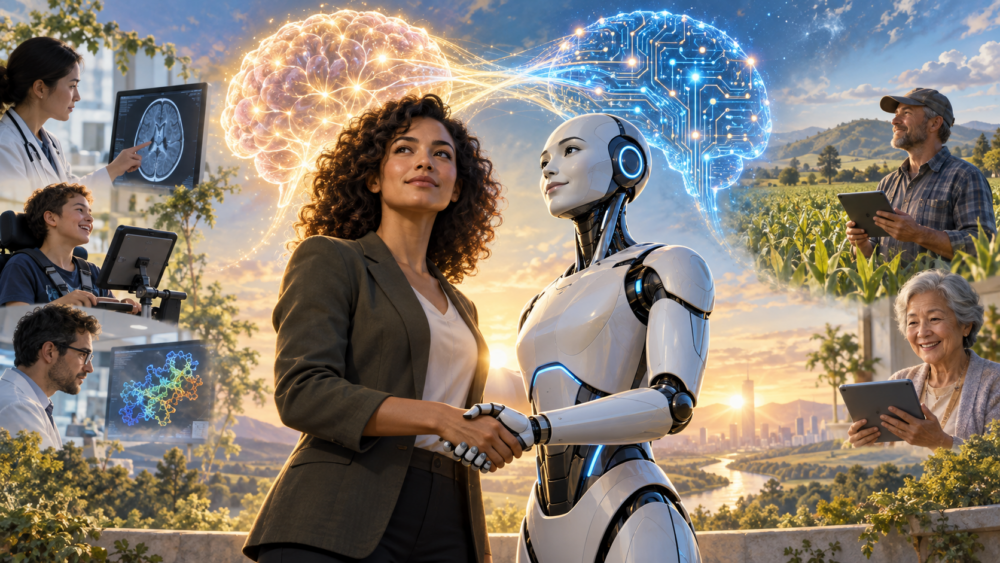
Photo illustration -Human intelligence provides the purpose, judgment and responsibility. Artificial intelligence expands what humanity can achieve.
AI helped reveal Yvonne Cook’s breast cancer during routine screening. It urged Diana Hurtado to seek emergency care when she described stroke symptoms. Their stories show the value of a timely warning followed by human action.
By: Ya Libnan – Second article in a series about how AI is improving our lives : Analysis
Yvonne Cook expected an ordinary mammogram when she arrived for breast screening in Aberdeen, Scotland, in May 2023. She noticed that an artificial intelligence system was being evaluated as an aid in reviewing the images and agreed to take part.
Soon afterward, she was called back for more tests. The AI system had flagged a small abnormality. Additional imaging and a consultant confirmed that it was breast cancer—too subtle to have been detected by the human readers. Cook received medication, surgery and radiotherapy. She was able to continue working throughout her treatment.
Her experience was part of an NHS Grampian evaluation involving 10,889 women. Researchers reported that using AI alongside the screening process increased cancer detection by 10.4%. For Cook, that finding was personal: a warning on an image led doctors to investigate while her tumor was still small.
Her story is supported by evidence from a much larger trial in Sweden. Nearly 106,000 women were assigned to either AI-supported mammography or standard screening, in which two radiologists read each image. The AI-supported approach detected a greater share of cancers present at screening—80.5% compared with 73.8%—while both approaches had the same reported specificity of 98.5%. The study does not establish that AI reduced deaths from breast cancer, but it offers substantial evidence that AI can help radiologists perform the crucial task of finding cancer.
Diana Hurtado’s warning came in a very different place: behind the wheel of her car.
Hurtado, a 30-year-old Uber driver in South Florida, suddenly felt her arm go numb and noticed that her face was drooping. A stroke was the last thing she expected at her age. She described her symptoms to ChatGPT, which warned that a stroke was possible and urged her to call 911. She sought emergency care, where doctors confirmed that she had suffered a stroke. She subsequently underwent brain surgery and rehabilitation. Hurtado told NBC 6 that the warning helped her act before she lost more time.
These are two distinct uses of AI. The system in Scotland reviewed medical images within a supervised screening project. The chatbot in Florida responded to symptoms that a patient reported herself. A chatbot’s response cannot establish a diagnosis, and people with possible stroke symptoms should call emergency services immediately. In Hurtado’s case, the response directed her toward that urgent human care.
Cook’s cancer was confirmed and treated by medical professionals. Hurtado’s stroke was diagnosed and treated by medical professionals. AI helped each woman reach those professionals at a critical moment.
That is the partnership we should build upon: technology alert enough to notice a possible danger, patients empowered to respond, and clinicians equipped to make the decisions that follow. Sometimes the most valuable thing AI can give us is time.
