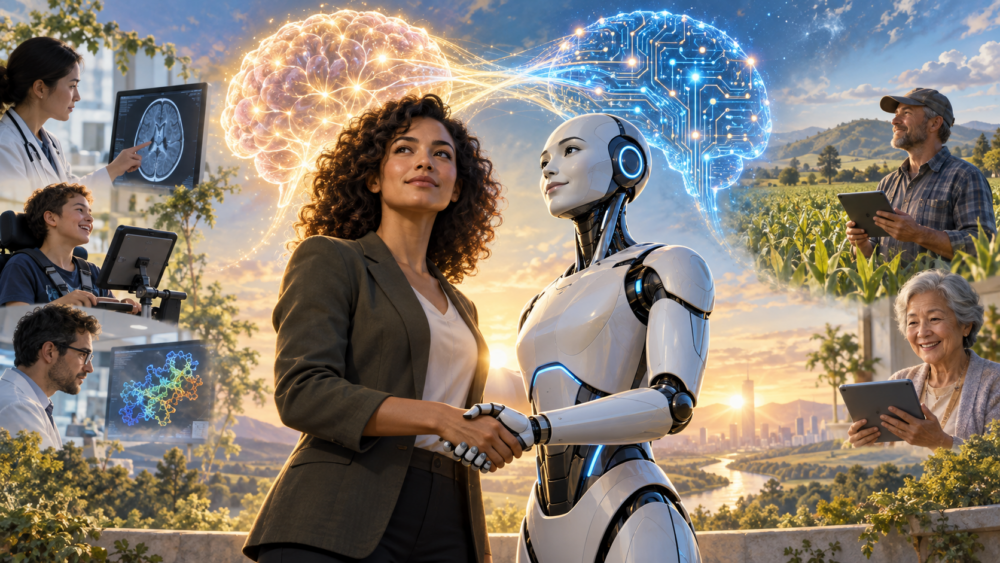
Photo illustration -Human intelligence provides the purpose, judgment and responsibility. Artificial intelligence expands what humanity can achieve.
From restoring speech and detecting disease to forecasting storms and accelerating scientific discovery, AI is demonstrating what can happen when human judgment and machine intelligence work together.
By: Ya Libnan – First article in a series about how AI is improving our lives : Analysis
The public conversation about artificial intelligence is often dominated by fear.
Will AI eliminate jobs? Will machines become more intelligent than their creators? Will technology eventually control the people who built it?
These are legitimate questions, and they should not be ignored. Every powerful invention can be misused. But if we speak only about the dangers of AI, we risk overlooking something extraordinary: artificial intelligence is already improving human lives in ways that would have seemed impossible only a generation ago.
It is helping doctors detect diseases earlier. It is giving a voice back to people who have lost the ability to speak. It is helping scientists understand the building blocks of life. It is improving weather forecasts, expanding access to knowledge and enabling people to communicate across languages and physical limitations.
These are not scenes from a science-fiction movie. They are happening now.
Giving people their voices back
One of the most moving examples comes from brain-computer interfaces.
Scientists have developed systems that use AI to interpret brain signals from people who have become paralyzed and translate those signals into audible speech. In one breakthrough reported by the National Institutes of Health, a brain implant combined with artificial intelligence converted a paralyzed woman’s intended words into speech rapidly enough to make natural conversation possible.
Think about what that means.
A person may be unable to move the muscles required for speech, yet the words still exist inside the mind. AI can help build a bridge between those thoughts and the outside world.
The machine is not replacing the human voice. It is restoring it.
Helping doctors protect our health
AI is also becoming an increasingly valuable partner in medicine.
It can examine medical images, recognize patterns and alert doctors to abnormalities that deserve closer attention. This is especially promising in detecting cancers, eye disease and other conditions for which early diagnosis can mean the difference between successful treatment and tragedy.
For people with diabetes, AI-assisted examination of retinal images can help identify diabetic retinopathy before serious vision loss occurs. The World Health Organization has highlighted the growing use of these systems, particularly in communities where access to eye specialists is limited.
AI does not replace the physician. It gives the physician another pair of highly trained eyes—eyes capable of examining enormous amounts of information without becoming tired or distracted.
The final diagnosis and treatment must remain in human hands. But when technology helps a doctor detect disease earlier, the patient gains precious time.
Accelerating scientific discovery
For decades, scientists struggled to predict how proteins fold into their three-dimensional shapes. Understanding those structures is essential because proteins perform much of the work inside living organisms, and their shapes can help researchers understand diseases and develop medicines.
AI changed the scale of that work.
Google DeepMind’s AlphaFold system has produced predictions for more than 200 million protein structures and made them available to researchers around the world. Scientists are using this resource in fields ranging from drug discovery and fundamental biology to research on malaria and plastic-degrading enzymes.
What once might have required years of painstaking investigation can now begin with an AI-generated roadmap.
AI does not eliminate the need for laboratories, experiments or scientists. It helps researchers decide where to look—and allows them to spend more time testing the most promising possibilities.
Warning us about dangerous weather
AI is also helping meteorologists produce faster and increasingly useful weather forecasts.
NOAA has introduced AI-driven global forecasting models designed to operate far more efficiently than traditional systems. Other AI tools are being developed to predict the evolution of dangerous thunderstorms and improve hurricane forecasting.
A more timely forecast is not merely a convenience. It can give families more time to evacuate, allow emergency officials to position resources and help farmers protect crops and livestock.
When minutes can save lives, speed matters.
Expanding human ability
The benefits of AI do not always arrive as dramatic scientific breakthroughs. Sometimes they appear quietly in daily life.
AI can read written material aloud for people with impaired vision. It can generate captions for those with hearing loss. It can translate languages, help students understand difficult subjects, assist small businesses and enable older adults to navigate an increasingly digital world.
For a writer, AI can help organize ideas, examine arguments and improve clarity. But the ideas, values, experience and responsibility must still come from the human being.
That distinction is essential.
AI can calculate, analyze and recommend. But it does not possess a human conscience. It has not raised a family, survived a war, suffered an illness, lost someone it loved or learned wisdom through decades of experience.
Human beings must therefore retain the final decision—and accept responsibility for its consequences.
A partnership, not a competition
The wrong question is whether humans or machines are superior.
A calculator is better than a person at performing millions of calculations. That does not make it wiser than the person using it. A medical imaging system may identify a suspicious pattern, but it takes a doctor to understand the patient, explain the finding and choose a humane course of treatment.
AI is most valuable when it strengthens human capability without replacing human responsibility.
That is the philosophy behind this series.
Each day, we will examine a real example of artificial intelligence helping humanity: saving lives, expanding knowledge, restoring independence, improving safety or solving a problem that once appeared beyond our reach.
We will not ignore the risks. AI requires oversight, ethical standards, transparency and firm human control. But fear should not blind us to progress.
Fire can burn a home or warm it. Electricity can kill or illuminate a city. Medicine can be abused or used to save a life. The value of a powerful tool ultimately depends on the purposes, judgment and character of those who control it.
Artificial intelligence may become the most powerful tool humanity has ever created.
Our responsibility is not to fear it blindly or worship it uncritically. Our responsibility is to guide it wisely, use it compassionately and ensure that its benefits reach as many people as possible.
The future of AI should not be machines against humanity.
It should be humanity, strengthened by AI, working toward a healthier, safer and more hopeful world.
