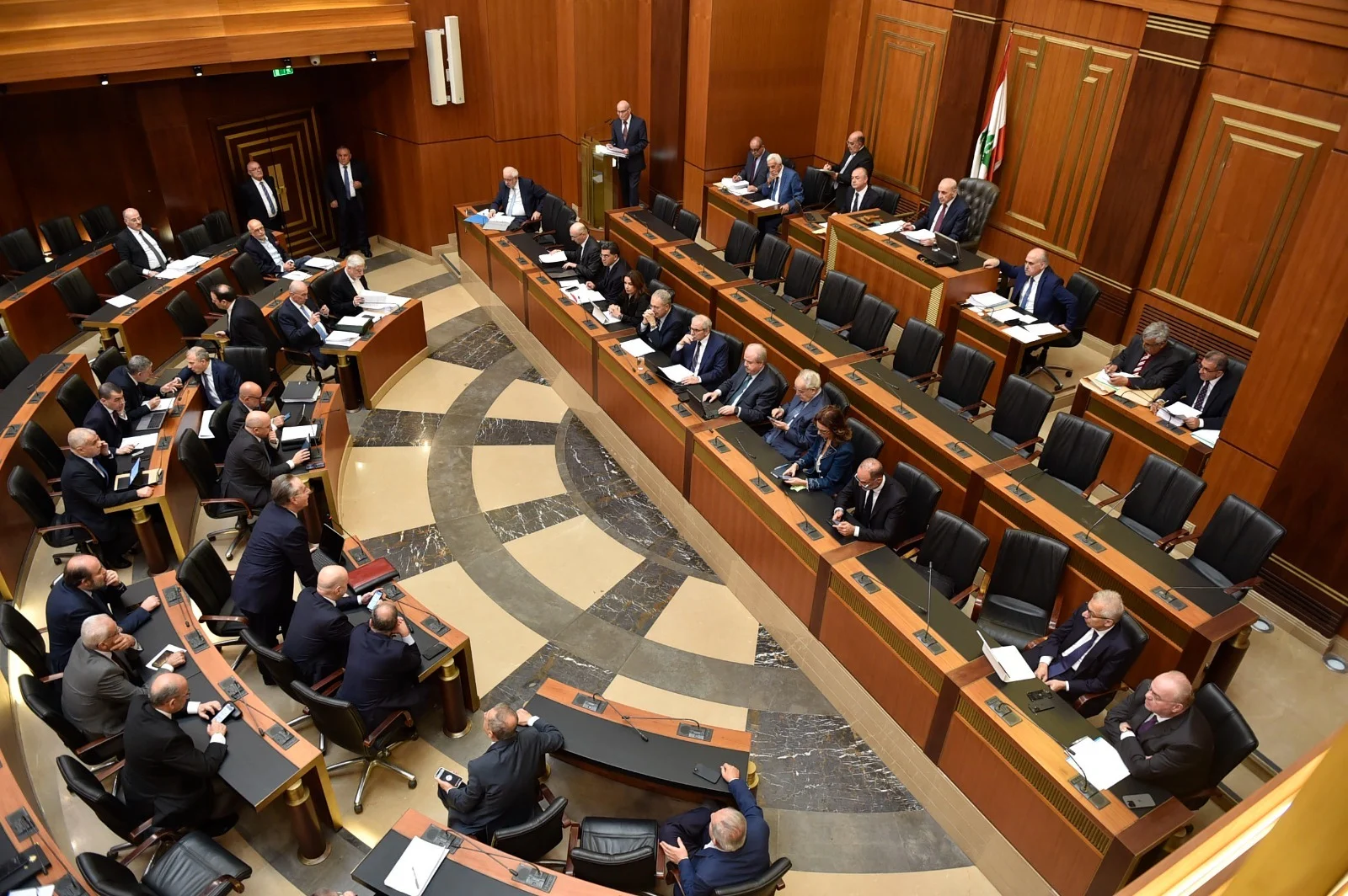
The Lebanese Parliament renewed its confidence in the government of PM Nawaf Salam with 68 votes in favor, 12 against, and two abstentions. Just before the vote of confidence was held, Hezbollah’s “Loyalty to the Resistance” parliamentary bloc members walked out of the chamber.
Key Highlights of the Debate
- Government Confidence: Despite sharp criticisms from various political blocs over economic strains and security handling, parliament ultimately backed the cabinet with 68 votes in favor and 12 against.
- Hezbollah and Weapons: Lawmakers engaged in intense exchanges regarding Hezbollah’s arsenal and disarmament, especially following recent regional developments and an ongoing push for state monopoly on weapons.
- The Framework Agreement: Opposition figures—including Free Patriotic Movement (FPM) leader Gebran Bassil and Deputy Speaker Elias Bou Saab—criticized a U.S.-mediated framework agreement with Israel, questioning its specific terms and impact on southern Lebanon.
- Economic Crisis and Budget: Discussions also centered on the looming 2027 budget, with MPs warning of severe socio-economic hardships, inflation, and potential social unrest as the country navigates the heavy financial toll of recent conflicts.
- What is historically significant according to an analyst is the fact that Hezbollah’s top ally the Amal Movement of Speaker Nabih Berri voted in favor of Prime Minister Nawaf Salam’s government during the confidence vote
- This decision stands in sharp contrast to their political allies, Hezbollah, whose bloc chose not to participate in the vote and withdrew from the parliamentary session.
Cracks in the Shiite duo
Recent reports from Nmeiriyeh in the Nabatieh district indicate that armed Hezbollah members from outside the village attempted to establish a position inside one of its houses. Residents objected, and local supporters of the Amal Movement reportedly stood with them. Together, they compelled the armed men to leave.
But Nmeiriyeh is not an isolated story.
In Arab Salim, reports claimed that Hezbollah attempted to move fighters and military equipment into residential houses, provoking opposition from residents associated with Amal and an exchange of gunfire. In Bissariyeh, another confrontation was reportedly triggered by objections to Hezbollah placing rockets or military equipment among civilian homes.
Officials subsequently denied political or military dimensions to some of these incidents, describing them as individual or family disputes. Such denials must be reported—but they should not automatically be treated as the final word.
- Ali Hussein a politica analyst commented on the vote by saying
- The message to Lebanon’s Shiite community should be unmistakable:
- You are not being asked by your government to surrender your security. You are being offered the protection of your state so that no armed organization can ever again drag your families into a war you did not choose.
- Shiites have paid the heaviest price
- Lebanon as a whole has suffered terribly from Hezbollah’s decision to enter wars without the authorization of the Lebanese government. But the heaviest human and material burden has fallen upon the Shiites in southern Lebanon, the Bekaa Valley and Beirut’s southern suburbs.
- They have lost family members, homes, businesses, farms and entire neighborhoods. Hundreds of thousands have endured displacement. Children have lost years of education. Families that rebuilt after earlier wars have watched their homes destroyed once again.
- These people were never consulted before Hezbollah opened its latest front in support of Iran. Yet they were expected to absorb the retaliation, defend Hezbollah’s decisions and remain silent about the presence of weapons among their homes.
- PM Salam’s speech
- At the conclusion of the parliamentary session dedicated to questioning the government, Prime Minister Nawaf Salam delivered a speech in which he said: “
- Mr. Speaker,
- My fellow ministers and I have listened with great interest to the remarks made by the honorable Members of Parliament. I thank everyone who offered constructive criticism regarding the government’s work or raised an issue requiring clarification or correction. I have no doubt that the citizen demanding the presence of the State is justified in that demand, and that the one complaining of the State’s absence is justified in that complaint.”
- We all bear the responsibility of enabling the State to fulfill its duties. Conversely, we do not want citizens to continue paying the price for the State’s involuntary absence.
- The government is aware that expectations were high upon its formation, yet it confronted a harsh reality—one further compounded by the war.
- Naturally, we will do our utmost to ensure that acknowledging the challenges surrounding our work does not turn into disappointment.
- We will not raise expectations, but at the same time, we will avert disappointment.
- In my response, I will make sure to address every point requiring an answer. As for remarks made for purposes other than inquiry—or statements framed to elicit an echo rather than a reply—I believe their objective was achieved the moment they were voiced.
- Naturally, time will not permit addressing every question or comment raised in your interventions. Therefore, I will focus on recurring issues and on matters regarding which the Lebanese people have a right to hear a clear, direct answer from their government.
- First, regarding the war, negotiations, and state sovereignty:
- There has been much discussion about the “tripartite framework“—its legal nature, its points of reference, and, most importantly, the results it has achieved to date.
- The tripartite framework is a political framework for negotiations; it is not an agreement or a treaty in the legal sense—a distinction clearly established by legal scholarship and the jurisprudence of the highest international courts.
- As is now well known, it entails a phased Israeli withdrawal and calls for the Lebanese state—and the state alone—to exercise sovereignty over its territory.
- It has been claimed that this path has distanced Lebanon from its established reference points and fundamental principles. This is incorrect.
- Nothing in it indicates a departure from the commitment to international resolutions, even if they are not explicitly mentioned. Nor does it signify any abandonment of the Arab Peace Initiative or the fundamental principles Lebanon has upheld for decades.
- If only those who made such claims had explained how and where this supposedly occurred, so that we could demonstrate the contrary.
