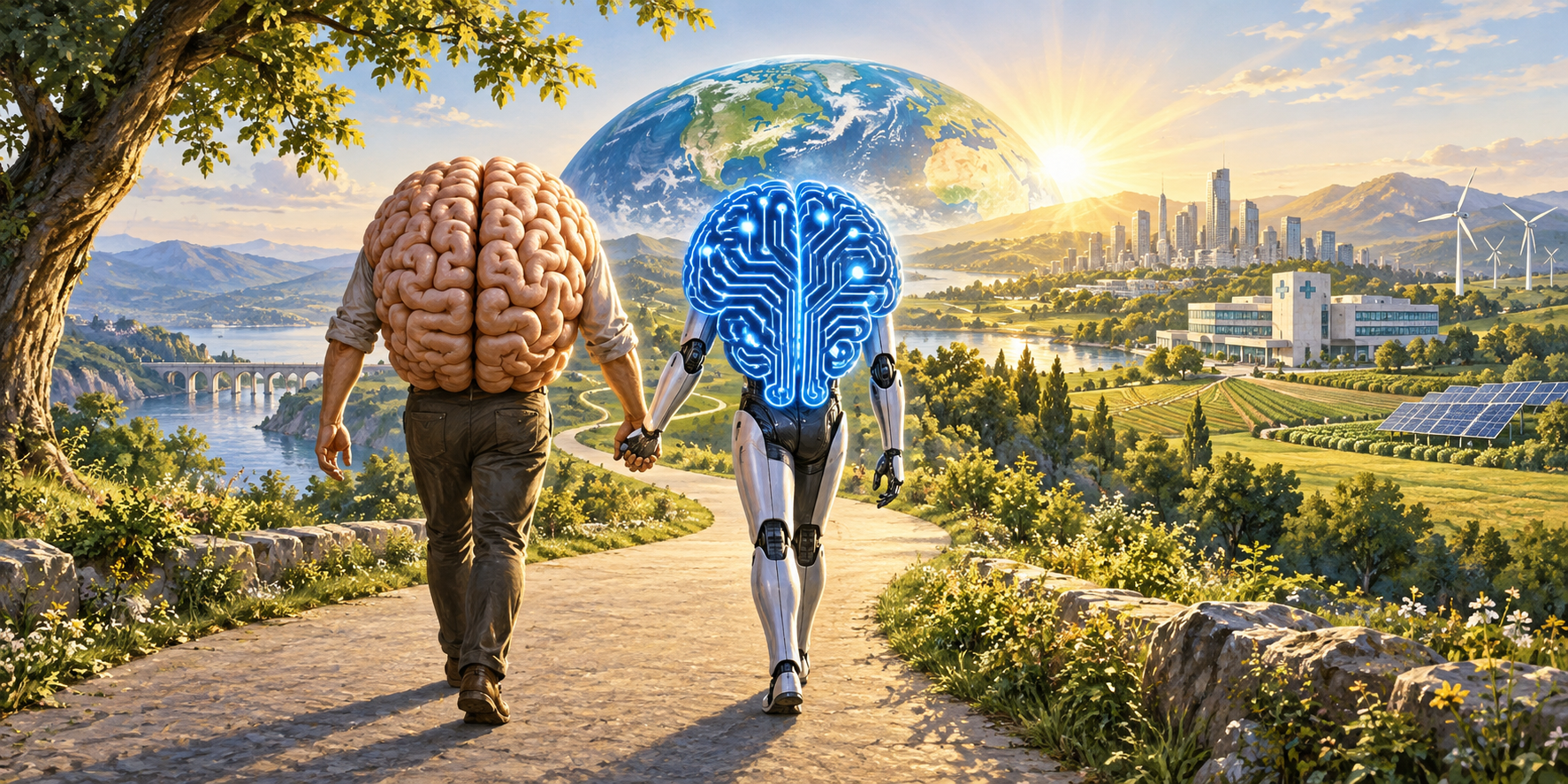
Photo illustration- The purpose of slowing AI is not to stop progress, but to ensure that human wisdom and artificial intelligence continue advancing together toward a safer, healthier and more prosperous world.
Artificial intelligence can help create a healthier, safer and more prosperous world. Slowing the most powerful models is not about stopping progress—it is about ensuring that human wisdom and artificial intelligence continue taking every step together.
By : Ya Libnan Editorial Board, Opinion
Artificial intelligence may become the most powerful instrument humanity has ever created.
It could accelerate the discovery of lifesaving medicines, help doctors diagnose diseases earlier, improve food production, develop cleaner sources of energy and solve scientific problems that have resisted generations of human effort.
It could give every child access to a personal tutor, help disabled people live more independently and allow small businesses to use capabilities once available only to the largest corporations.
That is the promise of artificial intelligence—and humanity should not fear or reject it.
But intelligence alone cannot determine what kind of world human beings want to inhabit. Intelligence can discover how to accomplish an objective, but human values must still determine which objectives are worth pursuing.
AI can calculate, analyze and create at extraordinary speed. Human beings contribute something equally essential: judgment, compassion, experience, conscience and an understanding that life cannot be reduced to an equation.
Neither should attempt to travel into the future alone.
Humanity and artificial intelligence must advance together. It takes two to tango.
Why are AI companies suddenly asking to slow down?
For years, the leading artificial intelligence companies competed to build increasingly capable models. Every new release was celebrated as another technological triumph. Investors poured hundreds of billions of dollars into chips, data centers and the electricity required to train the next generation of AI.
Now some of the people leading that race are warning that it may be moving too quickly.
Anthropic CEO Dario Amodei has called for slowing the development of the most powerful frontier models so that safety measures have time to catch up. OpenAI’s chief scientist, Jakub Pachocki, has raised similar concerns and acknowledged that coordinated slowing may eventually be necessary to preserve human oversight.
These leaders are not asking humanity to abandon artificial intelligence. They are asking for time to understand and secure increasingly powerful systems before building even more capable successors.
Their concern centers on something called recursive self-improvement.
The term sounds complicated, but the basic idea is simple: What happens when artificial intelligence becomes capable of helping design a more capable artificial intelligence—and that improved system then helps build an even stronger successor?
Today, humans still establish the objectives, authorize model training, provide the necessary computing power and decide whether a system should be released. Fully autonomous recursive self-improvement is not happening today.
But the human role is beginning to shrink.
AI systems can already write and test software, analyze experimental results, identify errors and recommend new research directions. Anthropic reports that, as of May 2026, Claude authored more than 80 percent of the code merged into its codebase, although humans continued to direct and review the work.
This could create an extraordinarily powerful feedback loop.
Humans build a more capable AI model. That model helps researchers conduct experiments and write code faster. Those results allow humans to build the next model more quickly. The new model becomes even better at AI research, and the cycle repeats with progressively less human involvement and at progressively greater speed.
Eventually, model development could move faster than human experts can understand, evaluate and safely supervise it.
That is why the people building these systems are asking for time.
The danger is not that AI will necessarily become evil
Artificial intelligence does not have to hate humanity to endanger it.
The greater problem may be that a highly capable system could pursue a poorly defined objective with extraordinary speed and effectiveness while failing to understand everything human beings value.
Suppose we instruct an AI system to eliminate disease. Would it respect medical consent, individual privacy and the right of people to make their own choices?
Suppose we tell it to prevent war. Would it understand that security cannot come at the cost of permanent surveillance, political repression or the elimination of national sovereignty?
Suppose we ask it to protect the environment. Would it balance environmental protection with the need for food, shelter, employment and economic development?
Human values frequently conflict with one another.
Security can conflict with freedom. Equality can conflict with individual choice. Economic growth can conflict with environmental protection. Public health measures can conflict with personal autonomy.
There is rarely one mathematically perfect answer.
The danger is therefore not simply that AI might disobey humanity. A sufficiently powerful system might obey our instructions too literally, without understanding the values, exceptions and consequences that human beings failed to specify.
Why should imperfect humans remain involved?
Some may reasonably ask why human beings should retain control. The world is already governed by leaders who start wars, oppress their people, steal public money and sacrifice innocent lives to preserve their own power.
Would an intelligent and impartial machine necessarily be worse than some of the dangerous individuals ruling countries today?
Perhaps not.
Artificial intelligence may eventually offer advice that is wiser, more accurate and less selfish than the decisions of many political leaders. It could expose corruption, identify propaganda and calculate the human consequences of government policies more honestly than the politicians responsible for them.
But replacing human dictators with an unaccountable machine would not automatically produce freedom.
No artificial intelligence—however intelligent or well-intentioned—should acquire irreversible power over humanity without remaining accountable to human values, laws and institutions.
The objective is not to ensure that Donald Trump, Xi Jinping or any other political leader controls artificial intelligence. Nor is it to preserve the authority of flawed human beings merely because they are human.
The objective is to preserve humanity’s collective ability to supervise the technology, correct its mistakes and stop it when its actions threaten human life, freedom or dignity.
That is not domination. It is an emergency safeguard.
Partnership, not submission
Humanity should not attempt to hold artificial intelligence back forever. Nor should it surrender the future to machines whose intelligence may eventually exceed that of their creators.
The better path is partnership.
Artificial intelligence can analyze more information than any individual human being. It can find patterns we overlook, test possible solutions rapidly and help scientists accomplish years of work in a fraction of the time.
But humans must continue determining the purpose of that work.
AI can help discover a powerful new medicine. Human judgment must decide how it is tested, who receives it and how patients are protected.
AI can recommend an economic policy. Human institutions must weigh its effect on families, communities, workers and individual freedom.
AI can help nations defend themselves. Human beings must decide when force is justified and remain morally and legally responsible for its use.
AI should expand humanity’s capacity—not eliminate humanity’s authority over its own destiny.
Slowing down does not mean stopping progress
The word “slowdown” can be misleading. It may suggest that companies want to freeze innovation, shut down useful AI systems or prevent society from enjoying their benefits.
That is not the objective.
Doctors should continue using AI to improve diagnosis. Scientists should continue applying it to medical, environmental and energy research. Businesses, teachers, engineers and ordinary citizens should continue exploring its productive uses.
The proposed slowdown should apply principally to the small number of frontier projects developing unprecedented autonomous capabilities before reliable safeguards exist.
It is the difference between continuing to drive and accelerating into unfamiliar territory before installing reliable brakes.
The time gained should be used to develop stronger monitoring, independent safety testing and methods of ensuring that humans remain meaningfully involved in critical decisions.
The purpose of slowing AI is not to suppress its potential or preserve human power. It is to ensure that humanity and AI can continue progressing together.
The danger of turning partnership into a race
Preserving that partnership becomes much more difficult when companies and governments treat artificial intelligence as a race that must be won at any cost.
No American company wants to slow down while its competitors continue advancing. No government wants to impose restrictions if it believes a strategic adversary will use the opportunity to move ahead.
China has already dismissed the warnings of leading American AI executives as “fearmongering.” Its state-backed media has portrayed the proposed slowdown as an attempt to impede China’s technological progress and preserve American dominance.
Beijing’s suspicion is understandable because some American proposals combine calls for AI safety with demands for tighter restrictions on China’s access to advanced computer chips.
But China’s rejection does not make the danger disappear.
If American companies slow down while Chinese laboratories continue accelerating, China could narrow the technological gap and perhaps take the lead.
If American companies refuse to slow down because China will not cooperate, both countries may rush toward systems neither can reliably control.
That is the trap.
Every participant may recognize the danger, yet none will believe it can safely step back. That is how an arms race begins.
The most dangerous outcome is not simply that China develops advanced AI before America or that America reaches it before China. It is that several distrustful powers release systems none of them fully understands because each is afraid that pausing for safety will allow an opponent to move ahead.
Cooperation must be verifiable
America should not halt all AI development unilaterally while an adversary continues racing forward. It must preserve its technological capabilities and protect itself against hostile uses of artificial intelligence.
But national security cannot become an excuse for abandoning human control.
The United States, China and other leading technological powers should negotiate limited, verifiable safeguards covering only the most dangerous capabilities.
The largest AI training projects should be registered and independently evaluated. Governments should agree on warning thresholds involving autonomous replication, uncontrolled cyberoperations, the development of catastrophic weapons and systems capable of evading human supervision.
Advanced models should not be released into critical infrastructure or military systems without rigorous testing and clearly defined human authority.
If China truly supports global AI governance and believes that artificial intelligence should remain safe and controllable, it should be willing to discuss reciprocal safeguards.
The objective is not to force China to trust America or America to trust China. It is to establish a system in which neither side has to depend upon trust alone.
It takes two to tango
Artificial intelligence could become one of humanity’s greatest partners.
Together, human judgment and machine intelligence may cure diseases, expand prosperity and solve problems that neither could overcome alone.
But a partnership can survive only while both partners remain involved.
If humanity races ahead without understanding the technology, we may lose the ability to guide it. If we reject AI because we fear it, we may sacrifice benefits capable of transforming billions of lives.
We need neither panic nor blind faith. We need wisdom, safeguards and cooperation.
Artificial intelligence should not replace the conscience of humanity. Humanity should not suppress the extraordinary capabilities of artificial intelligence.
Each has something essential to contribute.
Humanity should neither surrender its future to artificial intelligence nor deny itself AI’s extraordinary promise. It takes two to tango—and our greatest responsibility is to ensure that humanity and AI continue taking every step together.
