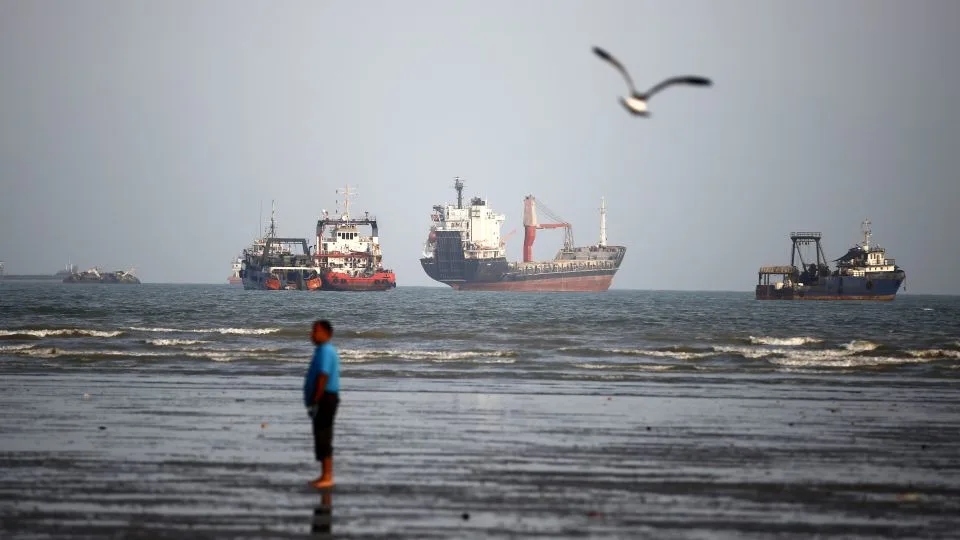
Iran reports commercial vessel struck in Strait of Hormuz
HERE IS THE LATEST:
- Iranian state media said early Sunday that 1 person was killed and 3 were injured after one of their commercial vessels was struck near the Strait of Hormuz.
- Yemen’s Houthis, a group backed by Iran, have in recent days expanded their control of the strategic Bab el-Mandeb Strait, through which much of Saudi Arabia’s oil has flowed since the disruption on the Strait of Hormuz. The move makes it easier for the Iran-backed rebels to further choke Saudi oil exports.
- Yemen government forces, supported by Saudi Arabia, said Saturday they had launched strikes against Mokha, newly in Houthi hands. Weapons and vehicles were destroyed and Houthi fighters were killed, a spokesperson said.
Iranian cargo vessel struck in Strait of Hormuz killed 1 and wounded 4, state media reports
An Iranian cargo vessel was struck early Sunday off Qeshm Island in the Strait of Hormuz, Iranian state media said, and a plan by Tehran to brief neighboring countries on its contested efforts to manage shipping in the strait was postponed.
The attack, which the reports said killed one and wounded four, drew attention back to the strait after threats to shipping in the region intensified last week when Iran-backed Houthi rebels captured an island on the Bab el-Mandeb Strait in the Red Sea.
Iran’s state-run IRNA news agency quoted the Qeshm governor as blaming a “terrorist enemy” for Sunday’s attack. There was no immediate comment by the U.S. military, which has struck Iranian-flagged vessels during its blockade of Iranian ports and faces a new threat from Iranian ballistic missiles launched at its warships.
Qeshm Island, about 14 miles from the port city of Bandar Abbas, is key to Iran asserting control over the Strait of Hormuz.
Hours before the attack, Iran’s government remained defiant. “Our people can’t be bullied into submission. Iran won’t surrender,” President Masoud Pezeshkian said in a social media post.
President Trump disagreed, saying on Sunday that Iran “wants to make a deal so bad” that “they’re calling constantly.” Mr. Trump spoke at his golf course in Doonbeg, Ireland, where he was attending a tournament.
Later, when asked by a reporter whether the U.S. struck the Iranian cargo vessel early Sunday in the Strait of Hormuz, Mr. Trump said: “I don’t want to say.” He then boarded Air Force One to head back to Washington.
U.S. Embassy in Abu Dhabi warns Americans of “continued need for caution”
The U.S. Embassy in the United Arab Emirates issued a security alert on Saturday, warning Americans in the Middle East country to exercise increased caution in areas associated with the Jewish and Israeli communities.
“The U.S. Mission to the United Arab Emirates reminds Americans of the continued need for caution at locations in the UAE associated with the Jewish and Israeli communities, including places of worship,” the alert dated Friday, Sept. 11, said.
The embassy did not specify whether there were threats at any specific sites. This weekend marks the Jewish holiday Rosh Hashanah.
Since March, the Department of State has advised Americans worldwide to exercise increased caution following the U.S.-Israeli war with Iran.
Trump says he doesn’t care if Gulf states meet with Iran
President Trump, asked about Gulf states meeting with Iran in Oman on Monday to discuss the Strait of Hormuz, said he doesn’t care.
“I don’t care. That’s up to them,” Mr. Trump told reporters at his golf course in Ireland. “If they could be happy… if they’re happy, that’s fine.”
The planned meeting comes as the Islamic Republic has blockaded the Strait of Hormuz during the war, driving up oil prices.
Mr. Trump claimed on Sunday that the war with Iran will end “right after the midterms,” adding that “gasoline is going to drop like a rock.” He said “Iran wants to make a deal so badly,” saying they are “calling constantly.”
Iran president says Tehran and UAE want to “turn the page” on war
Iran and the United Arab Emirates, whose relations have deteriorated since the start of the Middle East war, want to “turn the page”, the Iranian president claimed on Sunday.
“For the first time since the war and the incidents that occurred in the Persian Gulf, we had a constructive exchange with the crown prince of Abu Dhabi,” Massoud Pezeshkian said a day after a meeting with Sheikh Khaled Bin Mohamed Bin Zayed Al Nahyan in India, on the sidelines of the BRICS summit. “It was agreed that we would turn the page, look to the future and build it together.”
After U.S.-Israeli attacks on Iran in February launched the Middle East war, Tehran retaliated against America’s allies in the region, with the UAE bearing much of the brunt.
In August, the UAE announced it was suspending trade and financial exchanges with Iran.
Dubai, the UAE’s largest city, is home to a deeply rooted Iranian community and is a vital economic lifeline for Iran, which is struggling under the weight of U.S. and international sanctions.
Houthis say they fired drone towards Saudi Arabia
Iran-backed Houthi rebels in Yemen said they fired drones and missiles toward neighboring Saudi Arabia.
The Houthis’ military spokesperson, Brig. Gen. Yahya Saree, claimed in a statement that they targeted a military base in Sharurah province in the Najran region. He didn’t provide evidence or say when the attack took place. Sirens went off in the province on Saturday, according to the Saudi civil defense, which didn’t report casualties or damage.
The civil defense overnight also said a projectile fell in al-Tawwal governorate near the border with Yemen along the Red Sea, injuring two people and damaging a mosque and several other buildings. The statement blamed the Houthis.
Explosions heard off coast of Qeshm in southern Iran: State media
Explosions were heard Saturday off the coast of an island located in the Strait of Hormuz, Iranian state media said.
“A few minutes ago, the sound of two explosions was heard on Qeshm Island, coming from the direction of the sea,” the official IRNA news agency said.
In recent weeks, Iran has been targeting oil tankers passing through the strategic waterway as well as U.S. bases in the Gulf countries in retaliation for the attacks carried out by the U.S. military on Iranian targets.
The United States has also targeted ships trying to break its own counterblockade of Iranian ports.
Yemen government forces launch strikes against Houthis in Red Sea city
Yemen’s Riyadh-backed government forces said on Saturday they had struck Iran-allied Houthi fighters in the strategic Red Sea city of Mokha.
Following a weeklong offensive, the Houthis on Friday captured Yemen’s Red Sea coast, cementing their hold on the Bab el-Mandab Strait, a vital artery for Saudi Arabian oil exports as the Strait of Hormuz remains closed amid the U.S.-Iran war.
They had seized Mokha the day before after heavy fighting.
Israeli strikes escalate in South Lebanon
Israeli airstrikes have intensified across southern Lebanon, killing at least four people in Arab Salim as U.S.-mediated political talks face further delays, according to live updates from Al Jazeera.
Israeli warplanes bombed the southern town of Arab Salim after evacuation warnings, killing four people and injuring 20 others
Heavy artillery and airstrikes also hit the Ali al-Taher Heights, Khiam, and Kfar Reman, raising fresh concerns over a fragile border truce.
CBS
