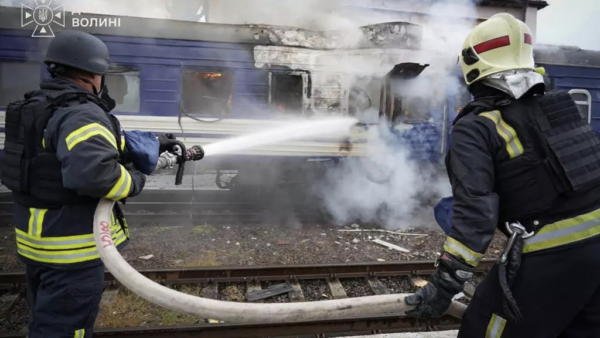
This handout picture taken and released by the Ukrainian State Emergency Service on September 13, 2026 shows firefighters spraying water at a train carriage damaged by a drone strike near the border with Poland. © Ukrainian State Emergency Service via AFP
Ukraine and Poland on Sunday condemned Russian strikes close to the Polish border as an “escalation” in the war, after drones struck a Warsaw-bound train. Ukraine’s rail operator said former British PM Boris Johnson and ex-US CIA director David Petraeus were at a border train station nearby around the time the train was hit.
Warsaw – Poland and Ukraine on Sunday denounced Russian strikes close to the Polish border, including on a Warsaw-bound train and near a frontier checkpoint – as an “escalation” in the war.
Ukraine’s rail operator said former British prime minister Boris Johnson and ex-US CIA director David Petraeus were at a border train station nearby around the time the train was hit.
But the strikes came as US President Donald Trump called on Ukraine’s President Volodymyr Zelensky to halt attacks on Russian refineries, saying it was causing a shortage of diesel fuel and “there are plenty of other targets”.
Ukraine has increasingly targeted Russian oil refineries in a bid to hurt Russia’s war effort.
Russia attacked western Ukraine with drones Sunday, just days after US envoys visited Kyiv and Moscow in a bid to revive talks to end Europe‘s worst conflict since World War II. European nations are meanwhile worried by what they say is increased Russian-orchestrated sabotage acts on their soil.
Poland and Ukraine said a Kyiv-Warsaw passenger train was struck just two kilometres (1.2 miles) from the Polish border, but reported no casualties.
“Shortly before the locomotive was hit at the Ukrainian-Polish border, a diplomatic train was at Yagodyn station. There were, among others, security advisers from several EU member states and former European leaders on board, including former UK Prime Minister Boris Johnson,” said the Ukrzaliznytsia rail operator.
“In another train that was at Yagodyn station at the very moment of the attack was former CIA Director David Petraeus,” it added. The operator did not say how far the officials were from the train attacked.
Zelensky said Moscow had “deliberately” struck the locomotive.
“It is precisely to prevent these strikes from spreading further into Europe that Ukrainian men and women fight every day, give their lives, and do not allow the aggression to expand,” Zelensky said.
Poland warns of possible more attacks
Poland has been one of Ukraine’s main allies and, with Ukrainian airspace closed, trains to Poland have been one of the main routes out of the war-torn country, used by refugees.
Poland’s Prime Minister Donald Tusk chaired an emergency meeting in Warsaw following the strikes, warning he expected Russia to escalate the war “in the coming weeks”. He added: “We cannot exclude that the escalation will also affect our territory… I hope not.”
Russia said it had hit “railway infrastructure used to transport military cargo” from European countries.
Russia ‘knocking at Europe’s door’
Speaking in Kyiv, Poland’s foreign minister Radoslaw Sikorski said the “escalation” should lead to allies to “double” their support for Ukraine.
“This was just a few hundred meters from the Polish border, this affects the safety of my countrymen,” Sikorski said.
“I understand that nobody died this morning in that particular attack, but it could easily have happened.”
Ukraine’s Foreign Minister Andriy Sybiga said President Vladimir Putin considered Russia was “de facto” at war with Europe.
“Europe may consider, or reassure itself, that it is not at war with Russia, but Russia does not see it that way. De facto, it is already at war with the Euro-Atlantic space, carrying out various hostile actions,” Sybiga said.
“Putin’s terror is literally knocking at the door of the European Union and NATO.”
Russian attacks killed at least two people on Sunday in the frontline city of Kramatorsk.
Twenty people, including two children, were also wounded in a second day of attacks on the southern port city of Odesa, Ukrainian officials said.
Three-way talks
The Kremlin, meanwhile, said negotiations with Ukraine and the United States on the war could take place in October.
“We do not rule out such a possibility; we are talking about the foreseeable future,” Kremlin spokesman Dmitry Peskov told journalists, cited by Russia’s Ria and Tass news agencies.
Several rounds of negotiations have failed, while US-led efforts stalled during the Middle East war.
In an interview released on Saturday, Zelensky said he would be willing to meet Putin at the G20 summit in Miami in December.
But Peskov said that was “impossible”, speaking to AFP in New Delhi on Saturday, repeating Moscow’s demand that a meeting could only take place in the Russian capital.
Putin has repeatedly rejected offers for face-to-face talks with Zelensky aimed at ending the conflict and repeatedly said Moscow intends to seize the rest of east Ukraine.
Putin cannot afford opposition
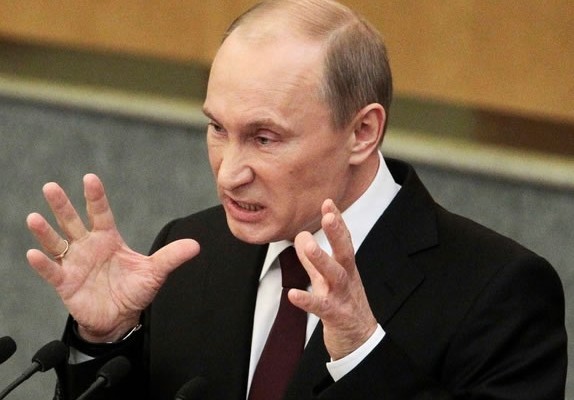
With fewer than seven days remaining before Russia’s September 18–20 parliamentary elections, the Kremlin is refining its methods of removing candidates it considers undesirable. At least 36 candidates have reportedly been disqualified by electoral authorities, according to an investigation by the independent Russian media outlet Verstka.
In Putin’s Russia, the threshold for being labeled an extremist or a threat to the state can be extraordinarily low.
One candidate reportedly encountered trouble after posting a photograph of artwork by the British artist Banksy. A social-media message honoring Lemmy Kilmister, founder of the celebrated rock group Motörhead, was reportedly enough to attract the attention of Russian authorities.
These are hardly acts of insurrection. But in today’s Russia, apparently even art, music and independent political activity can be interpreted as challenges to the Kremlin.
Putin is especially vulnerable because Russians are showing signs of exhaustion. His popularity and that of the ruling United Russia party have reportedly been affected by restrictions on internet access, fuel shortages, Ukrainian strikes inside Russia and growing fatigue with a war that has continued far longer than the Kremlin anticipated.
Russia’s invasion was supposed to demonstrate Russian power and produce a rapid victory. Instead, more than four years later, the war continues to consume lives, weapons and national resources.
Putin’s response is not to reconsider the war or permit Russians to debate its consequences freely. It is to eliminate challengers before voters can consider them.
(FRANCE 24 with AFP)
