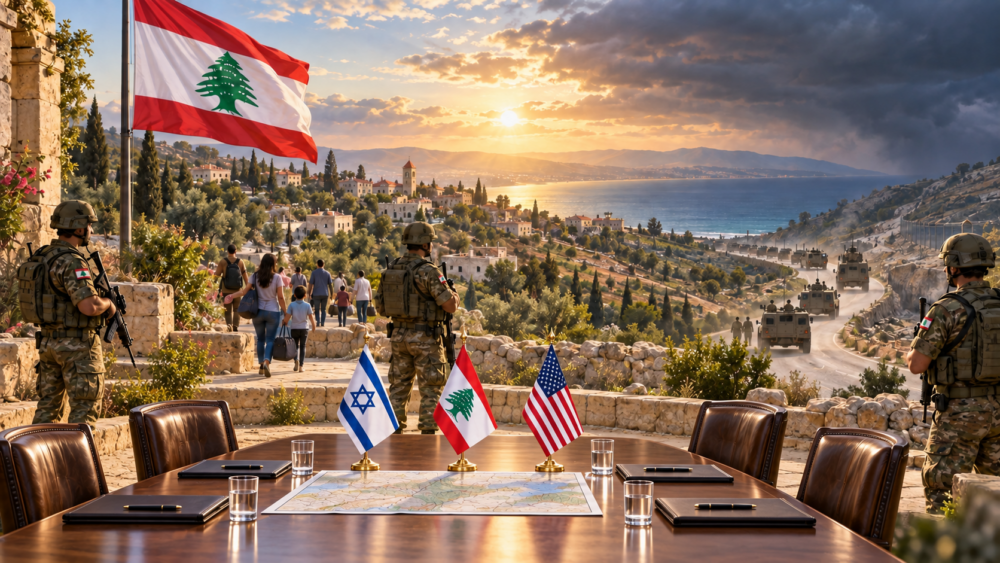
Photo illustration : Lebanon’s road to sovereignty: Negotiation under one government, security under one army and peace beneath one flag.
Hezbollah’s wars have repeatedly cost Lebanon lives, homes and territory. Only state-led diplomacy and negotiations can secure an Israeli withdrawal, disarm unauthorized forces and restore the authority of the Lebanese Republic.
By: Ya Libnan Editorial Board , Opinion
Israel and Lebanon are preparing for an eighth round of negotiations following the Jewish New Year, although no date has been formally announced. Reports suggest that the political talks could be held in Rome or Jordan, while military discussions may take place at the headquarters of the United States Central Command in Tampa, Florida.
Lebanese Prime Minister Nawaf Salam is also expected to meet with U.S. Secretary of State Marco Rubio in the United States on September 28, on the sidelines of the United Nations General Assembly. That meeting could be crucial for reviewing the diplomatic process and addressing the remaining border, security and sovereignty issues.
The negotiations are focused on three inseparable objectives: the gradual withdrawal of Israeli forces, the deployment of the Lebanese Army in southern pilot zones and the dismantling of Hezbollah’s military infrastructure.
Despite continued Israeli strikes and the fragility of the U.S.-brokered framework, negotiations remain Lebanon’s only realistic means of achieving all three.
Hezbollah’s wars have cost Lebanon territory
Hezbollah rejects the present framework and insists that Israel must withdraw completely before any serious discussion of its weapons can begin. But recent events have demonstrated that Hezbollah is no longer in a position to impose such conditions—or to defend Lebanon.
It could not even hold the strategic Ali al-Taher ridge, despite the tunnels, command facilities and weapons stores reportedly built there over many years with Iranian support. Hezbollah had refused an American-backed proposal to turn the ridge over to the Lebanese Army. Israel subsequently declared that it had taken operational control of the position and its underground infrastructure, although the precise extent of that control remains disputed.
The Lebanese Army was prepared to take responsibility for the area before the battle. It may now be forced to recover it through negotiations after Hezbollah failed to protect it militarily.
This has become a tragically familiar pattern.
After the 2006 war, Israel reoccupied the northern, Lebanese part of Ghajar and has never withdrawn from it. After Hezbollah opened its “support front” in 2023, Israel retained five strategic positions inside Lebanon. Following Hezbollah’s decision to enter the 2026 Iran war, Israel advanced much farther into Lebanese territory.
The scale of that loss should not be understated. An Associated Press mapping project estimated in June that Israel controlled approximately 608 square kilometers of Lebanese territory—not merely 60 square kilometers.
Whether every Israeli position becomes permanent will depend largely upon the negotiations now underway. But the lesson is unmistakable: Hezbollah promises liberation and repeatedly leaves Lebanon with more occupied territory.
Ali al-Taher should therefore end the myth that Hezbollah’s weapons protect Lebanese sovereignty. Weapons that are controlled by Iran, deployed without the government’s approval and used to drag Lebanon into foreign wars do not protect sovereignty. They destroy it.
Now Nabatieh faces the danger of becoming another Ali al-Taher: another Lebanese region devastated because Hezbollah insists on operating from populated areas while denying the state exclusive control over war and peace.
Refusing to negotiate is not resistance
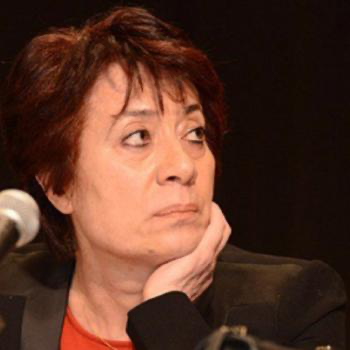
Dr Mona Fayad a Lebanese political activist and professor who has become one of the most prominent Shiite opponents of Hezbollah
Prominent Lebanese Shiite professor Mona Fayad recently explained the issue with remarkable clarity. In international relations, negotiation is neither weakness nor surrender. It is the normal instrument used by states when the cost of war exceeds their capacity to bear it.
Wars themselves almost always end through negotiation—but usually only after lives have been lost, homes destroyed and communities displaced.
The United States negotiated after its long war in Vietnam. Egypt negotiated with Israel after repeated wars. European powers that fought one another for centuries eventually replaced their battlefields with political institutions.
Negotiation is not the exception. It is the rule.
In a devastated country where hundreds of thousands have been displaced, refusing to negotiate cannot honestly be described as heroism. It reflects ignorance of international relations, evasion of responsibility, contempt for Lebanese lives—or an inability to make decisions without Iran’s permission.
That last possibility goes to the heart of Lebanon’s crisis.
The present war was not declared by the Lebanese government. It was not authorized by Parliament, approved by the Council of Ministers or requested by the Lebanese people.
Hezbollah chose to open the front in support of Iran.
For Hezbollah, this may be an “existential battle.” But it is existential primarily for Hezbollah’s weapons, its privileged position inside Lebanon and its role in Iran’s regional strategy. The Lebanese people are the ones paying the price through death, destruction, displacement and the loss of their land.
Hezbollah officials accuse the Lebanese government of surrender because it negotiates. But which side is actually surrendering Lebanon’s sovereignty—the government attempting to recover Lebanese territory, or the armed organization waiting for instructions from Tehran?
A government that negotiates in Lebanon’s name is exercising sovereignty. A militia that wages war on Iran’s behalf is violating it.
Negotiations must produce reciprocal steps
Supporting negotiations does not mean accepting every Israeli demand. Nor does it excuse Israeli strikes, civilian casualties, destruction or indefinite occupation.
Israel must withdraw from Lebanese territory. It must stop attacking Lebanese civilians and infrastructure. It must respect Lebanon’s internationally recognized borders and territorial integrity.
But Lebanon must also fulfill its responsibility: no armed organization can remain outside the authority of the state, and no foreign power can be permitted to decide when Lebanon goes to war.
The framework therefore requires reciprocal and verifiable implementation:
- Israel withdraws from an agreed pilot zone.
- The Lebanese Army immediately deploys and assumes exclusive security control.
- Hezbollah removes its weapons, fighters, tunnels and military installations.
- International monitors verify compliance by all sides.
- The process is repeated until Israel has completely withdrawn and the Lebanese state has recovered authority over all its territory.
This is not capitulation. It is the restoration of the Lebanese Republic.
President Joseph Aoun has correctly insisted that Lebanon’s future belongs to the Lebanese—not to Iran and not to Israel. That principle must now be translated into action.
Lebanon cannot defeat Israel militarily. Hezbollah has repeatedly proved that it cannot liberate Lebanese land through war. But a sovereign Lebanese government, backed by the Lebanese Army and supported by the United States and the international community, can recover the country through persistent and carefully enforced diplomacy.
Lebanon has tried Hezbollah’s road of unilateral warfare for decades. That road has brought funerals, ruined villages, displaced families and expanding occupation.
It is time to try Lebanon’s road: negotiation under one government, security under one army and sovereignty under one flag.
