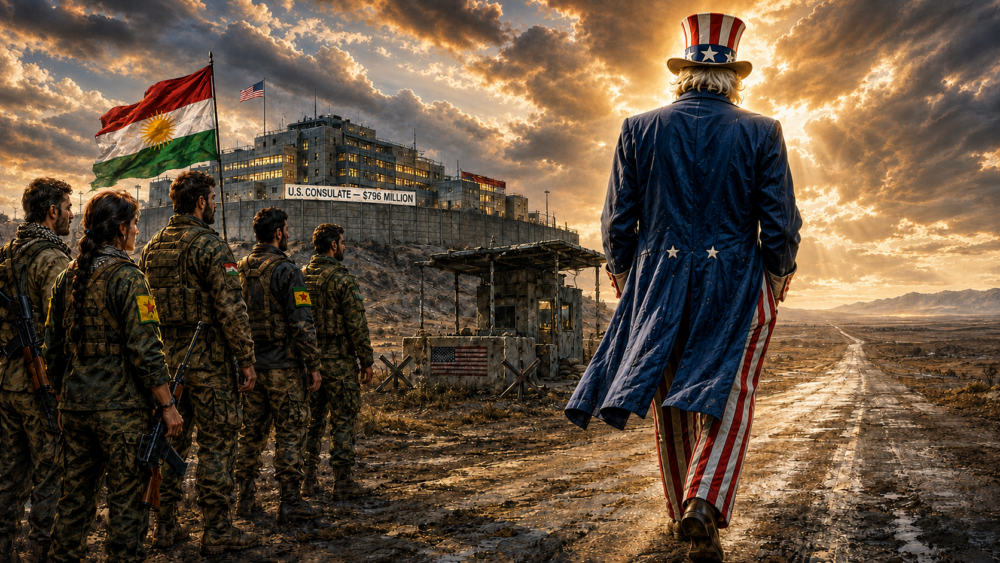
Photo illustration – “America cannot remain a global leader by abandoning the friends who fought beside it.”
Abandoning the Kurdish forces that fought alongside the United States against ISIS sends a dangerous message to every present and future American ally: Washington may accept your sacrifices today and forget you tomorrow.
By : Ya Libnan Editorial Board, Opinion
Does America aim to become friendless?
That question must be asked following reports that the Trump administration plans to terminate military assistance to one of America’s most dependable partners in the Middle East—the Kurdish Peshmerga—and close the remaining American military base in Iraq, located in Erbil, the capital of the Kurdistan Region.
According to the BBC, Pentagon officials informed Kurdish leaders that Washington does not plan to renew an expiring agreement providing security assistance to the Peshmerga. The agreement expires on September 30, the same day the United States and other coalition members are scheduled to withdraw their remaining troops from Iraq. The American military base in Erbil is also expected to close.
If these reports are accurate, the United States is preparing to walk away from yet another Kurdish force that stood beside it when America needed help.
The Peshmerga did not merely express support for the United States. Its fighters confronted the Islamic State on the ground, suffered casualties, protected civilians and helped prevent ISIS from overrunning much larger parts of Iraq.
When ISIS was advancing and many Iraqi military units were collapsing, the Kurds fought. They became an essential part of the international campaign that dismantled the terrorist organization’s territorial caliphate.
Now, as Iraqi Kurdistan faces punishing attacks from Iran and Iranian-backed militias, Washington appears ready to withdraw its limited assistance.
An $800 Million Contradiction
Only last December, the United States inaugurated a new $796 million consulate complex in Erbil—the largest American consulate in the world.
At its opening, senior State Department official Michael Rigas described the compound as “a testament to the value of the relationship between the United States and the Iraqi Kurdistan Region.” The 50-acre facility was presented as evidence of America’s long-term commitment to the Kurds.
How can Washington spend nearly $800 million constructing a diplomatic fortress designed to symbolize a lasting partnership, then only months later withdraw its military presence and refuse to renew $61 million in assistance to the Peshmerga?
The consulate itself is not reportedly closing. But without an effective security partnership, it risks becoming a monument to American inconsistency—a magnificent building surrounded by the remains of a relationship Washington chose to weaken.
Spending nearly $800 million on the symbol of a partnership while refusing $61 million to help sustain the forces that made that partnership possible is not strategic restraint. It is strategic incoherence.
The Peshmerga Is Not Asking for a Fortune
The Peshmerga has approximately 180,000 personnel, yet received only $61 million in fiscal year 2026 for weapons, training and stipends through the Pentagon’s counter-ISIS program.
That is a modest amount compared with the value of the territory it protects, the intelligence it provides and the stability it helps preserve.
The United States spends hundreds of billions of dollars annually on defense. Saving $61 million by weakening a loyal partner is not sound financial management. It is strategic shortsightedness.
Former U.S. ambassador James Jeffrey, who led the international coalition against ISIS during Trump’s first term, described continued support for the Peshmerga as money well spent. He warned that America had already learned the consequences when ISIS swept into northern Iraq.
Washington should not have to learn the same lesson twice.
The Syrian Kurds Were Abandoned Too
This is not an isolated case.
The United States previously relied heavily on the Syrian Democratic Forces, whose Kurdish fighters formed the backbone of the ground campaign against ISIS in northeastern Syria. Thousands of SDF fighters were killed while helping America defeat a common enemy.
Yet when American policy shifted, the SDF was left exposed to pressure from Turkey, the Syrian government and other armed forces. With Washington no longer providing reliable protection, the SDF was ultimately forced to reach an accommodation and join Syrian government forces.
The message could hardly be more damaging: Fight alongside America when America needs you, but do not expect America to remain beside you when you need it.
No country can build durable alliances on that basis.
Alliances Are Built on Trust
America’s global power does not come from its military strength alone. It comes from a network of alliances and partnerships constructed over generations.
American troops cannot fight every battle, guard every border or collect every piece of intelligence themselves. The United States needs local partners who understand their countries, speak the languages, know the terrain and are prepared to fight common enemies.
But why would any group take such risks if it believes Washington may later abandon it?
Future partners will remember what happened to the SDF. They will watch what happens to the Peshmerga. They will ask whether cooperation with America brings lasting security—or merely temporary usefulness followed by abandonment.
America’s adversaries will exploit that doubt. Russia, China and Iran will tell governments and armed groups throughout the world that Washington cannot be trusted.
Every time America deserts a partner, it strengthens their argument.
Withdrawal Does Not End the Threat
Closing the Erbil base will not make Iran’s ambitions disappear. It will not eliminate the remnants of ISIS. It will not stabilize Iraq or protect its religious and ethnic minorities.
It may produce the opposite result.
A diminished American presence could create more space for Iran and its allied militias to expand their influence. It could weaken one of the most stable and pro-American regions of Iraq. It could also make it more difficult for Washington to monitor and prevent a possible resurgence of ISIS.
America has made this mistake before.
U.S. combat forces withdrew from Iraq in 2011. The resulting vacuum contributed to the conditions that allowed ISIS to expand, forcing American forces to return only a few years later.
The United States does not need to occupy Iraq indefinitely. Nor should it offer unlimited or unconditional support to every partner. But there is a vast difference between maintaining a limited, mutually beneficial security relationship and simply walking away.
America should negotiate a revised agreement with the Kurdistan Regional Government, continue carefully monitored assistance to the Peshmerga and maintain sufficient military and intelligence cooperation to deter aggression and prevent ISIS from rebuilding.
It should also encourage unification and reform within the Peshmerga so that Kurdish forces become more professional, accountable and less divided by political parties.
Conditional assistance can encourage reform. Abandonment encourages instability.
America Needs Friends, Not More Enemies
The United States already faces growing challenges from China, Russia, Iran, North Korea and terrorist organizations. This is precisely the wrong moment to treat dependable friends as disposable instruments.
America cannot demand loyalty without returning it.
It cannot ask other people to fight and die alongside American forces, then disappear after the immediate danger has passed. And it cannot expect its alliances around the world to remain strong if partners conclude that American commitments expire whenever political priorities change in Washington.
Supporting allies does not mean accepting every demand they make. It means recognizing that relationships built through shared sacrifice possess strategic and moral value.
The Kurds have repeatedly demonstrated that they are willing to stand with the United States. America should remember who stood beside it when ISIS threatened the region and the world.
America does not need more enemies.
It needs trustworthy friends—and it must prove that it knows how to remain a trustworthy friend itself.
