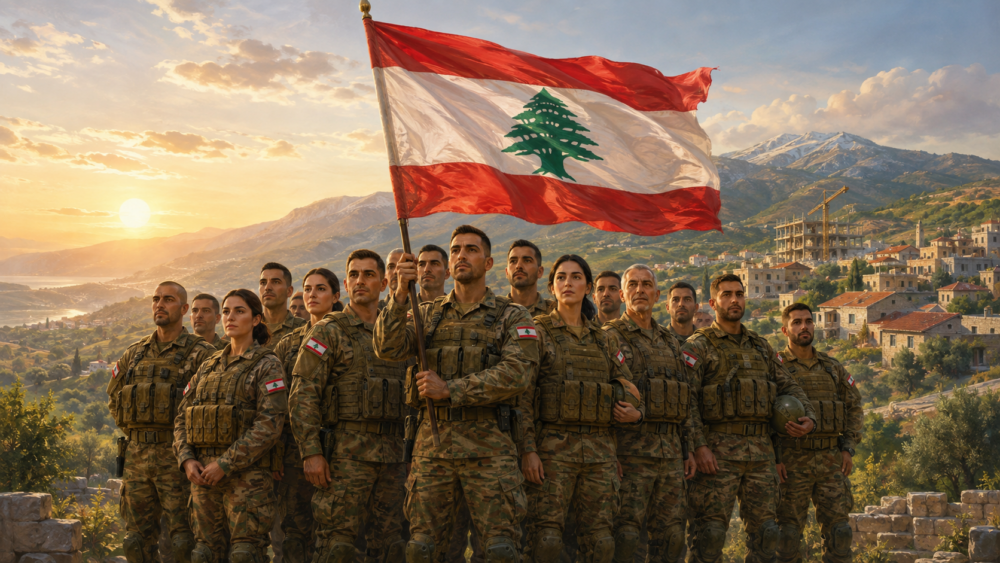
Photo illustration – “Lebanon’s soldiers serve one flag, one state and one people. Trust them, support them and let them restore the nation’s sovereignty.”
Lebanon must reject the politics of sectarian fear and trust the soldiers who remained loyal to their country when loyalty offered neither wealth nor privilege.
By: Ali Hussein, Political Analyst , Opinion
The Lebanese Army should accelerate implementation of the Framework Agreement with Israel, beginning with the pilot zones in southern Lebanon.
This is not about satisfying Israel. It is about liberating Lebanese territory, returning displaced Lebanese families to their villages and restoring the authority of the Lebanese state.
Paragraphs 2 and 3 of the Framework provide the only practical negotiated mechanism currently available for achieving these objectives.
Paragraph 2 establishes a reciprocal, phased process: the Lebanese Armed Forces restore effective sovereign authority, non-state armed groups are verifiably disarmed and their military infrastructure dismantled, and Israeli forces progressively redeploy out of Lebanon.
Paragraph 3 turns that principle into action. The Lebanese Army assumes full security responsibility in designated pilot zones. Once militia weapons and military infrastructure have been removed and that process has been verified, Israeli troops redeploy, reconstruction begins and Lebanese civilians return under the exclusive authority of the Lebanese state.
Without implementing these provisions, Lebanon will remain trapped in a vicious circle: Hezbollah will claim that its weapons are necessary because Israel occupies Lebanese territory, while Israel will claim that its occupation is necessary because Hezbollah remains armed.
The Lebanese Army is the only institution capable of breaking that circle.
The Politics of Fear
Some Lebanese warn that implementing the pilot zones could lead to confrontation with Hezbollah and cause the army to split along sectarian lines. They specifically fear that Shiite soldiers might abandon their units or side with Hezbollah.
This assumption is not only dangerous. It is deeply insulting to the patriotism of thousands of Shiite officers and soldiers who have served Lebanon honorably under extraordinarily difficult conditions.
Professor Makram Rabah has offered a compelling answer to those spreading this fear. During the worst years of Lebanon’s financial collapse, army personnel sometimes earned the equivalent of roughly $100 a month, while Hezbollah fighters reportedly received dollar-denominated salaries and benefits financed by Iran that were worth many times more.
Yet Shiite soldiers did not desert the Lebanese Army to join Hezbollah.
They remained at their posts.
They continued wearing the Lebanese flag on their uniforms. They continued serving alongside Sunni, Christian and Druze comrades. They continued protecting a state that could barely pay them, feed them or provide adequately for their families.
That is not weakness. That is patriotism.
The precise salary figures may have varied by period, rank and benefits, but the essential comparison remains undeniable: Hezbollah possessed foreign currency, extensive financing and a powerful social-support network, while the Lebanese Army struggled through the collapse of the national currency.
And still, Shiite soldiers chose the army.
Their allegiance should be judged by their conduct—not by their sect.
Shiite Soldiers Are Not Hezbollah Soldiers
Lebanon must stop treating every Shiite citizen as though he or she were automatically loyal to Hezbollah.
Hezbollah is an armed political organization created, financed and supported by Iran. Lebanon’s Shiites are a historic and indispensable part of the Lebanese nation. The two are not interchangeable.
To suggest otherwise accepts Hezbollah’s most damaging claim: that it alone represents Lebanon’s entire Shiite community.
It does not.
A Shiite soldier serving in the Lebanese Army has already made a choice. He has chosen the flag of Lebanon, the command of the Lebanese state and the principle of one national army.
The government must honor that choice by trusting him or her , supporting his or her family, improving his or her salary and equipping him or her to perform his constitutional duty.
Disarming Hezbollah is not an anti-Shiite project. It is a pro-Lebanese project—and it will ultimately benefit Shiite communities that have repeatedly paid the highest price for wars initiated without the Lebanese state’s authorization.
Implementation Must Be Reciprocal
The army should move quickly, but Lebanon must also insist that Israel fulfill its side of the Framework.
Every verified Lebanese step must be matched by a clearly defined Israeli redeployment. Every pilot zone placed under exclusive Lebanese Army control must lead to reconstruction and the safe return of its residents.
Israel cannot demand that the Lebanese Army establish its authority and then weaken that same authority through continued attacks, shifting conditions or an indefinite occupation.
Recent experience has demonstrated this danger. The Lebanese Army has begun operating in pilot-zone villages, but Israeli attacks and the absence of a firm withdrawal timetable have undermined public confidence in the process. Lebanese officials have warned that the pilot zones cannot succeed unless the population sees a credible path toward withdrawal.
The Framework must therefore be implemented as a reciprocal process—not as a collection of obligations imposed exclusively upon Lebanon.
The United States, as mediator and supporter of the agreement, must enforce this reciprocity. When the Lebanese Army completes an agreed stage, Israel must complete the corresponding withdrawal without delay.
The Army Must Be Given the Means to Succeed
The Lebanese government cannot send poorly paid soldiers into an immensely difficult national mission and then abandon them.
Army salaries must be restored to a dignified level. Soldiers’ families must receive reliable healthcare, education and social assistance. The army must receive the equipment, intelligence capabilities and international support required to clear unauthorized weapons infrastructure and prevent its return.
The contest between the state and Hezbollah will not be decided by weapons alone. It will also be decided by which institution protects citizens, rebuilds roads, restores services and offers young Lebanese a future.
The state must become visible in the south—not merely through checkpoints and uniforms, but through schools, hospitals, electricity, reconstruction and justice.
Have No Fear
Lebanon cannot recover its sovereignty while remaining afraid to exercise it.
Fear of Hezbollah has paralyzed the state for decades. Fear of sectarian division has been used repeatedly to prevent the enforcement of Lebanese law. Every time the government hesitates, the militia becomes stronger and the state becomes less credible.
The Lebanese Army is not a Christian army, a Sunni army, a Shiite army or a Druze army.
It is Lebanon’s army.
Its Shiite soldiers proved their loyalty when the state could offer them almost nothing. Lebanon must now prove its loyalty to them.
Move forward with the pilot zones. Demand reciprocal Israeli withdrawal. Support the soldiers entrusted with the mission. Return displaced citizens to their villages. Rebuild the south under the Lebanese flag.
One sovereign state. One national army. One authority over war and peace.
Have no fear.
